
Earthquakes at Mendocino Triple Junction, California
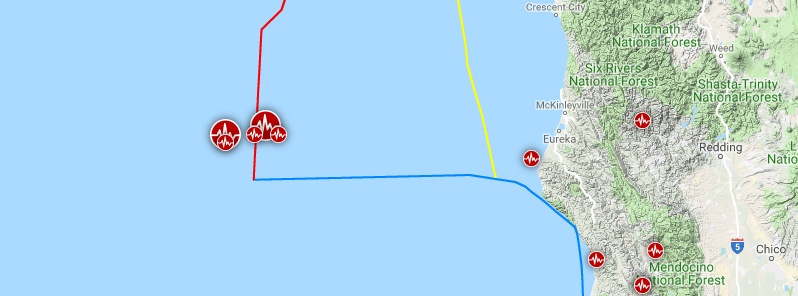
Image credit: Google, TW/SAM
Five minor to moderately strong earthquakes were registered at Mendocino Triple Junction, west of Eureka, California at a depth of 10 km (6.2 miles) on May 5, 2019.
The strongest was M4.8 detected at 06:46 UTC on May 5.
The sequence started with M3.1 at 04:17 UTC, followed by M3.3 at 06:29, M4.3 at 06:32, M4.8 at 06:46, and ended at 07:12 UTC with M3.2.
Earthquakes such as these are a common occurrence in this area.
This is a juncture of three plates, the Gorda plate, the North American plate, and the Pacific plate, creating what seismologists call Mendocino Triple Junction (MTJ).
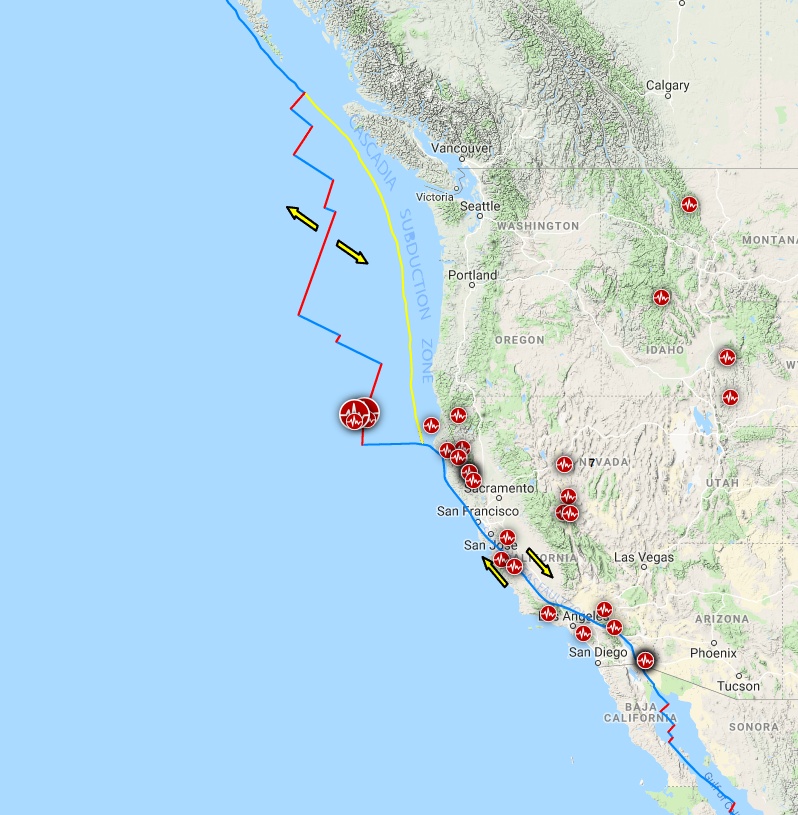
West Coast earthquakes detected on May 5, 2019. Credit: Google, TW/SAM. Data source: USGS
MTJ is the location of a change in the broad plate motions which dominate the west coast of North America, linking convergence of the northern Cascadia subduction zone and translation of the southern San Andreas Fault system.
The Gorda plate is subducting, towards N50ºE, under the North American plate at 2.5 – 3 cm per year (1 – 1.2 inches), and is simultaneously converging obliquely against the Pacific plate at a rate of 5 cm per year (1.9 inches) in the direction N115ºE.
The accommodation of this plate configuration results in a transform boundary along the Mendocino Fracture Zone, and a divergent boundary at the Gorda Ridge.

I'm a dedicated researcher, journalist, and editor at The Watchers. With over 20 years of experience in the media industry, I specialize in hard science news, focusing on extreme weather, seismic and volcanic activity, space weather, and astronomy, including near-Earth objects and planetary defense strategies. You can reach me at teo /at/ watchers.news.

Commenting rules and guidelines
We value the thoughts and opinions of our readers and welcome healthy discussions on our website. In order to maintain a respectful and positive community, we ask that all commenters follow these rules.