
Earthquake swarm in San Ramon continues with multiple events on December 15, California
An earthquake swarm that began near downtown San Ramon, California, in October remained active on December 15, with three earthquakes recorded within a few hours by the U.S. Geological Survey. The swarm is occurring in a structurally complex fault zone near the Calaveras Fault, where stress is released through repeated small ruptures rather than a single larger earthquake.
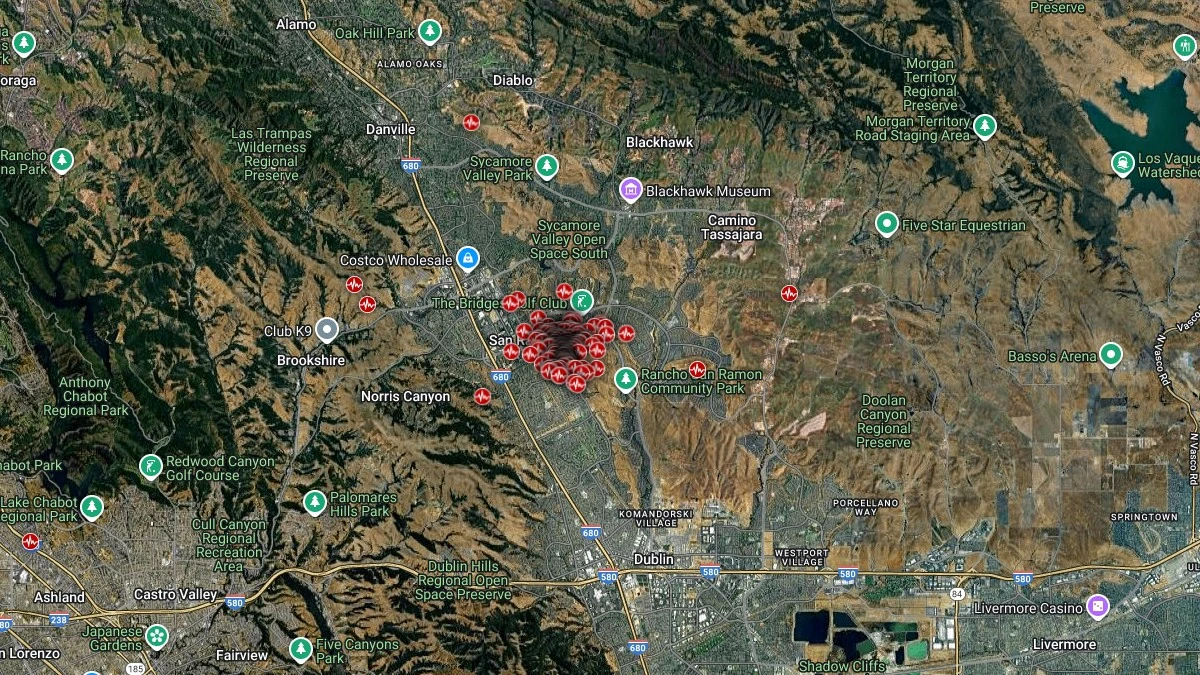
Earthquakes in San Ramon, California from November 15 to December 15, 2025. Credit: TW/SAM, Google
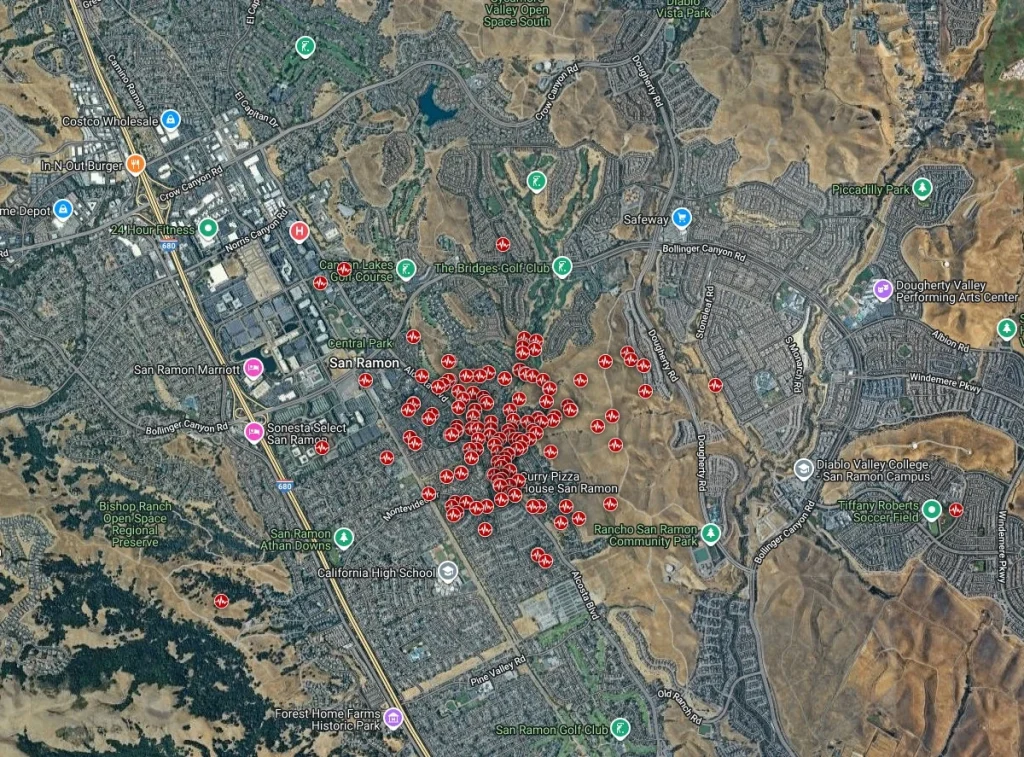
An earthquake swarm near downtown San Ramon, California, remained active on December 15, with three earthquakes recorded by the U.S. Geological Survey (USGS). The swarm began in October and has since produced dozens of small-to-moderate earthquakes concentrated in a limited area southeast of the city center.
USGS data show that the swarm is centered approximately 4–5 km (2.5–3.1 miles) east-southeast of downtown San Ramon, with most earthquakes occurring at mid-crustal depths. Since the sequence began, hypocentral depths have generally ranged between about 6 and 10 km (3.7–6.2 miles), indicating a stable source region rather than migrating activity.
Three earthquakes were recorded within the swarm area on December 15 (UTC). The first event was registered as M2.1 at 06:52 UTC at a depth of 6.5 km (4 miles). This was followed by a M2.0 earthquake at 08:42 UTC at a depth of 7.3 km (4.5 miles).
As of the latest USGS update, the strongest earthquake on December 15 was a M2.2 event recorded at 09:43 UTC at a depth of 8 km (5 miles), located about 4 km (2.5 miles) east-southeast of downtown San Ramon.
Although these earthquakes are dated December 15 in Coordinated Universal Time, local time in California places them during the late evening of December 14 and the early morning of December 15 Pacific Standard Time.
The strongest quake recorded during the swarm to date occurred on December 8, when a M3.6 earthquake struck at a depth of 9.6 km (6 miles). That day marked the most energetic phase of the sequence, with several earthquakes of magnitude 2.9 and higher occurring within a short period.
Other larger events since the swarm began include a M3.3 earthquake on November 18 and a M3.2 event on November 20. Like the December 15 earthquakes, these events were tightly clustered in location and depth, suggesting repeated rupture of closely spaced fault segments rather than progressive fault failure.
No damage or injuries have been reported.
The swarm is occurring near the Calaveras Fault system, a right-lateral strike-slip fault zone that forms part of the broader network accommodating tectonic motion in the eastern San Francisco Bay Area. Earthquake swarms have been documented in this region in the past and typically consist of numerous small earthquakes.

Teo Blašković founded The Watchers in 2011 and edited it until 2026, covering seismic and volcanic activity, extreme weather, space weather and near-Earth objects. Articles on this page are his archive.
Published in the last 24 hours
- In 1920, a man out hunting on a farm in Namibia sat down on a strange black rock, scratched it with his knife and saw metal shine underneath. It was Hoba, a 60-ton meteorite, the largest ever found, and there is no crater around it Epicenter
- On December 26, 2004, a 10-year-old British girl on a Phuket beach recognized the frothing sea from a recent geography lesson, and her warning helped clear the beach before the tsunami struck Epicenter
