
M4.2 earthquake recorded during dense earthquake swarm near San Ramon, California
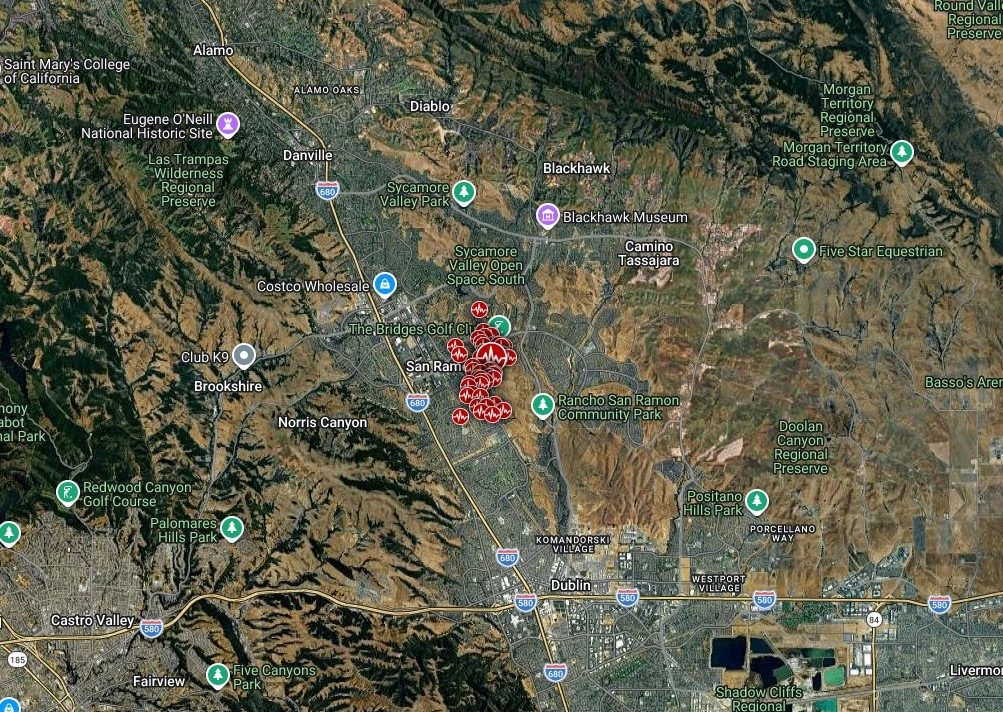
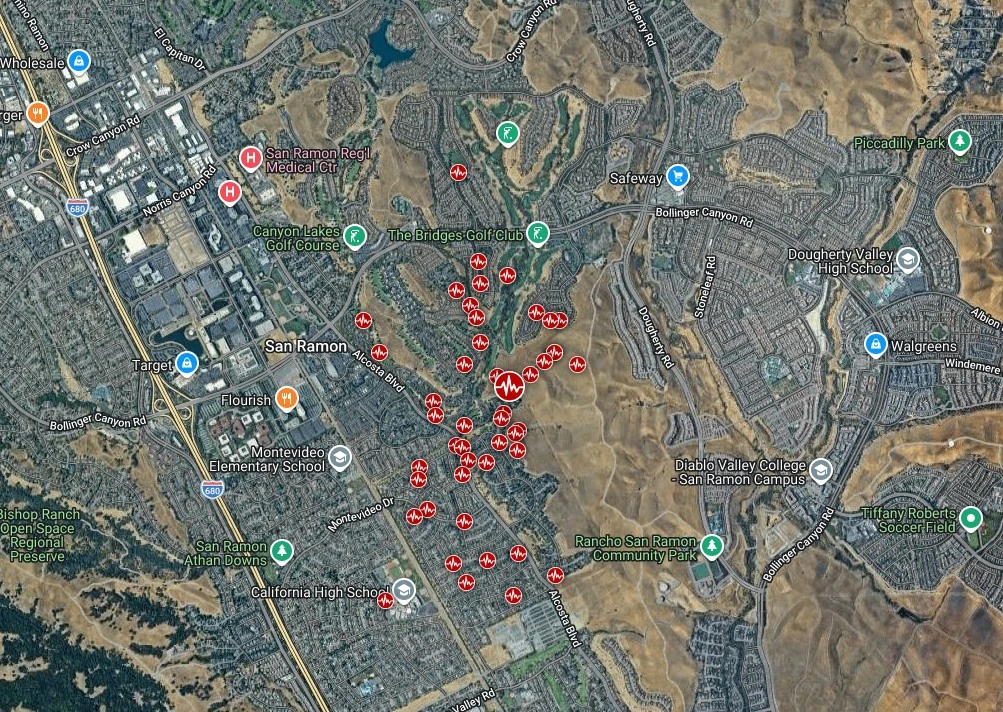
A shallow M4.2 earthquake occurred 4 km (2.5 miles) east-southeast of San Ramon, California, at 15:01 UTC on February 2, 2026, as part of an intense earthquake swarm in the East Bay. U.S. Geological Survey data show sustained seismic activity before and after the main event.

San Ramon, California, earthquake swarm - February 2, 2026. Credit: TW/SAM, Google
A shallow M4.2 earthquake occurred 4 km (2.4 miles) east-southeast of downtown San Ramon in the eastern San Francisco Bay Area at 07:01 LT (15:01 UTC) on February 2, according to the U.S. Geological Survey (USGS). The earthquake originated at a depth of 9.4 km (5.8 miles) and was reviewed by the Northern California Seismic Network.
This earthquake was part of a dense earthquake swarm that unfolded over roughly 16 hours, beginning with an isolated M1.7 event at 03:43 UTC and intensifying rapidly after 14:27 UTC. The USGS recorded 48 earthquakes in 24 hours to 20:00 UTC, with magnitudes ranging from M1.3 to M4.2. The swarm is concentrated within a few kilometers of San Ramon center and extending marginally north toward Dublin.
Seismic activity increased sharply during the 34 minutes preceding the M4.2 earthquake, with multiple M2.5–M3.8 earthquakes recorded at depths of 7-9.5 km (4.3–5.9 miles). Two M3.8 earthquakes occurred at 14:27 UTC and 15:27 UTC.
Seismicity remained elevated for several hours, with numerous M2 earthquakes recorded between 15:02 and 19:34 UTC and several events sharing nearly identical origin times and locations, suggesting closely spaced ruptures on adjacent fault patches rather than a steadily decaying aftershock sequence.
Earthquake depths across the swarm ranged from approximately 3 to 9.5 km (1.9–5.9 miles), with most between 6.5 and 8.5 km (4–5.3 miles).
Comparable East Bay earthquake swarms have been documented by the USGS in the San Ramon–Danville area during the 1970s, 1980s, and 2010s, exhibiting similar spatial confinement and sustained activity without increasing into larger ruptures.
The swarm occurred within the broader Calaveras Fault system, a right-lateral strike-slip fault zone that accommodates part of the relative motion between the Pacific and North American plates. The eastern Bay Area contains multiple subparallel and branching fault strands, allowing stress to be released through clustered moderate-magnitude earthquakes rather than a single continuous rupture.

Teo Blašković founded The Watchers in 2011 and edited it until 2026, covering seismic and volcanic activity, extreme weather, space weather and near-Earth objects. Articles on this page are his archive.
Published in the last 24 hours
- Weather radar tracked meteorites falling into Cape Cod Bay after a 1.1-kiloton fireball over Massachusetts on 30 May 2026; researchers have now traced its orbit almost out to Jupiter. Epicenter
- 10 named storms, one hurricane for the first time since 1925: Why has the Atlantic been so quiet in 2026 Epicenter
- Amazon fire hotspots rise 82.6% in October 2026 as El Niño intensifies Epicenter
- In 2005, a driver near Russia's Chulyshman River picked up a stone to wedge under his car wheel and kept it for 20 years; the Meteoritical Bulletin has now approved it as the Altai Republic's first meteorite. Epicenter
