
High level of activity at Stromboli volcano, Italy

Image credit: Luciano B. (2013)
Activity at Stromboli volcano, Aeolian Islands, Italy remains at high levels since the end of December 2018.
Today's activity at the volcano is characterized by puffing with high amplitude mainly located at NE vent and by high amplitude explosions at NE e C vent, the Laboratorio Geofisica Sperimentale (LGS) noted in Stromboli Daily Report published by 12:49 UTC on January 21, 2019.
VLP amplitude is medium with a rate showing high values and the tremor is at medium level.
The infrasonic activity is high. The acoustic pressure of explosions is high, 2.91 bar (standard values <1 bar). The amplitude of puffing is high, ~100 mbar.
Tiltmeters analysis doesn't show any significant deformation.
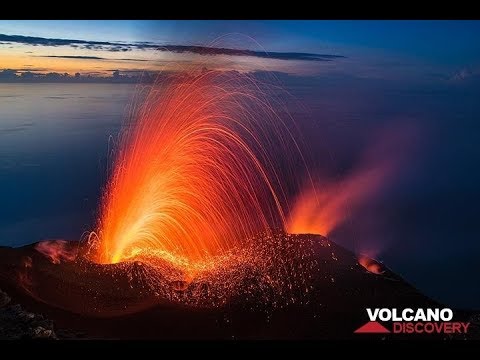
Stromboli on January 20, 2019. Video courtesy Volcano Discovery
Thermal activity of explosive events is high. The number of thermal transients in the NE sector of the crater (standard = 100) is high, 164. The amplitude of thermal transients is low, <10 ºF. Exit velocity of pyroclasts, estimated through thermal camera analysis, is high, 44 m/s.
SO2 flux in the NE sector of the crater terrace remains up to medium values.
Rockfall activity is low (zero detections during the last 24 hours) and the SO2 flux in the NE sector of the crater terrace remains up to medium values. The activity is compatible with the thermal anomalies recorded by MODIS (max 15 MW).

Image credit Laboratorio Geofisica Sperimentale (LGS)

Image credit Laboratorio Geofisica Sperimentale (LGS)
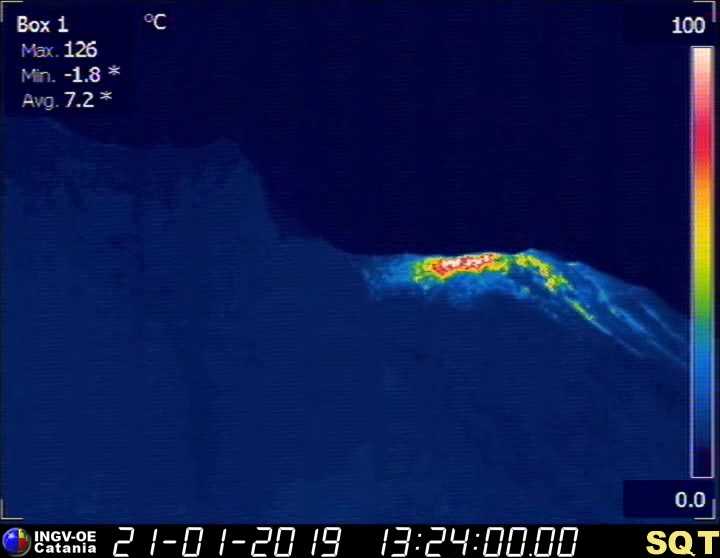
"When observed from close earlier today, there were 6 active vents producing intermittent strombolian explosions of small to large size," volcanologist Dr. Tom Pfeiffer of the Volcano Discovery reported on January 20.
"The new cinder cone that has been built recently around the NE vent displayed mild and continuous lava spattering with intense lava glow at night, as well as strombolian explosions of small to moderate size (ejection heights racing from few tens of meters to approximately 150 m / 492 feet) at intervals of 10 – 20 minutes:

Stromboli on January 20, 2019. Video courtesy Volcano Discovery
High-quality Stromboli webcam is here.
Geological summary
Spectacular incandescent nighttime explosions at this volcano have long attracted visitors to the "Lighthouse of the Mediterranean."
Stromboli, the NE-most of the Aeolian Islands, has lent its name to the frequent mild explosive activity that has characterized its eruptions throughout much of historical time. The small, 924-m-high (3 031 feet) island is the emergent summit of a volcano that grew in two main eruptive cycles, the last of which formed the western portion of the island.
The Neostromboli eruptive period from about 13 000 to 5 000 years ago was followed by formation of the modern Stromboli edifice. The active summit vents are located at the head of the Sciara del Fuoco, a prominent horseshoe-shaped scarp formed about 5 000 years ago as a result of the most recent of a series of slope failures that extend to below sea level.
The modern volcano has been constructed within this scarp, which funnels pyroclastic ejecta and lava flows to the NW. Essentially continuous mild strombolian explosions, sometimes accompanied by lava flows, have been recorded for more than a millennium. (GVP)

Teo Blašković founded The Watchers in 2011 and edited it until 2026, covering seismic and volcanic activity, extreme weather, space weather and near-Earth objects. Articles on this page are his archive.
Published in the last 24 hours
- The fastest wind gust ever measured on Earth, 253 mph, hit an oil island off Australia during Cyclone Olivia in 1996, and nobody noticed for more than a decade, until experts reading old data quietly took the record from New Hampshire's Mount Washington Epicenter
- In 1954, a grapefruit-sized meteorite crashed through a roof in Sylacauga, Alabama, and struck Ann Hodges as she napped on her couch Epicenter
- A meteorite blew a crater beside a village near Lake Titicaca in 2007, and dozens of villagers who went to see it got headaches and nausea, though tests found nothing the rock had added to the water Epicenter
- The people who pay closest attention to the weather are the ones storms have already cost the most, a study of 946 students found, with one damaging storm making little difference to how much attention a student paid, but two or more making a clear one Epicenter
