
Strong explosive activity at Etna opens new vent feeding lava flow toward Valle del Bove, Italy
Etna’s eruptive activity intensified rapidly between December 24 and 27, 2025, culminating in short-lived lava fountains about 200 m (650 feet) high and a new lava flow from the upper Voragine crater toward the Valle del Bove. INGV Etna Observatory (OE) raised the Aviation Color Code to Red on December 27 as tremor and infrasound amplitudes reached very high levels.
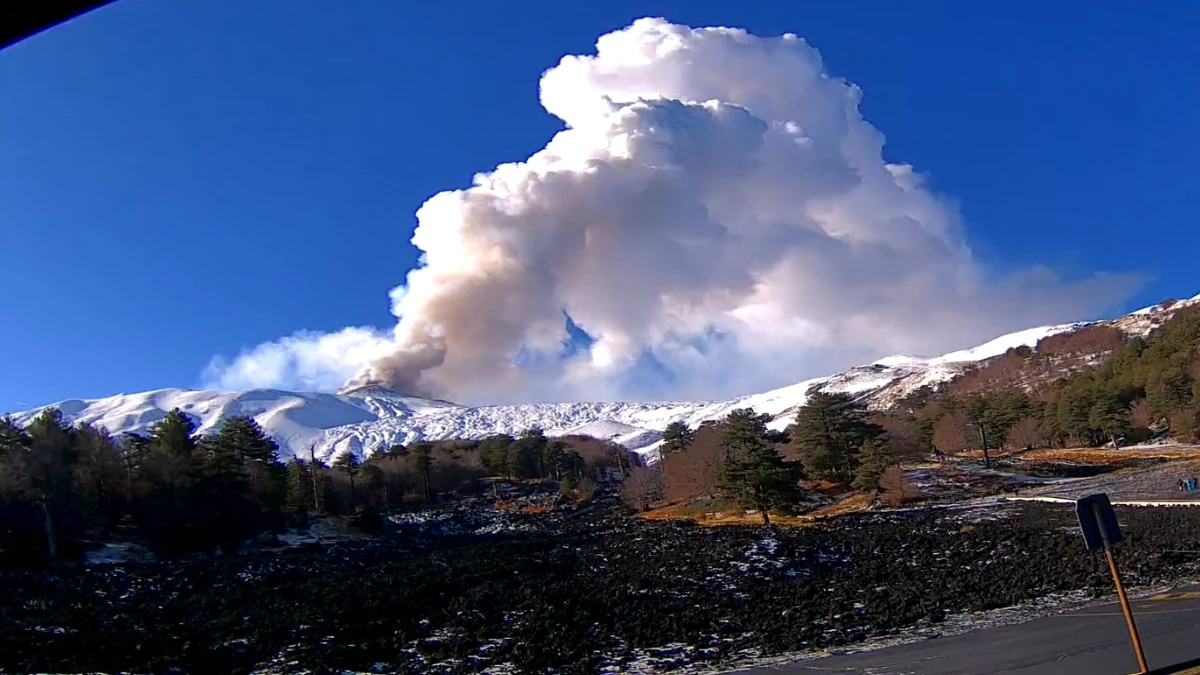
Mount Etna erupting on December 27, 2025. Credit: Weather Italy - WS Cam (stillshot)
Eruptive activity at Mount Etna, Italy, increased sharply between December 24 and 27. The National Institute of Geophysics and Volcanology (INGV), Etna Observatory (OE), reported progressive intensification of Strombolian activity at the Northeast Crater and the appearance of a new vent on the upper eastern flank of the Voragine crater.
Initial signs of unrest were observed at 18:00 UTC (19:00 LT) on December 24, prompting INGV to raise the Aviation Color Code from Green to Yellow at 18:46 UTC (19:46 LT).
By late December 25, intracrater activity had transitioned to frequent explosions and glow visible above the Northeast Crater, with the Aviation Color Code increased to Orange at 22:46 UTC (23:46 LT). Volcanic tremor reached high levels, and ground deformation showed positive trends of about 80 nanostrain at the DRUV dilatometer and over 1.5 microradians at the ECP summit clinometer.
On December 26, continuous Strombolian activity was recorded at the Northeast Crater with occasional ash emission and light ashfall reported from Piano Provenzana, Linguaglossa, and Taormina on the northeastern flank.
Activity also resumed at vent BN-2 of Bocca Nuova. Volcanic tremor remained within the high range and continued its increase through the night. Ground deformation persisted with the DRUV strainmeter reaching approximately +100 nanostrain and the ECP clinometer about +2 microradians.
A rapid intensification occurred on the morning of December 27. At approximately 09:00 UTC (10:00 LT), lava fountains 150–200 m (492–656 feet) high developed at the Northeast Crater, accompanied by continuous ash emission. The Aviation Color Code was raised to Red at 09:37 UTC (10:37 LT).
Around the same time, a vent opened on the upper eastern flank of the Voragine crater, producing a lava flow advancing toward the upper Valle del Bove. Visibility was intermittent due to cloud cover, and the flow extent remained uncertain pending field inspection by INGV-OE teams.
Volcanic tremor amplitude increased to very high values around 12:00 UTC (13:00 LT) on December 26 and remained elevated until early December 27. Two sharp peaks were recorded at 05:50 UTC (06:50 LT) and 08:45 UTC (09:45 LT), coinciding with lava-fountaining phases, followed by a rapid decline after 09:50 UTC (10:50 LT).
Infrasound activity was very frequent and strong, originating mainly from the Northeast Crater and secondary sources at Bocca Nuova. Episodes of infrasonic tremor between 05:30–06:10 UTC (06:30–07:10 LT) and 08:40–09:50 UTC (09:40–10:50 LT) exhibited amplitudes typical of lava-fountaining events.
Ground-deformation measurements showed a temporary deflation of the summit area during the fountaining phase. The DRUV dilatometer recorded a decrease of about 110 nanostrain between 08:30 and 09:40 UTC (09:30–10:40 LT) before reversing trend.
At the ECP clinometer, two distinct deformation stages were observed: around 5 microradians between 16:30–21:00 UTC (17:30–22:00 LT) on December 26 and 3.5 microradians between 09:00–10:00 UTC (10:00–11:00 LT) on December 27. The high-frequency GNSS network outside instrumental noise detected no measurable deformation.
At 10:36 UTC (11:36 LT) on December 27, INGV-OE reported that activity at the summit craters had subsided to sporadic ash emissions.
An eruption column several kilometers high, composed mainly of white steam, drifted toward the west-southwest. No ashfall was reported in populated areas at that time.
The previous notable eruptive activity at Etna took place in August and September.
According to the Smithsonian Institution’s Global Volcanism Program (GVP) Weekly Report for August 27 to September 2, eruptive activity at Etna’s summit craters during late August was characterized by decreasing lava effusion at multiple vents.
Strombolian explosions and ash emissions occurred from the Southeast Crater, while gas emissions were observed at the Northeast, Bocca Nuova, and Voragine craters. Lava effusion persisted from vents between Bocca Nuova and the Southeast Crater, forming a complex overlapping flow field with ephemeral vents and lava tunnels that extended to about 2 250 m (7 400 feet) elevation.
At the end of August, effusion rates had declined markedly, and by August 31, the upper vents were inactive, leaving cooling lava fields on the southern and southeastern flanks.
Mount Etna, towering above Catania on the island of Sicily, has one of the world’s longest documented records of volcanism, dating back to 1500 BCE. Historical lava flows of basaltic composition cover much of the surface of this massive volcano, whose edifice is the highest and most voluminous in Italy.
The Mongibello stratovolcano, truncated by several small calderas, was constructed during the late Pleistocene and Holocene over an older shield volcano. The most prominent morphological feature of Etna is the Valle del Bove, a 5 x 10 km (3.1 x 6.2 miles) caldera open to the east.
Two styles of eruptive activity typically occur, sometimes simultaneously. Persistent explosive eruptions, sometimes with minor lava emissions, take place from one or more summit craters.
Flank vents, typically with higher effusion rates, are less frequently active and originate from fissures that open progressively downward from near the summit, usually accompanied by Strombolian eruptions at the upper end. Cinder cones are commonly constructed over the vents of lower-flank lava flows.
Lava flows extend to the foot of the volcano on all sides and have reached the sea over a broad area on the southeastern flank.
References:
1 Comunicato Etna – INGV-Osservatorio Etneo – December 25-27, 2025
2 Volcano Observatory Notice for Aviation (VONA) – Etna – INGV-Osservatorio Etneo – December 27, 2025
3 Volcanic Ash Advisories for ETNA – VAAC Toulouse – December 27, 2025
4 Global Volcanism Program – Mount Etna, Italy – Accessed December 27, 2025

I'm a dedicated researcher, journalist, and editor at The Watchers. With over 20 years of experience in the media industry, I specialize in hard science news, focusing on extreme weather, seismic and volcanic activity, space weather, and astronomy, including near-Earth objects and planetary defense strategies. You can reach me at teo /at/ watchers.news.

Commenting rules and guidelines
We value the thoughts and opinions of our readers and welcome healthy discussions on our website. In order to maintain a respectful and positive community, we ask that all commenters follow these rules.