
New eruptive activity at Nishinoshima volcano, Japan

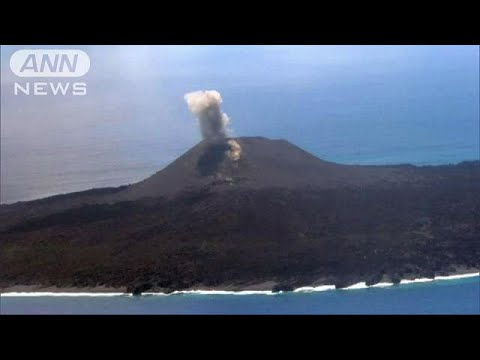
Featured image: Nishinoshima volcano on July 12, 2018. Credit: Japanese Coast Guard
A new eruptive activity is taking place at Japanese Nishinoshima volcano in Ogasawara (Bonin Islands).
The Japan Meteorological Agency reported a bright spot emerging in Himawari-8 imagery it Nishinoshima on July 12. In addition, a brown smoke was seen rising from near the crater around 12:24 JST, July 12.
According to JMA, the surface temperature at Nishinoshima remains unchanged and it seems that lava has not reached the surface.

Image credit: Japanese Coast Guard
Although this volcano is far from the mainland, the agency warned that volcanic material could reach distances of around 500 m (1 640 feet) from the crater and advised caution.
The last known eruption of this volcano took place in August 2017 (VEI 2).
Update
July 14, 12:07 UTC
Another eruption took place on Friday, July 13. It occurred in a crater in the center of the island where officials observed lava flows and large ash deposits up to 500 m (1 640 feet) from the crater.
JMA says it has confirmed via satellites that surface temperatures on Nishinoshima are higher in places, pointing out to continued volcanic activity and the possibility of a larger eruption.
A volcanic alert was issued at 22:00 JST, urging people to stay away from the crater. It has also warned of possible falling rocks and lava flows within 1.5 kilometers (0.93 miles) of the crater.
The coast guard issued a navigation warning in the sea around Nishinoshima on Friday.

Geological summary
The small island of Nishinoshima was enlarged when several new islands coalesced during an eruption in 1973-74. Another eruption that began offshore in 2013 completely covered the previously exposed surface and enlarged the island again. Water discoloration has been observed on several occasions since.
The island is the summit of a massive submarine volcano that has prominent satellitic peaks to the S, W, and NE. The summit of the southern cone rises to within 214 m (702 feet) of the sea surface 9 km (5.6 miles) SSE. (GVP)

Teo Blašković founded The Watchers in 2011 and edited it until 2026, covering seismic and volcanic activity, extreme weather, space weather and near-Earth objects. Articles on this page are his archive.
Earlier reporting
Nothing on Watchers was published in the last 24 hours. These are older articles.
- On October 22, 2017, a single flash of lightning stretched 515 miles from eastern Texas to near Kansas City, a distance that takes eight hours to drive, and nobody realized how far it had gone until scientists went back through the satellite data years later Epicenter
- CPC posts a slight risk of heavy rain from the Gulf Coast to the Northeast urban corridor November 25-29, and a moderate risk of West Coast wind and Sierra snow on November 25
- Florida's east coast faces a moderate flash flood risk Wednesday through Friday, with 4 to 8 inches of rain forecast and the St. Johns River near Cocoa already in major flood at 17.13 feet
- Cyclone Akvan to make landfall between Nellore and Visakhapatnam around noon on November 20, IMD forecasts 120-130 km/h winds gusting to 145

The earth is about to give birth to the children of another land that the nations of the earth said that it was to cool to live at in the north the center of the earth, ooh the birth pains are keeping it coming, “you think? Matthew 24:7-8