
The closest images ever of a distant Kuiper Belt object – 1994 JR1
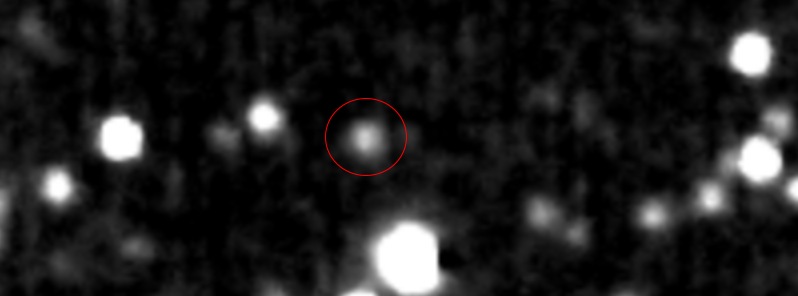
Image credit: NASA/JHUAPL/SwRI
There is a region of space filled with comets beyond the gas giant Neptune known as the Kuiper Belt. This expanse holds trillions of objects – remnants of the early Solar System – and NASA's New Horizons spacecraft recently took the closest images of one of them.
The moving dot on the animation below, taken by the spacecraft’s Long Range Reconnaissance Imager (LORRI) on November 2, 2015, might seem a small object at first glance but being 150 km (90 miles) wide it's a pretty big thing. It is humanity's closest-ever look at an object in the Solar System's distant Kuiper Belt.

New Horizons image of 1994 JR1, taken Nov. 2, is the closest-ever picture of a Kuiper Belt object. Credit: NASA/JHUAPL/SwRI
The Kuiper Belt is an area full of comets that begin near the orbit of Neptune and continues beyond Pluto.
The Belt's inner edge is about 30 astronomical units (AU) away from the Sun and the distance between the Sun and the outer edge of Kuiper Belt is about 50 AU (AU – Astronomical Unit – one AU equals the average distance between Earth and the Sun – or about 150 million km (93 million miles)).
When these images were made, 1994 JR1 – which is it's official name – was 5.3 billion km (3.3 billion miles) away from the Sun, but only 280 million km (170 million miles) away from New Horizons.
Video courtesy of Space.com
Scientists plan to study many more ancient Kuiper Belt objects if an extended mission to New Horizons is approved.
The next big flyby won't be until New Year's Day 2019, when the ship swings by 2014 MU69, another Kuiper Belt object, but it won't be surprising if there's more to see before then.
New Horizons flew through the Pluto system on July 14, 2015, making the first close-up observations of Pluto and its family of five moons.

Published in the last 24 hours
- Four small asteroids will pass close to Earth from November 21 to 23
- Male toads abandoned a pond in Italy five days before a deadly 2009 earthquake, while a scientist was counting them Epicenter
- An asteroid was spotted 19 hours before it exploded over Sudan in 2008, and students picked its pieces off the desert Epicenter
- A wave up to 3 m (10 feet) high rose out of Lake Michigan on a sunny June morning in 1954 and swept fishermen off Chicago’s piers, and when a second came 10 days later, warnings had cleared the shore Epicenter
