
Destructive Cyclone Cleopatra drops record-breaking rainfall in Sardinia, Italy

Image credit: NASA Terra/MODIS
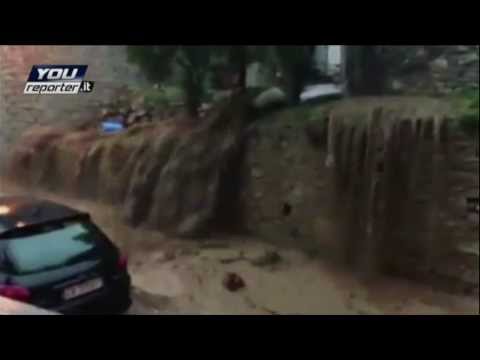
A destructive storm named Cleopatra struck the Mediterranean island of Sardinia, Italy, on November 18, 2013, flooding towns and villages, killing at least 17 people and leaving hundreds homeless. This is one of the strongest storms to hit Sardinia in decades. It dropped a record-breaking 450 mm (17.7 inches) of rain in an hour and a half in some areas and caused rivers to burst their banks.
Bau Mandara station had a decades-long rainfall record broken with 370 mm (14.5 inches) of rain on the same day. There are only 12 recorded cases of 200 mm (7.8 inches) and more at that station in one day.
A river burst its flank in Uras (Province of Oristano) where the amount of rain exceeded all local historic records.

A car was swallowed by a sinkhole that opened in the middle of a street, electricity was cut off throughout the island, trains were stranded, ferries and air flights were delayed.
Winds of up to 120 km/h were recorded.
A State of emergency was declared on Tuesday, November 19, 2013, a day after the storm, while search and rescue teams were still on the ground. Chaotic conditions are still present on the island.
The mayor of Olbia, the northeastern Sardinian town and one of the worst affected areas, said the sudden flooding had burst "like a bomb." Some areas there recorded 3 m (9.8 feet) high flood waters.



Teo Blašković founded The Watchers in 2011 and edited it until 2026, covering seismic and volcanic activity, extreme weather, space weather and near-Earth objects. Articles on this page are his archive.
Published in the last 24 hours
- A Virginia park ranger was struck by lightning seven times and lived, even though three of the strikes set his hair on fire Epicenter
- The hole in the ozone layer over Antarctica was about twice the size of the US this year, and scientists say it would have been bigger still if ozone-eating chemicals were at their 2000 levels Epicenter
