
China’s massive algae bloom could leave the ocean’s water lifeless

Image credit: NASA MODIS Rapid Response Team
Since 2007, massive algae blooms in the Yellow Sea have been fueled, scientists think, by pollution and increased seaweed farming south of Qingdao, China. The mats of photosynthetic phytoplankton (Enteromorpha prolifera) aren’t dangerous to people, but the return of these massive algae blooms year after year could be troubling for the marine creatures living in the Yellow Sea.
This year, the green tide, as some call it, is the largest algal bloom ever recorded in China. It spead over 28,900 square kilometers (11,158 square miles), and is thought to be twice the size of an outbreak in 2008.
Last month, officials declared a “large-scale algae disaster,” sending hundreds of boats and bulldozers to clean up the waters off Qingdao. By July 1, 2013, about 20 000 tons of the algae had been cleared.
Changing ecology of environment beneath
“The carpet on the surface can dramatically change the ecology of the environment beneath it,” says the Guardian. “It blocks sunlight from entering the ocean and sucks oxygen from the water suffocating marine life. The algae thrives on an abundance of nutrients in the sea."
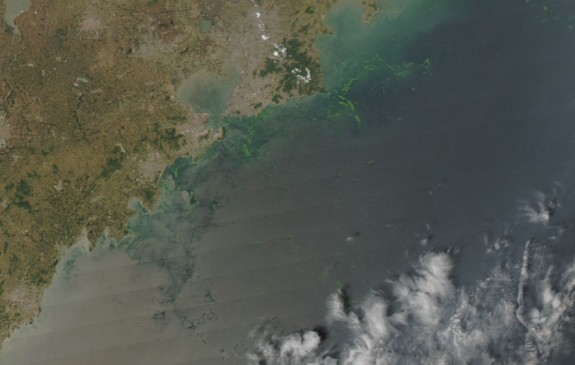
Algae in the Yellow Sea near Qingdao in 2008. Photo: MODIS Rapid Response Team / Earth Observatory
Vast blooms of algae can cause the water to become “hypoxic,” to have the concentration of oxygen in the water drawn down so low that it makes it uninhabitable for many marine creatures. A strong case of hypoxia can further lead to something called a “dead zone.” And, by drawing down the oxygen levels and messing with the chemistry of the water, algae blooms can temporarily amplify ocean acidification. The National Oceanic and Atmospheric Administration explains how algae blooms lead to dead zones:
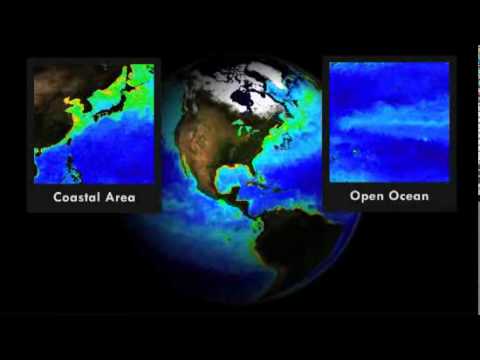
405 dead zones around the world
Such recurring, annual algae blooms like the one in Qingdao aren’t limited to China’s Yellow Sea.
According to Scientific American, there are at least 405 dead zones around the world. One of the worst in the world is the one in the Gulf of Mexico, where this year researchers with NOAA expect around 20,800 square kilometers (8,000 square miles) of the Gulf to be oxygen depleted (National Geographic). If the bloom lives up to expectations, this year’s would be the largest dead zone in the Gulf on record.
Sources: Smithsonianmag, Guardian

Teo Blašković founded The Watchers in 2011 and edited it until 2026, covering seismic and volcanic activity, extreme weather, space weather and near-Earth objects. Articles on this page are his archive.
Earlier reporting
Nothing on Watchers was published in the last 24 hours. These are older articles.
- On October 22, 2017, a single flash of lightning stretched 515 miles from eastern Texas to near Kansas City, a distance that takes eight hours to drive, and nobody realized how far it had gone until scientists went back through the satellite data years later Epicenter
- CPC posts a slight risk of heavy rain from the Gulf Coast to the Northeast urban corridor November 25-29, and a moderate risk of West Coast wind and Sierra snow on November 25
- Florida's east coast faces a moderate flash flood risk Wednesday through Friday, with 4 to 8 inches of rain forecast and the St. Johns River near Cocoa already in major flood at 17.13 feet
- Cyclone Akvan to make landfall between Nellore and Visakhapatnam around noon on November 20, IMD forecasts 120-130 km/h winds gusting to 145
