
Extremely high particulate levels recorded as Delhi’s air pollution worsens after Diwali
Air quality across New Delhi, India, deteriorated sharply between October 19 and 21, 2025, reaching “very poor” and “severe” levels at multiple monitoring stations. According to the Central Pollution Control Board (CPCB), the 24-hour average AQI rose from 296 on October 19 to 345–346 on October 20–21, prompting Stage II measures of the Graded Response Action Plan (GRAP) across the National Capital Region.

Image credit: Chetan Bhattacharji
Between October 19 and 21, New Delhi experienced a sustained deterioration in air quality, entering the “very poor” and “severe” categories defined by India’s National Air Quality Index (NAQI).
CPCB reported a 24-hour average AQI of 296 on October 19, 345 on October 20, and 346 on October 21. These values correspond to high concentrations of fine particulate matter (PM2.5 and PM10), largely attributed to post-Diwali fireworks, stagnant atmospheric conditions, and seasonal crop-residue burning in neighbouring states.
At several CPCB monitoring stations, hourly AQI values exceeded 400 on October 20 and 21. Wazirpur, Bawana, and Dwarka were among the most polluted locations, each registering “severe” readings above 410.
The Commission for Air Quality Management (CAQM) invoked Stage II of the Graded Response Action Plan (GRAP) across the Delhi National Capital Region (NCR), ordering restrictions on construction and demolition activities and urging industries to switch to clean fuels.
Meteorological analyses from the India Meteorological Department (IMD) indicated weak surface winds below 5 km/h (3 mph) and a shallow mixing layer under 100 m (330 feet), limiting vertical dispersion of pollutants. Temperature inversions during the night further trapped particulate matter near the surface, intensifying smog formation each morning. Hourly CPCB records show that AQI peaked near 400 at 09:00 LT (03:30 UTC) on October 21.
#WATCH | Visuals from near Dilli Haat INA as GRAP-2 invoked in Delhi.
— ANI (@ANI) October 21, 2025
The Air Quality Index (AQI) around the RK Puram was recorded at 368, in the 'Very Poor' category, in Delhi this morning as per the Central Pollution Control Board (CPCB). pic.twitter.com/SbDigf1Zfk
International air-quality platforms such as IQAir displayed readings above 1 000 and close to 2 000 for several Delhi locations, including Lodhi Road and Mandir Marg. According to an analysis published by MENAFN – Live Mint on October 21, these extreme numbers reflect the U.S. Environmental Protection Agency (EPA) method of AQI calculation, which has no fixed upper limit and can scale beyond 500.
India’s CPCB defines the “severe” category as 401–500, and values cannot exceed that range. For instance, while IQAir reported AQI 1 365 at Lodhi Road and 1 479 at Mandir Marg, CPCB’s official monitors at the same sites showed 327 and 317, respectively.
This divergence arises from differing conversion formulas for particulate concentrations (µg/m³). Both methods confirmed extremely polluted air, but only CPCB readings represent official NAQI values used for public-health advisories.
CPCB measurements on October 22 continued to register average values near 340, showing no significant relief.
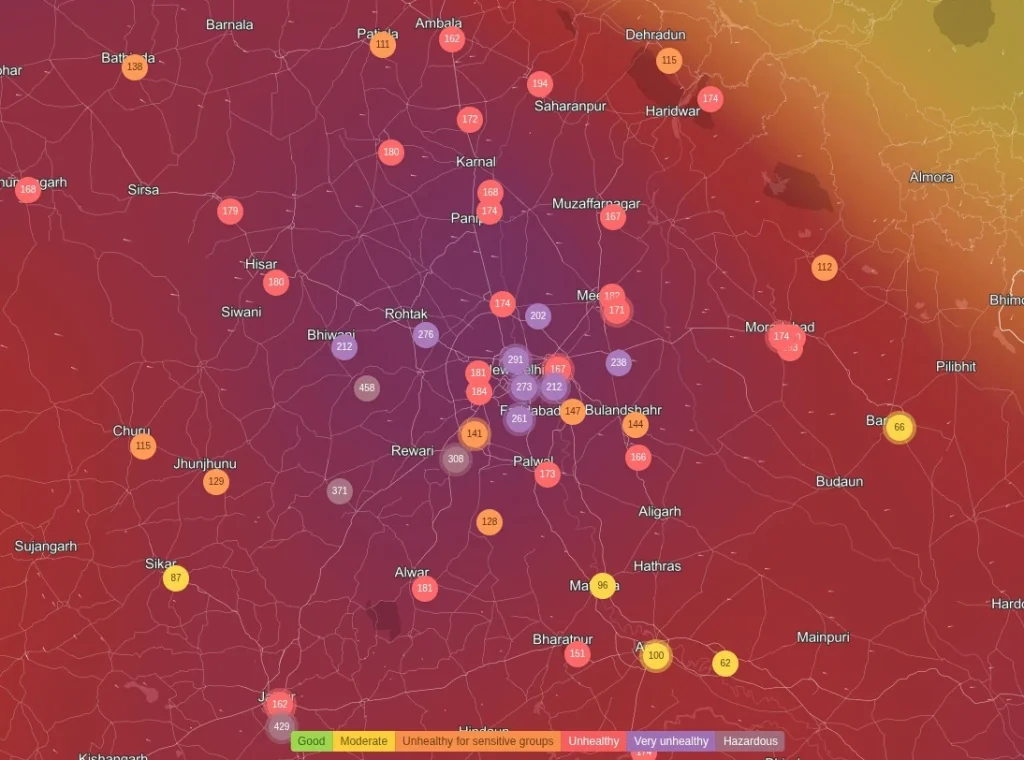
Delhi’s average AQI remained in the “poor” to “very poor” category through most of October 2025. CPCB 10-day trend data show daily means between 240 and 350, reflecting a persistent pollution episode linked to post-monsoon stagnation and increased regional emissions.
Satellite observations from the Copernicus Atmosphere Monitoring Service (CAMS) also detected elevated aerosol optical depth over northern India during this period.
The CAQM stated that further worsening was possible if meteorological conditions remained unfavourable.
Health advisories urged residents to limit outdoor activity and use N95-grade masks when exposure was unavoidable. By the evening of October 21, isolated gusts of north-easterly winds provided minor improvement in visibility, but overall air quality remained within the “very poor” band.

I'm a dedicated researcher, journalist, and editor at The Watchers. With over 20 years of experience in the media industry, I specialize in hard science news, focusing on extreme weather, seismic and volcanic activity, space weather, and astronomy, including near-Earth objects and planetary defense strategies. You can reach me at teo /at/ watchers.news.

Commenting rules and guidelines
We value the thoughts and opinions of our readers and welcome healthy discussions on our website. In order to maintain a respectful and positive community, we ask that all commenters follow these rules.