
Potomac River advisory lifted in Washington, D.C. as repairs begin on collapsed interceptor
The District Department of Health lifted a recreational advisory for the Potomac River in Washington, D.C., on March 2, 2026, after three weeks of monitoring showed bacterial levels had returned to typical ranges following the January 19 collapse of the Potomac Interceptor sewer line. Repair operations advanced the following day as crews prepared the damaged pipe for structural reinforcement while environmental restoration continues in the affected section of the C&O Canal National Historical Park.
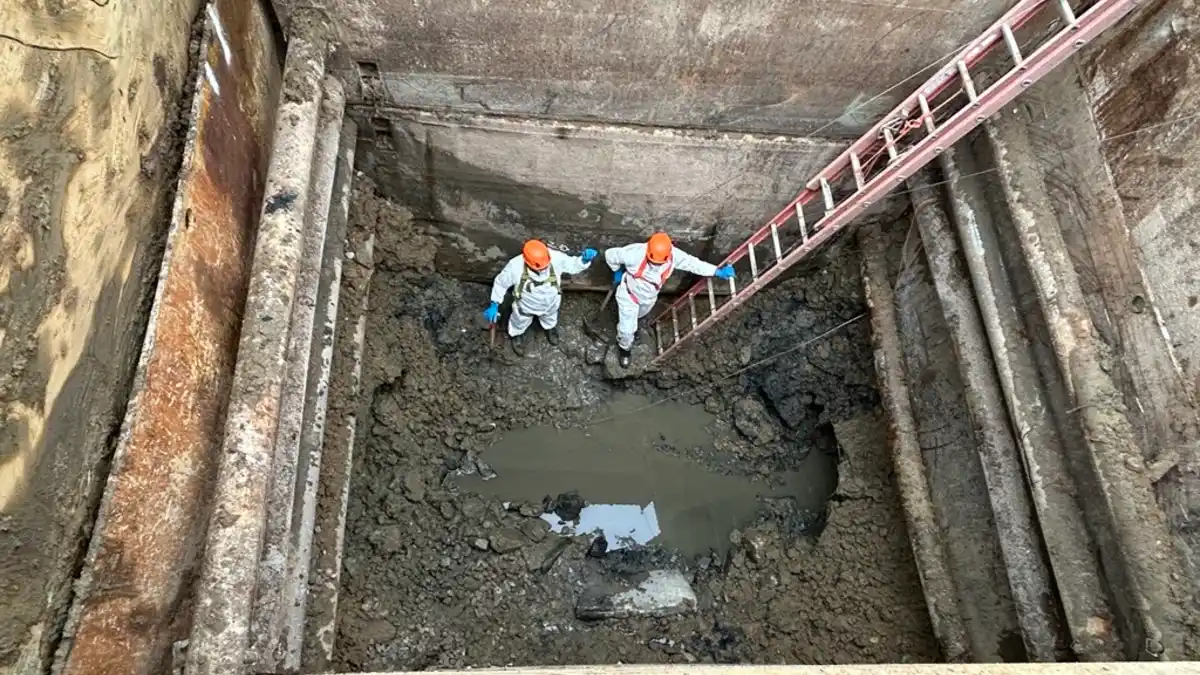
Workers inspect the collapsed section of the Potomac Interceptor sewer line during repair operations in Montgomery County, Maryland. Credit: DC Water
The District Department of Health lifted the recreational advisory for the Potomac River in Washington, D.C., after monitoring confirmed bacterial levels had returned to typical ranges following the January 19 collapse of the Potomac Interceptor sewer line.
The collapse released more than 757 million liters (200 million gallons) of untreated wastewater into the Potomac River and nearby sections of the C&O Canal National Historical Park.
Monitoring of river conditions has continued since the incident through coordination between DC Water, the District Department of Energy and Environment, the District’s Homeland Security and Emergency Management Agency, the U.S. Environmental Protection Agency, and the Federal Emergency Management Agency.
Testing focused on Escherichia coli, a bacterium used as an indicator of sewage contamination in freshwater systems. Measurements in the District’s portion of the Potomac River remained within typical ranges for 21 consecutive days after the last overflow reached the river on February 8.
Water quality monitoring began on January 29 at six upstream and downstream locations. At the drainage channel near Swainson Island, DC Water recorded an E. coli concentration of 242 000 MPN/100 mL on February 6, following correction of an earlier reporting error.
Independent sampling conducted by Potomac Riverkeeper Network in coordination with University of Maryland researchers measured concentrations up to 4 880 000 MPN/100 mL near the discharge point during the early phase of the spill, equivalent to approximately 12 000 times the EPA single-sample recreational threshold.
Downstream sampling stations, including Fletcher’s Boathouse, Georgetown at Wisconsin Avenue, National Harbor, and the Anacostia River at South Capitol Street, showed lower bacterial counts in mid-February compared to initial readings.
The U.S. Environmental Protection Agency (EPA) advises against primary contact recreation in freshwater when single-sample E. coli concentrations exceed 410 MPN/100 mL.
Historical monitoring indicates typical E. coli concentrations in the Potomac River range from 10–5 000 MPN/100 mL, with variability influenced by precipitation, runoff, and seasonal watershed dynamics.
The incident did not affect Washington’s drinking water supply because the city’s water intake is located upstream near Great Falls.
Environmental restoration is underway around the collapse area, but cleanup work must pause during rainfall or measurable precipitation to prevent contaminated material from washing into nearby waterways. No additional overflows have reached the Potomac River since February 8.
Dr. Ayanna Bennett, director of the District Department of Health, said three weeks of monitoring confirmed the river no longer posed an elevated public health risk within the District. The advisory removal applies only to waters within Washington, D.C., and residents are advised to follow guidance issued by neighboring jurisdictions for other sections of the river.
DC Water is expanding the monitoring network by adding sampling locations at Sycamore Island and the feeder channel near Lock 6, bringing the total number of monitoring sites to 10.
References:
1 Department of Health Lifts Potomac River Recreational Advisory for Washington, DC – Office of the Mayor, Washington, DC – March 2, 2026.
2 Update: Emergency repair work set to begin on Potomac Interceptor – DC Water – March 3, 2026

I’m a science journalist and researcher at The Watchers, contributing to the Epicenter edition, where I cover peer-reviewed scientific research and emerging discoveries across Earth and space sciences. With a background in astronomy and a passion for environmental science, I’ve worked in shark and coral conservation in Fiji, conducting reef and shark-behavior research, contributing to mangrove restoration, and earning PADI Open Water and Coral Reef Certifications. I bring a blend of scientific rigor and storytelling to illuminate the discoveries shaping our planet and beyond.

Commenting rules and guidelines
We value the thoughts and opinions of our readers and welcome healthy discussions on our website. In order to maintain a respectful and positive community, we ask that all commenters follow these rules.