
Ring-shaped prominence and Earth directed CME erupts from Sun – January 31, 2013
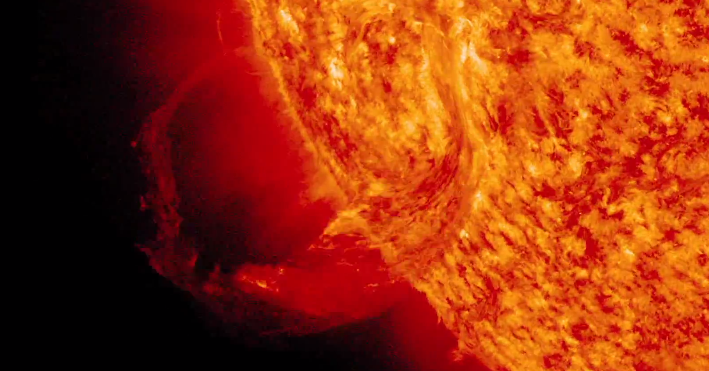
Image credit: TW
An Earth-directed Coronal Mass Ejection (CME) on January 31, 2013 (07:09 UTC) was accompanied by a large prominence eruption best visible in light with a wavelength of 304 angstroms. NASA’s Solar Dynamics Observatory captured this footage from 10 p.m. EST (03:00 UTC) on January. 30, 2013, to 4 a.m. (09:00 UTC) the next morning. In this video, the imaging cadence is one frame every 36 seconds.
Experimental NASA research models, based on observations from the Solar Terrestrial Relations Observatory (STEREO) and ESA/NASA’s Solar and Heliospheric Observatory, show that the CME left the sun at speeds of around 575 miles per second, which is a fairly typical speed for CMEs. Historically, CMEs at this speed are mild.
Not to be confused with a solar flare, a CME is a solar phenomenon that can send solar particles into space and reach Earth one to three days later.
Earth-directed CMEs can cause a space weather phenomenon called a geomagnetic storm, which occurs when they connect with the outside of the Earth’s magnetic envelope, the magnetosphere, for an extended period of time. In the past, CME’s such as this have caused auroras near the poles but didn’t disrupt electrical systems on Earth or interfere with GPS or satellite-based communications systems.
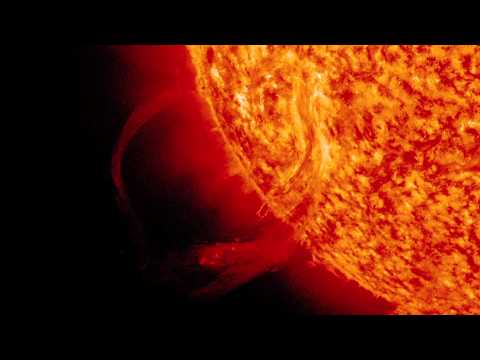
Filament vs Prominence
“Filaments are formed in magnetic loops that hold relatively cool, dense gas suspended above the surface of the Sun,” explains David Hathaway, a solar physicist at the NASA Marshall Space Flight Center. “When you look down on top of them they appear dark because the gas inside is cool compared to the hot photosphere below. But when we see a filament in profile against the dark sky it looks like a giant glowing loop — these are called prominences and they can be spectacular.”
Featured image and video credit: NASA Goddart Space Center

Teo Blašković founded The Watchers in 2011 and edited it until 2026, covering seismic and volcanic activity, extreme weather, space weather and near-Earth objects. Articles on this page are his archive.
Published in the last 24 hours
- High Risk of excessive rainfall covers Florida’s Space Coast as St. Johns River near Cocoa reaches 5.67 m
- Asteroid 2026 WJ to pass Earth at 1.7 lunar distances at 04:20 UTC on November 22, with 2026 WD following at 4.4 lunar distances on November 23
- Cyclone Akvan crossed the north Andhra Pradesh and south Odisha coasts close to Gopalpur on November 20 with 70-80 km/h winds gusting to 90, and has weakened into a deep depression
- A broad low over southeastern Florida and the northwestern Bahamas has a 30 percent chance of subtropical or tropical development within 48 hours and a 50 percent chance within 7 days, the National Hurricane Center says
