
“Dragon Tail” – Huge filament eruption – January 31, 2013
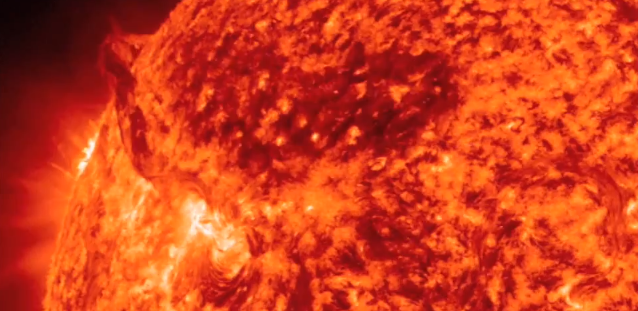
Image credit: TW
A large filament stretching hundreds of thousands of kilometers erupted on Thursday, January 31, 2013. The eruption lasted about 4 hours and was located in the northeast quadrant of the Sun.
The following SDO video shows a variety of views of the break-up of this structure.
Filaments are anchored to the Sun’s surface in the photosphere, and extend outwards into the Sun’s hot outer atmosphere, called the corona.
A filament forms over timescales of about a day, and stable filaments may persist in the corona for several months, looping hundreds of thousands of miles into space.
Some of the plasma was released into space but not all could escape the gravitational pull of the Sun. It’s not surprising that plasma should fall back to the Sun. After all, the Sun’s gravity is powerful.
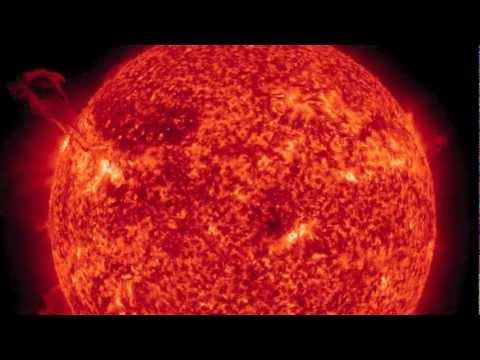
Filament vs Prominence
“Filaments are formed in magnetic loops that hold relatively cool, dense gas suspended above the surface of the Sun,” explains David Hathaway, a solar physicist at the NASA Marshall Space Flight Center. “When you look down on top of them they appear dark because the gas inside is cool compared to the hot photosphere below. But when we see a filament in profile against the dark sky it looks like a giant glowing loop — these are called prominences and they can be spectacular.”
Featured image and video credit: NASA SDO

Teo Blašković founded The Watchers in 2011 and edited it until 2026, covering seismic and volcanic activity, extreme weather, space weather and near-Earth objects. Articles on this page are his archive.
Published in the last 24 hours
- High Risk of excessive rainfall covers Florida’s Space Coast as St. Johns River near Cocoa reaches 5.67 m
- Asteroid 2026 WJ to pass Earth at 1.7 lunar distances at 04:20 UTC on November 22, with 2026 WD following at 4.4 lunar distances on November 23
- Cyclone Akvan crossed the north Andhra Pradesh and south Odisha coasts close to Gopalpur on November 20 with 70-80 km/h winds gusting to 90, and has weakened into a deep depression
- A broad low over southeastern Florida and the northwestern Bahamas has a 30 percent chance of subtropical or tropical development within 48 hours and a 50 percent chance within 7 days, the National Hurricane Center says
