
Spectacular filament eruption & Earth directed CME – August 6, 2013
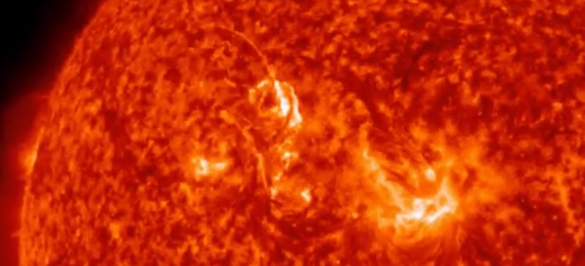
Image credit: NASA SDO
A spectacular filament eruption was observed yesterday August 6, 2013 at 02:04 UTC. A strong Coronal Mass Ejection (CME) has been seen following this energetic impulsive eruption and it does seem to have an earth-bound component which should impact the Earth late on the August 10.
Highest geomagnetic storm levels predicted by day: Aug 08: None (Below G1); Aug 09: None (Below G1); Aug 10: G1 (Minor)
There was three Halo Coronal Mass Ejections in last 24 hours.

Sunspots
There are currently 4 numbered sunspot regions on the disk. NOAA SWPC forecasters estimated 1% chance for M and X-class solar flares.

1806 – Alpha
1808 – Alpha
1809 – Beta
1810 – Beta
Complete magnetic pole reversal of the Sun in 3 – 4 months
As it does approximately every 11 years on a solar cycle, the Sun's magnetic field is now reversing. Measurements have confirmed that we are about 3 – 4 months away from complete magnetic field reversal when Sun's inner magnetic dynamo will re-organize itself. When that happens Sun's magnetic north pole, which is in the northern hemisphere now, will point south and south will point north. Though this reversal process of north and south magnetic pole is yet again proven to be asymmetrical, when they both flip we will officially be in Solar Maximum. Read more about it here.
- Follow Sun's activity in real time on our Space weather station.

Teo Blašković founded The Watchers in 2011 and edited it until 2026, covering seismic and volcanic activity, extreme weather, space weather and near-Earth objects. Articles on this page are his archive.
Published in the last 24 hours
- High Risk of excessive rainfall covers Florida’s Space Coast as St. Johns River near Cocoa reaches 5.67 m
- Asteroid 2026 WJ to pass Earth at 1.7 lunar distances at 04:20 UTC on November 22, with 2026 WD following at 4.4 lunar distances on November 23
- Cyclone Akvan crossed the north Andhra Pradesh and south Odisha coasts close to Gopalpur on November 20 with 70-80 km/h winds gusting to 90, and has weakened into a deep depression
- A broad low over southeastern Florida and the northwestern Bahamas has a 30 percent chance of subtropical or tropical development within 48 hours and a 50 percent chance within 7 days, the National Hurricane Center says

Like all of the others that have been mentioned in the news this will pass without any fanfare.
And there will be signs in the sun, moon, and the stars.