
Exceptionally fast, Extremely Rare CME launched from farside of the Sun
A powerful coronal mass ejection (CME) with an estimated speed of 3 161 km/s erupted on the Sun’s farside around 16:00 UTC on Tuesday, December 17, 2024.
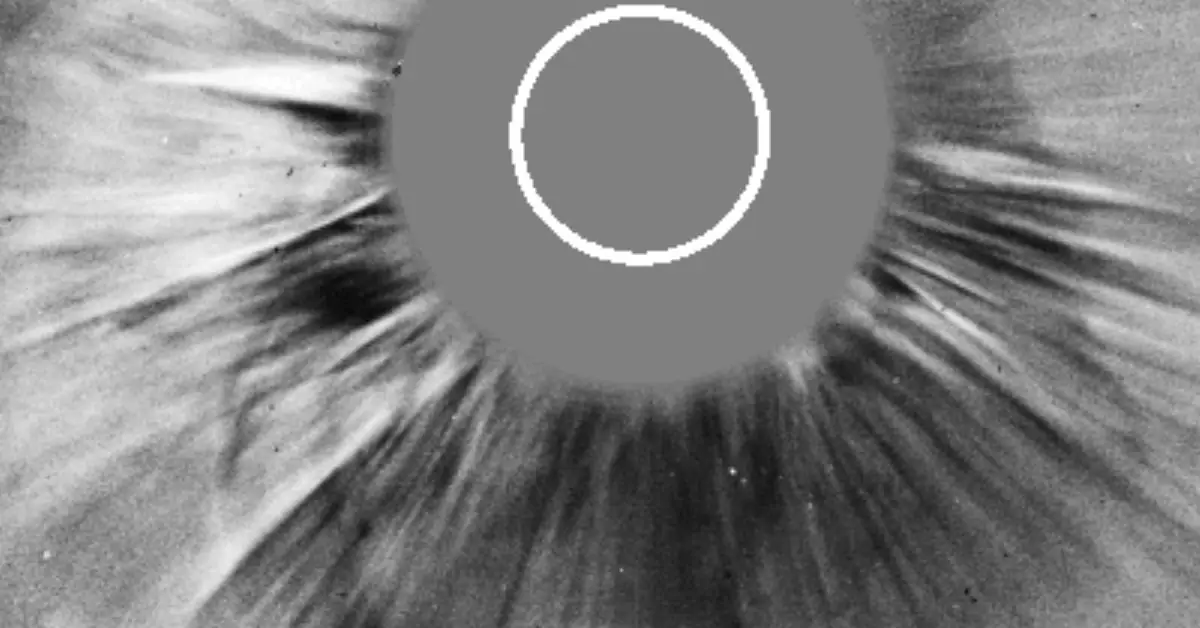
Image credit: ESA/NASA LASCO
A fast-moving halo CME was first observed in LASCO imagery around 16:00 UTC on December 17 following a powerful eruption on the farside of the Sun. No radio emissions were detected, and Earth-facing imagery confirms that this event was a result of a farside eruption, not directed toward Earth.
The CME was classified as an ER-type (Extremely Rare) by CCMC DONKI (Community Coordinated Modeling Center’s Database Of Notifications, Knowledge, Information), with an estimated speed of approximately 3 161 km/s (1 964 miles/s).
This speed is notably higher than some of the fastest historically recorded CMEs, such as those associated with the 2003 “Halloween storms,” which were recorded at speeds below 3 000 km/s.
If it had been Earth-directed, we’d be looking at G5 – Extreme geomagnetic storming on December 18 and 19.
Absolutely exceptionally fast CME (estimated speed ~3161 km/s). If this was an Earth-directed CME, we'd likely be looking at a G5 storm by late afternoon (UTC) tomorrow. Sun-Earth transit time would likely be <18 hrs. https://t.co/aRHbs4MECG pic.twitter.com/o8UuEMHx9M
— Jure Atanackov (@JAtanackov) December 17, 2024
“This is truly an exceptionally rare kind of CME,” said Jure Atanackov, geologist and researcher associated with the Geological Survey of Slovenia (GeoZS) who reported extensively about this exceptional event. “Few recorded CMEs are as fast or faster than this one (~3 161 km/s). The 23 July 2012 far side event, known as the ‘Carrington event that missed us’ clocked in at ~3 300 km/s. The 2003 Halloween G5 storm CMEs were slower, <3 000 km/s.”
This is the fourth farside CME in the past 10 days, indicating the presence of a highly active sunspot currently hidden from view. This active region is likely located in the southern hemisphere near the central meridian. As the Sun rotates, Earth will face this active region next week.

I am an Assistant Editor and Severe Weather & Science Journalist at The Watchers, specializing in real-time severe weather coverage, geophysical event reporting, and research-driven scientific analysis. You can reach me at rishav(at)watchers(.)news.

Yes, Nektli, the Sun is externally powered and the true interpretation of the observational data that support my claim are decisive and overwhelming. Actually, all solar phenomena that are currently considered mysteries like the temperature of the solar corona, the working of the solar cycle and the latest mystery of the high energy gamma-rays cannot be explained without taking into consideration the external energy supply that powers the Sun…..etc
Looking forward to seeing this active region next week!
The intensity of any type of solar eruption is directly proportional to the intensity of the magnetic field of the active region. Moreover, the eruption of the active region cannot happen without an external energy triggering (above the active region). But, this view of course is not accepted by current solar physics. Namely, current solar physics says that flares occur when intense magnetic fields on the Sun become too tangled. WHAT CAUSES THE FIELDS TO BECOME TOO TANGLED? Real physics is the study of cause and effect, but since the beginning of the 20th century, the principle of causality in physics has been destroyed. Now, some theoreticians are telling us there are infinite numbers of Universes, and the entertainment industry loves it.
Do you mean that there is an external energy triggering the activity of the sun, and if so, what that is or where does it come from? I am not a physic.