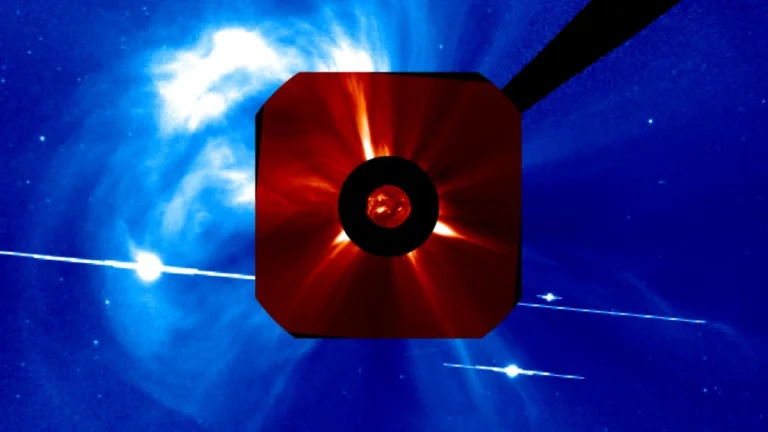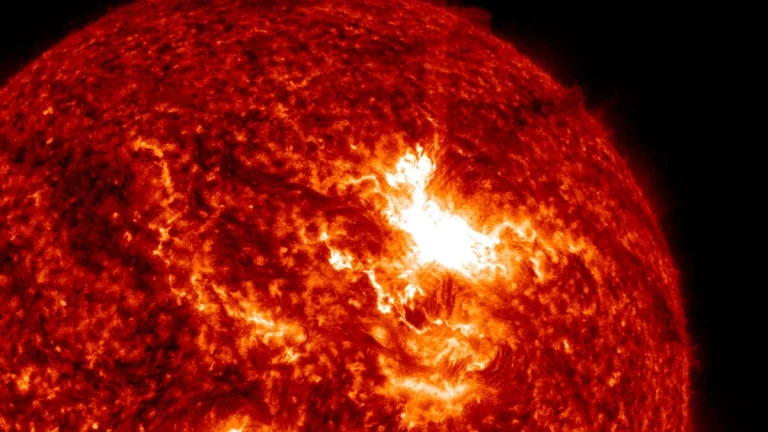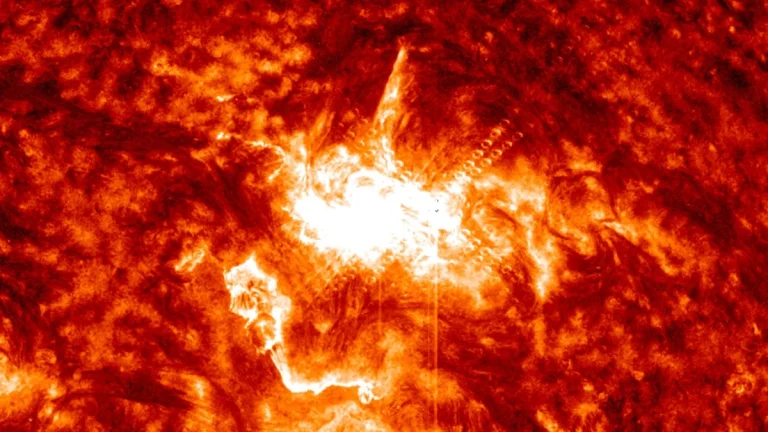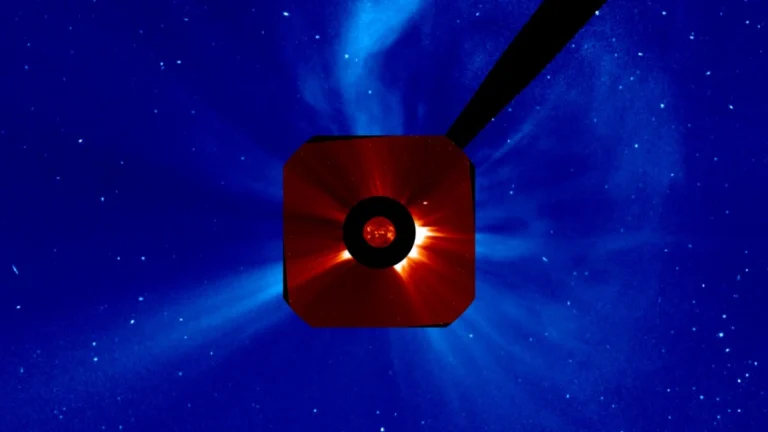
• Long-duration M1.9 flare produces Earth-directed CME, G1-G2 geomagnetic storm conditions forecast for August 2

    A long-duration M1.9 flare from Active Region 4492 coincided with a filament eruption near N20W67, producing an eruptive sequence associated with an Earth-directed partial-halo CME and an S1 – Minor solar radiation storm on July 30, 2026. WSA-Enlil model runs placed a possible CME arrival at Earth early on August 2, when NOAA’s Space Weather Prediction Center expects G1-G2 (Minor-Moderate) geomagnetic storm conditions.

  • Brief S1 solar radiation storm observed after large far side CME

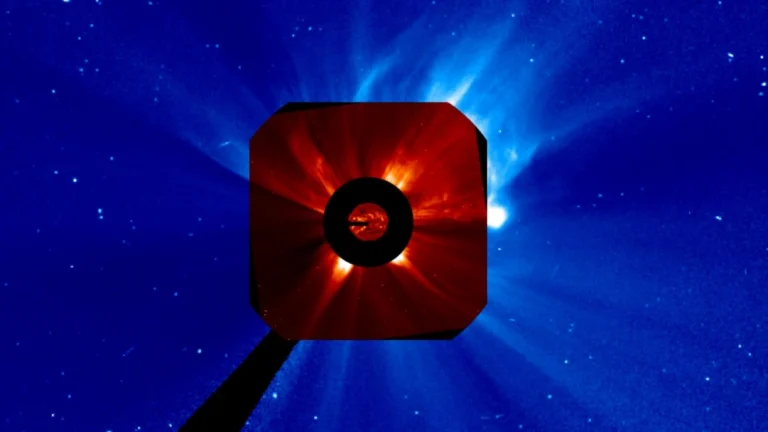
    High-energy solar protons briefly reached S1 – Minor solar radiation storm levels on May 26, 2026, following a large partial halo coronal mass ejection (CME) from the far side of the Sun. The eruption was first detected by the GOES-19 CCOR-1 coronagraph at 22:00 UTC on May 25. Forecast calls for a 10% chance of another S1 or stronger solar radiation storm on May 27.

  • Very rare S4 – Severe solar radiation storm in progress, G4 – Severe geomagnetic storm forecast

    A G4 – Severe solar radiation storm is in progress after ≥10 MeV proton flux exceeded 10 000 pfu at 18:10 UTC on January 19, 2026, following the X1.9 solar flare on January 18. As the associated full-halo coronal mass ejection approaches Earth, forecasters warn that a G4 – Severe geomagnetic storm is likely early on January 20.

  • Rare S3 – Strong solar radiation storm in progress after X1.9 flare on January 18

    A strong solar radiation storm (S3) is in progress after ≥10 MeV proton flux exceeded 1 000 pfu at 10:20 UTC on January 19, 2026. The event follows an X1.9 solar flare and full-halo coronal mass ejection that erupted on January 18. S3 – Strong solar radiation storms are relatively rare, occurring just a few times in one 11-year solar cycle.