
Long-duration M3.9 solar flare erupts with large CME off west limb
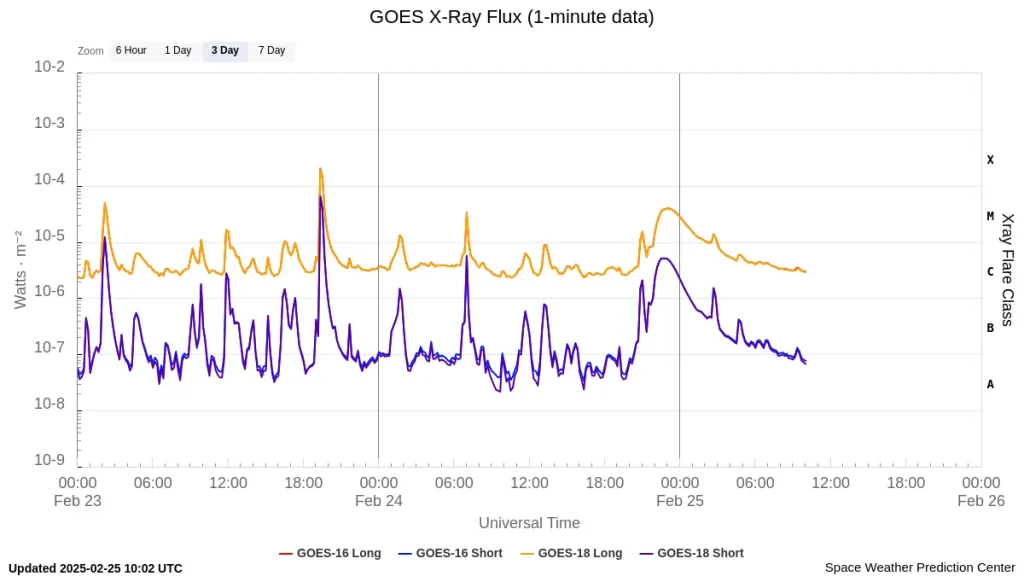
A long-duration M3.9 solar flare erupted from a region off the SW limb at 23:02 UTC on February 24, 2025, producing a large coronal mass ejection (CME) and triggering a minor solar radiation storm. While this CME is not Earth-directed, solar wind conditions have become enhanced yesterday, and geomagnetic activity may increase in the coming days. There is a 65% chance of an M-class flare through February 27 and a 25% chance of an X-class flare.

CME produced by M3.9 solar flare on February 24, 2025. Image credit: NASA/ESA, LASCO C2 and C3, Helioviewer, The Watchers
A long-duration M3.9 solar flare erupted at 23:02 UTC on February 24, 2025, from a region located off the SW limb. The event started at 21:50 and ended at 00:19 UTC on February 25.
The flare was accompanied by Type IV and Type II (estimated velocity 641 km/s) radio emissions and a large coronal mass ejection (CME) off the WSW limb at 21:24 UTC.
While the region’s position did not favor Earth-directed CMEs, it did result in a solar radiation storm. Proton flux began rising sharply around 23:20 UTC, reaching S1 – Minor solar radiation storm level at 00:20 UTC on February 25. The storm persisted at this level until 08:40 UTC on February 25.


Solar wind conditions became enhanced after 21:00 UTC on February 23, likely due to the glancing influence of a CME that left the Sun on February 19. The total magnetic field strength (Bt) reached 16 nT, with the Bz component dropping as low as -10 nT. Solar wind speeds remained relatively low, fluctuating between 300 and 375 km/s for most of the period.
At 08:00 UTC on February 24, the phi angle turned predominantly negative, followed by a solar sector boundary crossing into the positive sector at approximately 17:15 UTC. After this transition, solar wind parameters became further enhanced, with Bt reaching 18 nT and Bz dropping to -13 nT for a sustained period. Solar wind speeds began to rise, reaching 460 km/s.
Negative polarity coronal hole high-speed stream (CH HSS) influences are likely on February 25, along with residual glancing effects from the February 19 CME. A return to nominal solar wind conditions is expected on February 26–27.
The geomagnetic field remained at quiet to active levels in 24 hours to 00:30 UTC today.
Geomagnetic conditions are expected to be quiet to active on February 25 due to residual CME influences and negative polarity CH HSS effects. Mostly quiet conditions with occasional unsettled periods are likely on February 26–27.

There is a 65% chance of an M-class flare through February 27 and a 25% chance of an X-class flare.
References:
1 Forecast Discussion – SWPC – Issued at 00:30 UTC on February 25, 2025

Teo Blašković founded The Watchers in 2011 and edited it until 2026, covering seismic and volcanic activity, extreme weather, space weather and near-Earth objects. Articles on this page are his archive.
Published in the last 24 hours
- Northern lights are possible at high latitudes on November 17 and 18 as NOAA forecasts minor (G1) geomagnetic storms from coronal hole wind
- In April 2014, golden-winged warblers in the mountains of Tennessee, songbirds weighing about as much as four dimes, fled their breeding grounds a day or two before a tornado outbreak and flew hundreds of miles south, while the scientists tracking them sheltered in a Waffle House Epicenter
- After record Nordic heatwave, Swedish researchers to recreate indoor heat to study older adults Epicenter
- San Juan River cuts through 300-million-year-old rocks while retaining its winding course in Utah Epicenter
