
Brief S1 solar radiation storm observed after large far side CME
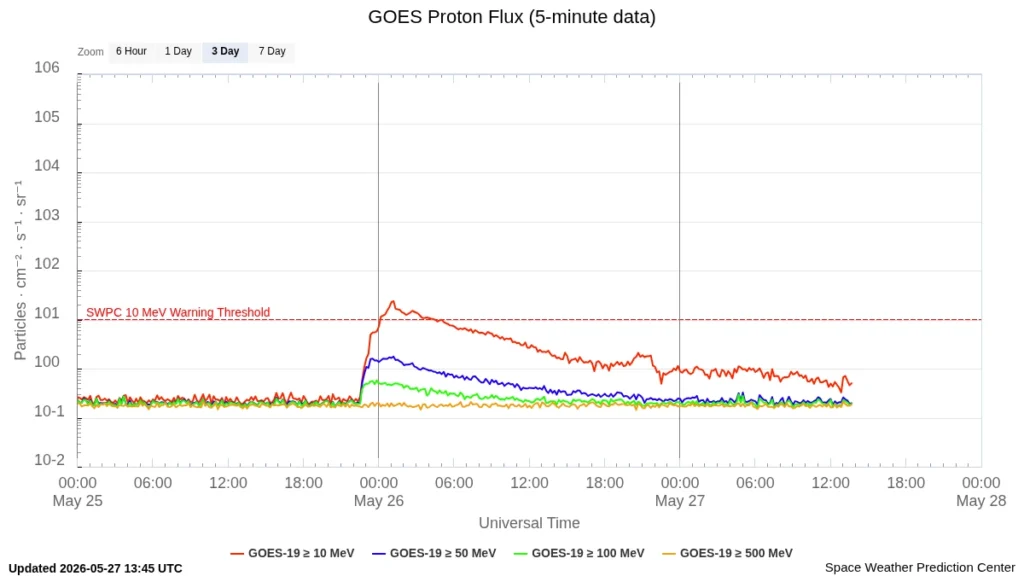
High-energy solar protons briefly reached S1 – Minor solar radiation storm levels on May 26, 2026, following a large partial halo coronal mass ejection (CME) from the far side of the Sun. The eruption was first detected by the GOES-19 CCOR-1 coronagraph at 22:00 UTC on May 25. Forecast calls for a 10% chance of another S1 or stronger solar radiation storm on May 27.
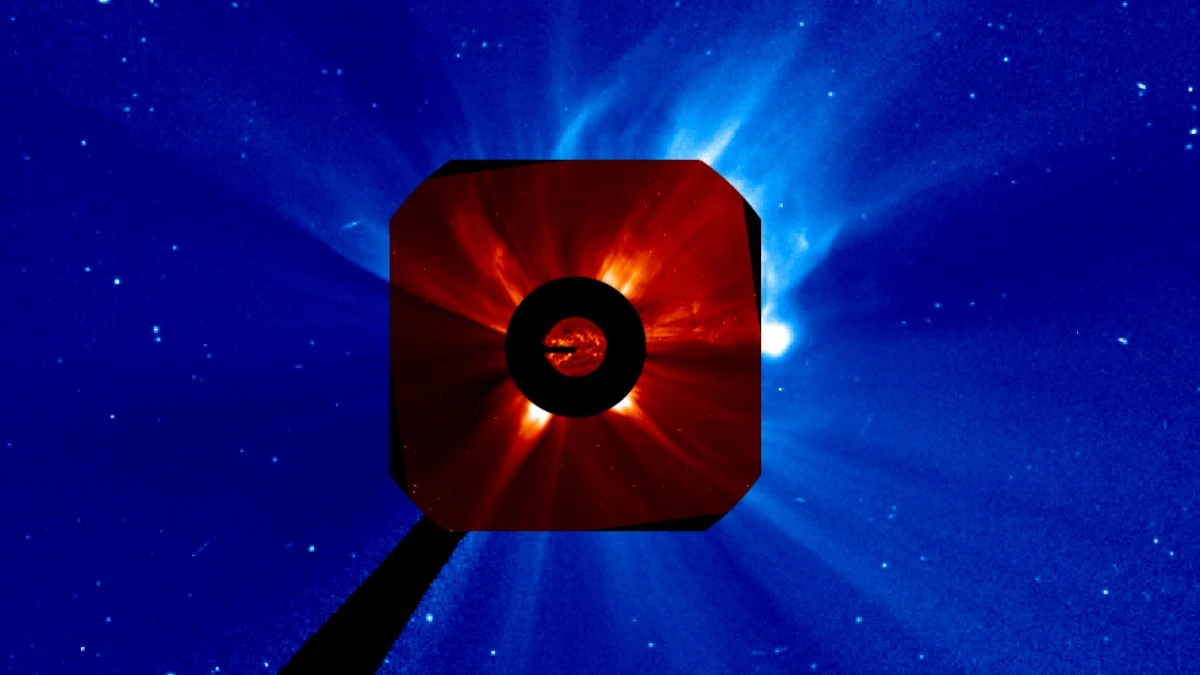
Image credit: NASA/ESA AIA 304, ESA/NASA LASCO C2/C3, Helioviewer, The Watchers
Proton levels were already falling by the start of May 27 after reaching S1 solar radiation storm levels on May 26. The event was linked to a large far-sided partial halo CME. The decline slowed after about 17:15 UTC on May 26 when the greater than 10 MeV proton flux averaged about 1 pfu, below NOAA’s S-scale storm threshold.
By 12:30 UTC on May 27, solar radiation levels observed by GOES-19 over the previous 24 hours were below storm levels. Elevated background proton levels kept a small chance of renewed S1 or stronger conditions in the latest forecast, with probabilities of just 10% on May 27, 5% on May 28, and 5% on May 29.
Solar activity remained low during the same period over the past 24 hours. The strongest flare was a C9.7 from Region 4446 at 12:38 UTC on May 26, while several partly hidden flares were observed on the northeast limb as a new sunspot group rotated onto the visible disk.
A Type II radio emission began at 12:44 UTC on May 26 and was likely associated with the C9.7 flare. The estimated shock speed was 650 km/s (404 mi/s), but any related CME was too faint or narrow to be seen clearly in available coronagraph imagery.
A separate faint, possibly partial halo CME seen from about 22:30 UTC on May 26 was still under analysis.
An S1 storm is the lowest level on NOAA’s solar radiation storm scale and can cause minor high-frequency radio effects in polar regions. Stronger S2 to S5 storms can affect satellites, navigation systems, aviation, and biological exposure risk.
References:
1 Forecast Discussion – NOAA/SWPC – May 26/27, 2026

I'm a dedicated researcher, journalist, and editor at The Watchers. With over 20 years of experience in the media industry, I specialize in hard science news, focusing on extreme weather, seismic and volcanic activity, space weather, and astronomy, including near-Earth objects and planetary defense strategies. You can reach me at teo /at/ watchers.news.

Commenting rules and guidelines
We value the thoughts and opinions of our readers and welcome healthy discussions on our website. In order to maintain a respectful and positive community, we ask that all commenters follow these rules.