
S1 – Minor Solar Radiation Storm in progress after X1.2 solar flare
Proton flux rose sharply following X1.2 solar flare at 07:19 UTC on November 10, 2025, reaching S1 – Minor Solar Radiation Storm levels at 11:20 UTC.

X1.2 solar flare on November 10, 2025. Credit: NASA SDO/AIA 304, The Watchers
Potential impacts from S1 – Minor Solar Radiation Storm include minor effects on polar high-frequency (HF) radio communications. Users may experience occasional fades or degradation at lower frequencies, particularly on polar routes. S1 storms occur approximately 50 times per 11-year solar cycle.
High-energy particles can reach Earth anywhere from ~10 minutes (for a 500 MeV proton) to many hours following the initiating solar event.
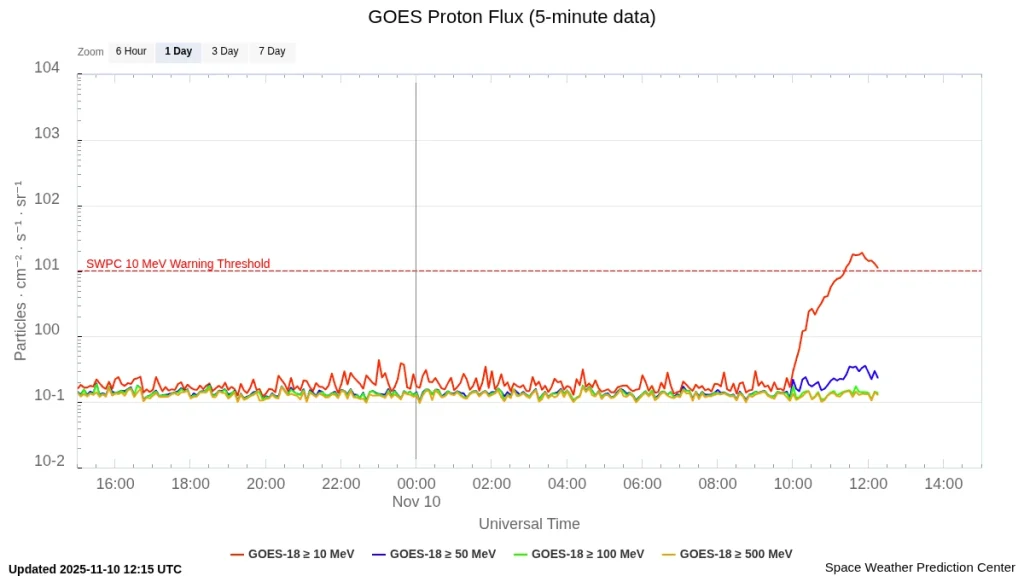

The storm was caused by a major X1.2 solar flare at 09:18 UTC today, accompanied by Type II and Type IV radio emissions that indicated the release of a strong coronal mass ejection (CME). The estimated shock velocity was 1 321 km/s. Given the region’s current geoeffective position, the CME is expected to have an Earth-directed component.
“This event also had a Castelli-U radio burst, which is a good indication a proton event is possible, as well as a halo CME,” SWPC forecasters noted at 12:30 UTC today.
“The bulk of the full halo CME, first observed in LASCO C2 imagery at 10/0936 UTC, appears to have a NW bias, but with the source location being near the center disk, an Earth-directed component is highly likely. Analysis is underway to determine arrival time at Earth.”
The same region produced an X1.7 flare at 07:19 UTC on November 9, which launched an asymmetric halo CME observed in LASCO C2 imagery at 07:48 UTC. The CME is forecast to arrive around midday UTC on November 11, likely causing geomagnetic disturbances ranging from G1 – Minor to G2 – Moderate levels.
The greater than 2 MeV electron flux was at normal to moderate levels in 24 hours to 00:30 UTC today, and the greater than 10 MeV proton flux remained at background levels.
The SWPC forecast maintains a 70% probability for additional M-class flares and a 25% chance for X-class events through November 12, as Region 4274 retains its complex beta-gamma-delta magnetic configuration.

Periods of geomagnetic storming are likely on November 10 due to residual CME influences from November 7, followed by stronger disturbances between November 11 and 12 as Earth encounters the CME from November 9.


I'm a dedicated researcher, journalist, and editor at The Watchers. With over 20 years of experience in the media industry, I specialize in hard science news, focusing on extreme weather, seismic and volcanic activity, space weather, and astronomy, including near-Earth objects and planetary defense strategies. You can reach me at teo /at/ watchers.news.

Commenting rules and guidelines
We value the thoughts and opinions of our readers and welcome healthy discussions on our website. In order to maintain a respectful and positive community, we ask that all commenters follow these rules.