
Major X1.7 solar flare erupts from Earth-facing Region 4274, CME impact expected on November 11
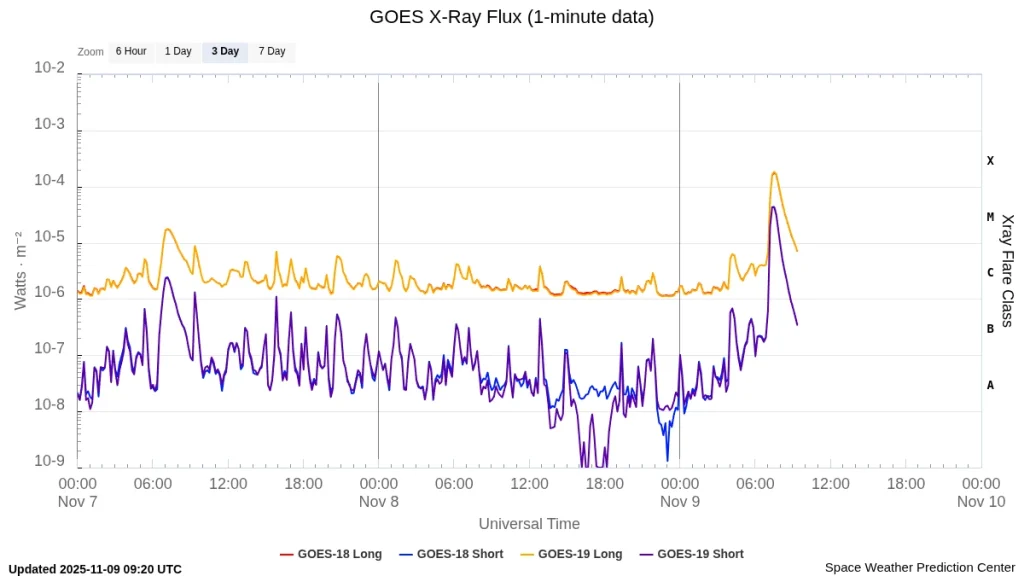
A major long-duration solar flare measuring X1.7 erupted from Active Region 4274 at 07:35 UTC on November 9, 2025, producing an assymetric halo CME with impact expected around 12:00 UTC on November 11. The event started at 07:01 and ended at 07:55 UTC.

X1.7 solar flare on November 9, 2025. Credit: NASA/SDO AIA 304, Helioviewer, The Watchers
A Type II Radio Emission, with an estimated velocity of 804 km/s, and a Type IV emission were associated with the event, indicating a strong coronal mass ejection (CME) was produced during the event.
Additionally, a 10cm Radio Burst lasting 25 minutes and with a peak flux of 25 minutes was detected from 07:10 to 07:35 UTC. A 10cm radio burst indicates that the electromagnetic burst associated with a solar flare at the 10cm wavelength was double or greater than the initial 10cm radio background.
This can indicate significant radio noise associated with a solar flare. This noise is generally short-lived but can cause interference for sensitive receivers, including radar, GPS, and satellite communications.
The region is directly facing Earth, making an Earth-directed CME from this event very likely. It has a ‘beta-gamma-delta’ magnetic configuration and is capable of producing more major eruptions on the Sun. Earth-directed CMEs from this region are possible in the days ahead.
Radio frequencies were forecast to be most degraded over the Indian Ocean.


Solar wind parameters in 24 hours to 00:30 UTC on November 9 reflected remnant CME effects and negative polarity coronal hole high speed stream (CH HSS) influences. Total field strength gradually decreased from 11 nT to 5 nT. Bz was sustained southward, by as much as -9 nT, between 0000-08:30 UTC on November 8. Solar wind speeds ranged from 575 to 700 km/s, while Phi was predominantly negative.
Solar wind parameters are expected to remain enhanced through November 11 with negative polarity CH HSS influences (November 9–11) and the anticipated arrival of a CME from November 7 (November 10–11).

The geomagnetic field reached G1 – Minor to G2 – Moderate storm levels due to CME and negative polarity CH HSS influences. Periods of G1 – Minor storming are likely on November 9 in response to negative polarity CH HSS influences.
Periods of G1 – Minor and G2 – Moderate storming are likely on November 10 due to continued negative polarity CH HSS influences and the anticipated arrival of a CME that left the Sun on November 7.
Update
08:16 UTC, November 10
An asymmetric halo CME, first observed in LASCO C2 imagery at 07:48 UTC on November 9 off the NNE, is expected to be Earth-directed with an anticipated arrival around 12:00 UTC on November 11.
The solar wind environment is forecast to become enhanced today as the November 7 CME passes in close proximity to Earth. Stronger solar wind disturbances and periods of G1 – Minor to G2 – Moderate are likely on November 11 and 12 due to the anticipated arrival of the November 9 asymmetric halo CME.
The greater than 2 MeV electron flux is expected to reach high levels on November 10 to 12. There is a chance for the greater than 10 MeV proton flux to reach S1 – Minor storm levels during the period due to the flare potential and location of Region 4274.

References:
1 Forecast Discussion – NOAA/SWPC – 00:30 UTC on November 9, 2025

I'm a dedicated researcher, journalist, and editor at The Watchers. With over 20 years of experience in the media industry, I specialize in hard science news, focusing on extreme weather, seismic and volcanic activity, space weather, and astronomy, including near-Earth objects and planetary defense strategies. You can reach me at teo /at/ watchers.news.

Commenting rules and guidelines
We value the thoughts and opinions of our readers and welcome healthy discussions on our website. In order to maintain a respectful and positive community, we ask that all commenters follow these rules.