
X5.1 solar flare produces strongest GLE in 20 years, sharply increasing radiation at flight altitudes
UK researchers report that radiation levels at commercial flight altitudes reached their highest values in 20 years following the X5-class solar flare on November 11, 2025, with the resulting Ground Level Enhancement driving single-event upset rates in avionics not seen since 2006.

CME produced by X5.1 solar flare on November 11, 2025. Credit: NASA SDO/AIA 304, The Watchers
A Ground Level Enhancement (GLE) is the most energetic class of Solar Energetic Particle (SEP) events, produced when solar eruptions accelerate protons to relativistic energies. Most SEPs remain confined to space and are detected only by satellites, but a GLE is intense enough for secondary particles generated in the atmosphere to reach ground-based neutron monitors. Since systematic observations began in the 1940s, only about 70 such events have been recorded.
Radiation measurements collected over the UK show that the Veteran’s Day solar storm on November 11 produced the strongest Ground Level Enhancement (GLE) in two decades.
Early results from the Surrey Space Centre and the UK Met Office indicate that effective dose rates at aviation altitudes rose sharply during the event.
The GLE followed an X5-class solar flare on November 11. Soon after the eruption, researchers from Surrey deployed balloon-borne radiation sensors to analyze the storm’s impact on the upper atmosphere.
According to their measurements, effective dose rates at 12 200 m (40 000 feet) went over 55 μSv per hour, with modelling suggesting that some high-latitude flight paths may have reached 80 μSv per hour. Typical cruise-altitude dose rates are only a few μSv per hour, so this represents an order-of-magnitude increase over nominal conditions.
Analysis by Surrey and the UK Met Office suggests that several high-latitude transatlantic routes likely received roughly twice their normal cosmic-ray dose during the peak of the event. Professor Clive Dyer of the Surrey Space Centre said that neutron monitors worldwide detected the surge. “This was the strongest Ground Level Event since December 13, 2006,” he said.
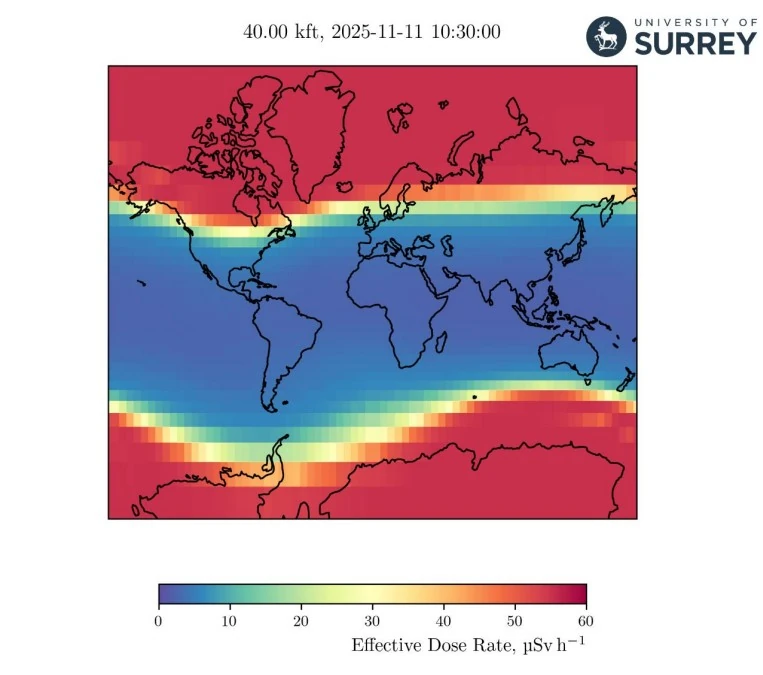
While the measured doses remained far below thresholds associated with acute radiation effects for passengers or crew, the storm heightened technical risks for avionics.
Surrey’s analysis, as reported by Dr. Tony Phillips of SpaceWeather, estimates that single-event upsets, bit-flips in memory caused by energetic particles, could have reached rates of around 60 errors per hour per gigabyte at the peak.
Significant GLEs typically occur once or twice per solar cycle. The event of February 23, 1956, remains the largest of the modern observational era, with dose rates inferred to have exceeded normal conditions by more than two orders of magnitude. Last week’s GLE was approximately 2% of that 1956 event, according to Surrey’s assessment.
Cosmogenic-isotope records preserved in tree rings and ice cores show that far larger solar-particle events have occurred in the past. These so-called Miyake Events, such as those in 775 CE and 994 CE, exceeded typical modern GLEs by several orders of magnitude and remain essential to ongoing studies of extreme solar behaviour.

I am an Assistant Editor and Severe Weather & Science Journalist at The Watchers, specializing in real-time severe weather coverage, geophysical event reporting, and research-driven scientific analysis. You can reach me at rishav(at)watchers(.)news.

Commenting rules and guidelines
We value the thoughts and opinions of our readers and welcome healthy discussions on our website. In order to maintain a respectful and positive community, we ask that all commenters follow these rules.