
Scientists uncover the mystery of toxic “halo” barrels off the Los Angeles coast
Scientists have found that the toxic DDT barrels dumped off the coast Los Angeles, California, have been leaking alkaline waste into the ocean floor. This has drastically changed the ocean floor environment around the barrels, resulting in the ghostly halos around the barrels and creating conditions similar to deep-sea hydrothermal vents and alkaline hot springs.

Scientist uncover the mystery of toxic halo barrels off the Los Angeles coast. Credit: PNAS/NEXUS, Gutleben et al.
A new research study conducted by the UC San Diego Scripps Institution of Oceanography found decades-old industrial waste on the deep ocean floor off the coast of Los Angeles, and how it’s affecting the ocean floor.
The waste barrels in question began to catch the public eye in 2020 when they were found by David Valentine, a scientist from UC Santa Barbara.
Back then, it was unclear what they contained. However, it was believed that these barrels were full of industrial waste, including the pesticide dichlorodiphenyltrichloroethane (DDT), petrochemicals, and other materials.
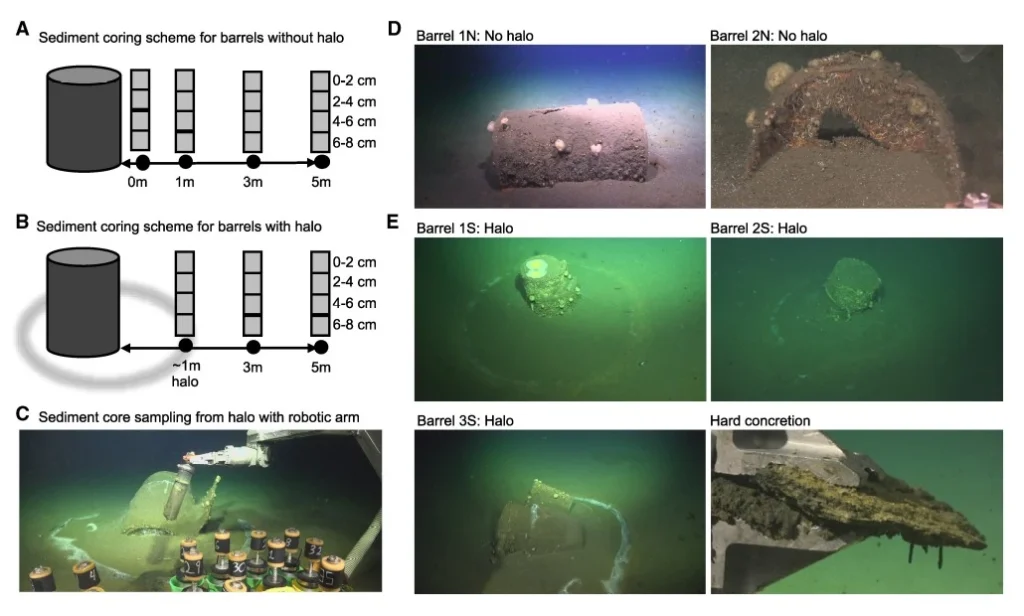
One big question everyone had, though, was: what are the ghostly halos present in the sediments surrounding the barrels?
The new study links this waste to DDT contamination and suggests that these halos were a result of leaking alkaline waste from the barrels.
According to scientists, the barrels have been leaking alkaline waste into the sea floor. This transforms portions of the seafloor into extreme environments, mirroring natural hydrothermal vents — complete with specialized bacteria that thrive where most life cannot survive.
Scientists asked the same question as they tried to collect samples of the halos. What they realized was that the seafloor within the halo was hard as concrete, making it difficult to collect samples with their coring devices.
They then used the remotely operated vehicle (ROV) SuBastian to collect sediment samples at precise distances from five barrels, three of which had white halos. These were then taken to the lab.
What baffled the scientists was that the sediment samples didn’t show an increase in DDT concentration as they got closer to the barrels. This would not happen if the DDT was leaking out of the barrels.
When lead author Johanna Gutleben, the study’s lead author, tested the pH of these samples, that’s when she found that they had an extremely high pH of around 12. This was found to be consistent with the conclusion that the barrels had been leaking highly alkaline waste into the surrounding environment.
This explained the limited amount of microbial DNA she and her colleagues had been able to extract from the halo samples. The samples turned out to have low bacterial diversity compared to other surrounding sediments, and the bacteria came from families adapted to alkaline environments, like deep-sea hydrothermal vents and alkaline hot springs.
According to the study, the alkaline waste from the barrels reacted with magnesium in the seawater, creating brucite. This caused the sediments to harden, forming the concrete-like crust. Since it is a slow-dissolving mineral, brucite maintains its high pH, creating a harsh environment where only a few extremophilic species of microbes can survive.
The halos form when the high-pH brucite reacts with the surrounding seawater to form calcium carbonate, which deposits around as dust, forming the mysterious halos.
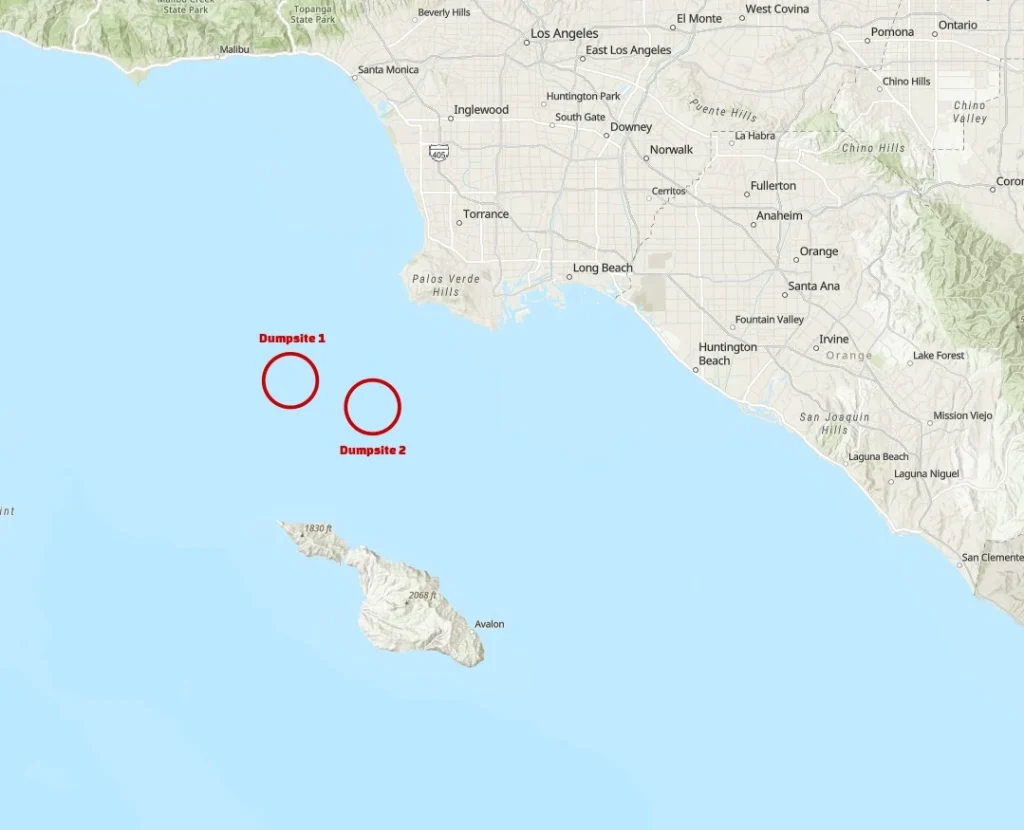
Surveys of over 14 500 ha (36 000 acres) of seafloor, conducted between 2021 and 2023 by the UC San Diego Scripps team, discovered 27 000 objects that were likely to be barrels of toxic waste. They also discovered over 100 000 pieces of debris during the survey.
These however do not represent the actual number as the survey had a limited scope of area and many of the barrels that have been in the ocean for decades could have been buried deeper or lost.
According to the researchers of the study, around 300 000 barrels are likely to have been dumped in the San Pedro Basin between the 1940s and 1970s.
Meanwhile, independent media sources and researchers say that the number of barrels could be far higher than these estimates, with some suggesting over half a million barrels of waste on the ocean floor off Los Angeles.
The dumping of these barrels is said to have begun in the 1940s during World War II and involved some major industry names, including the Montrose Chemical Corporation, the largest DDT producer in the U.S. at the time.
The dumping finally came to an end in 1972 when the Ocean Dumping Act of 1972, formally known as the Marine Protection, Research, and Sanctuaries Act, was enacted.
Researchers estimate that roughly one-third of the barrels observed in the San Pedro Basin may have contained alkaline waste.
“DDT was not the only thing that was dumped in this part of the ocean, and we have only a very fragmented idea of what else was dumped there,” said Gutleben. “We only find what we are looking for, and up to this point we have mostly been looking for DDT. Nobody was thinking about alkaline waste before this, and we may have to start looking for other things as well.”
“This adds to our understanding of the consequences of the dumping of these barrels,” said Paul Jensen, emeritus marine microbiologist at Scripps and senior author of the study. “It’s shocking that 50-plus years later you’re still seeing these effects. We can’t quantify the environmental impact without knowing how many of these barrels with white halos are out there, but it’s clearly having a localized impact on microbes.”
References:
1 Extremophile hotspots linked to containerized industrial waste dumping in a deep-sea basin – Johanna Gutleben et al – PNAS -September 9, 2025 – https://doi.org/10.1093/pnasnexus/pgaf260
2 Decades-old barrels of industrial waste still impacting ocean floor off LA – UC San Diego – Septemeber 9, 2025

I am an Assistant Editor and Severe Weather & Science Journalist at The Watchers, specializing in real-time severe weather coverage, geophysical event reporting, and research-driven scientific analysis. You can reach me at rishav(at)watchers(.)news.

Commenting rules and guidelines
We value the thoughts and opinions of our readers and welcome healthy discussions on our website. In order to maintain a respectful and positive community, we ask that all commenters follow these rules.