
Earth has a second planetary symmetry, maintained by a hidden balance of clouds
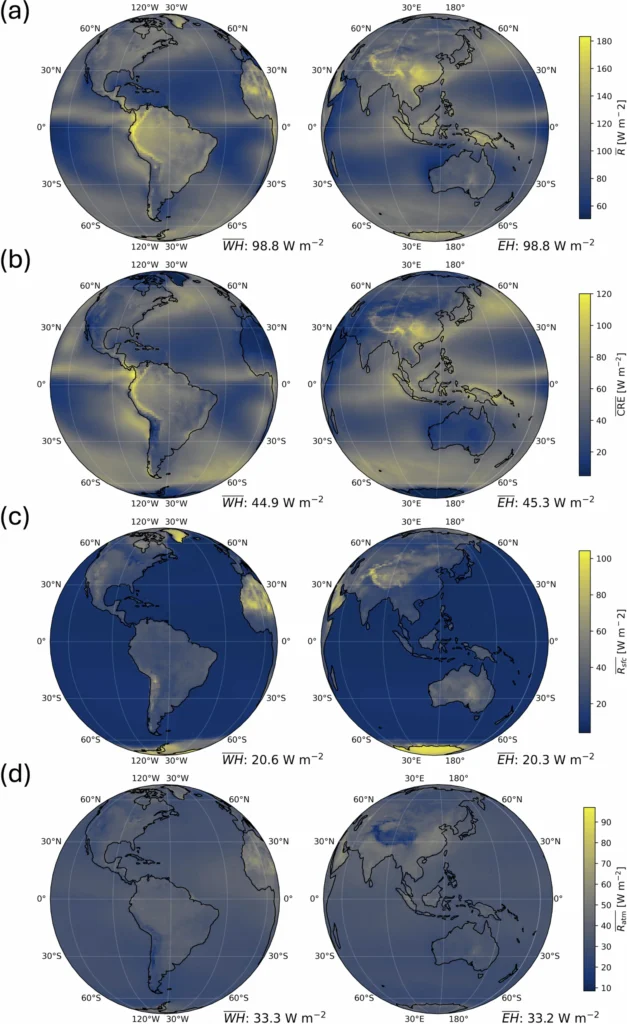
Earth’s eastern and western hemispheres reflect almost exactly the same amount of sunlight despite being dominated by very different cloud systems, land masses, and ocean basins. A new study has identified a previously unknown planetary symmetry centered on 27° E longitude, revealing a new large-scale feature of Earth’s climate system and a phenomenon that many current climate models fail to reproduce.
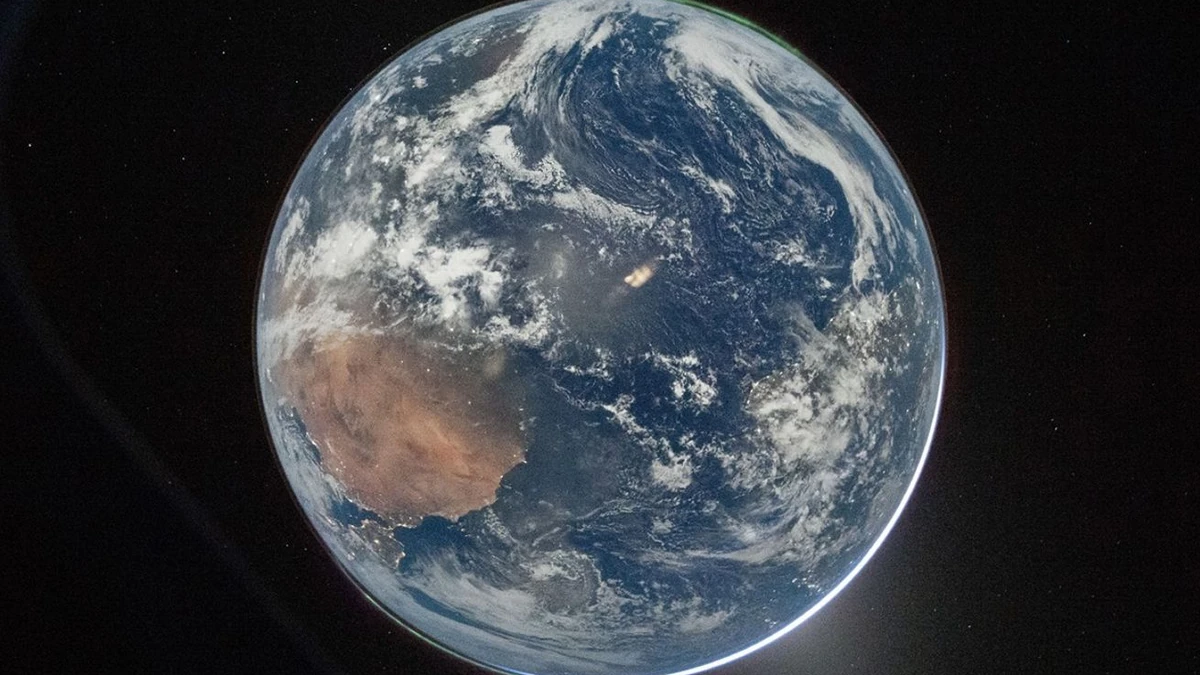
A pictures of Earth as Seen From Artemis II. Credit: NASA Earth Observatory
Earth reflects about 29% of the sunlight it receives back into space. This reflectivity, known as planetary albedo, plays a major role in regulating the planet’s temperature and overall energy budget.
For decades, scientists have known that the Northern and Southern hemispheres reflect nearly equal amounts of sunlight despite major differences in geography, cloud cover, and surface characteristics.
The new study suggests that Earth also has a second symmetry based on longitude rather than latitude.
Using 25 years of observations from NASA’s Clouds and the Earth’s Radiant Energy System (CERES) satellite record, researchers Jianhao Zhang, Jake J. Gristey, and Graham Feingold found that a line running through 27° E longitude divides the planet into eastern and western hemispheres that reflect nearly identical amounts of solar radiation.
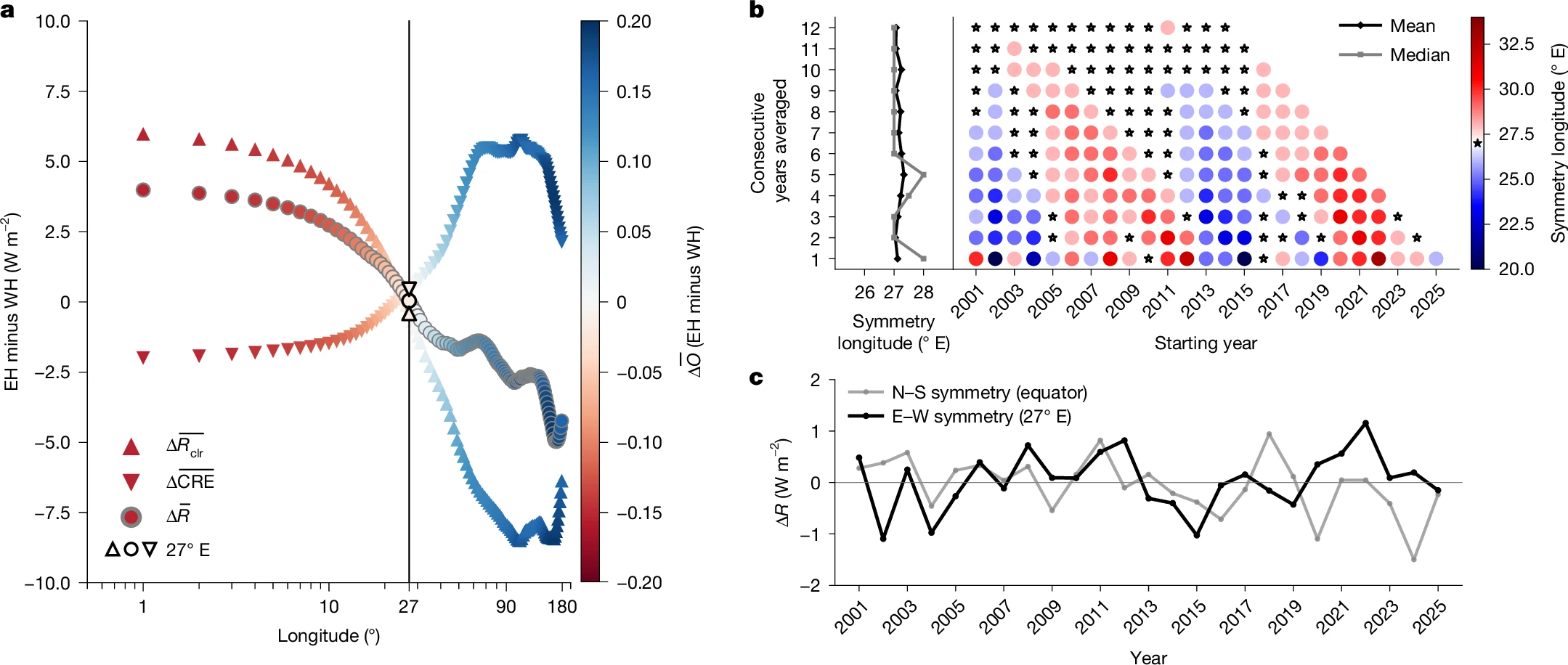
Across the 2001–2025 record, the difference between the two hemispheres averaged just 0.04 ± 0.24 W m⁻², showing that the balance has remained remarkably stable over time.
To search for possible east–west symmetries, the researchers divided Earth into eastern and western hemispheres at every longitude and compared how much sunlight each pair reflected back into space.
Out of all possible divisions, only the hemisphere pair separated by 27° E showed a persistent and nearly perfect balance.
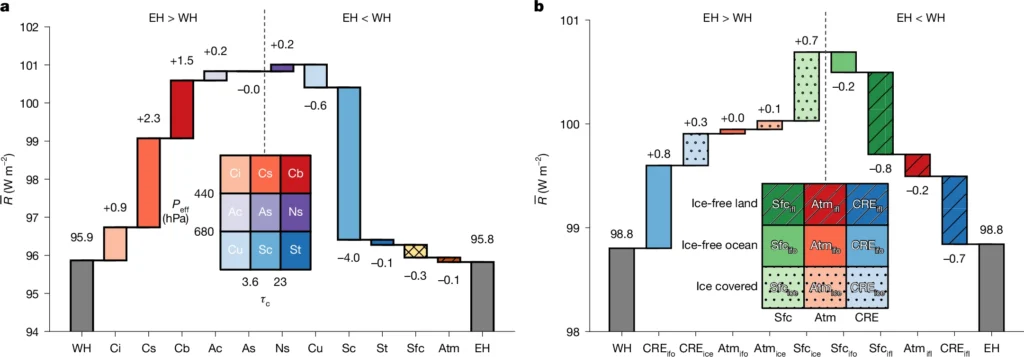
However, the most surprising aspect of the discovery is how the symmetry is maintained.
The Eastern Hemisphere reflects more sunlight from high-altitude clouds, while the Western Hemisphere reflects more sunlight from low-altitude clouds, including extensive stratocumulus cloud decks over subtropical oceans.
Although these cloud systems are very different, their effects balance each other closely enough to produce nearly identical amounts of reflected sunlight in both hemispheres.
The researchers describe the phenomenon as a “triple symmetry.” At the same longitudinal divide, three independent properties approach hemispheric balance simultaneously: total reflected sunlight, clear-sky reflection, and cloud radiative effect.
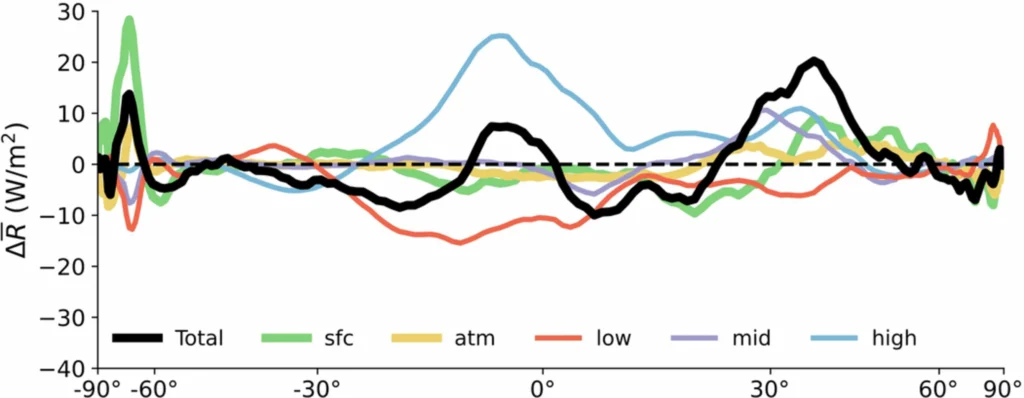
The divide also closely matches a boundary that separates Earth into eastern and western hemispheres containing nearly equal fractions of ice-free ocean. Together, these relationships point to a coupled interaction among clouds, oceans, sea ice, and atmospheric circulation rather than a simple geographic coincidence.
The study also found a statistically significant relationship between the symmetry and the El Niño-Southern Oscillation (ENSO), one of the most important drivers of global climate variability.
Year-to-year changes in the east–west symmetry closely tracked changes in ENSO conditions. According to the authors, this suggests that large-scale atmospheric circulation patterns, including the Walker circulation across the tropical Pacific, may help maintain the observed balance.
The discovery also exposes an important weakness in current climate models.
The researchers found that many CMIP6 Earth system models fail to reproduce the observed triple symmetry, even though they simulate many of the large-scale climate processes involved.
The mismatch points to possible shortcomings in how models represent clouds, particularly low-level boundary-layer clouds, which remain one of the largest sources of uncertainty in climate projections.
For climate scientists, the newly identified symmetry is important because it provides a new observational constraint on Earth system models. In other words, it gives researchers another real-world benchmark against which climate simulations can be tested.
Rather than evaluating only whether models reproduce Earth’s overall energy balance, scientists can now examine whether they capture the observed relationships among cloud radiative effects, ocean distribution, and hemispheric reflection. Improving these representations could help increase confidence in future climate projections.
The authors caution that both the well-known north–south symmetry and the newly identified east–west symmetry may be temporary characteristics of the current climate rather than permanent features of the Earth system.
References:
1 Zhang, J., Gristey, J. J., & Feingold, G. (2026). Earth’s east–west albedo symmetry. Nature. https://doi.org/10.1038/s41586-026-10624-2

I am an Assistant Editor and Severe Weather & Science Journalist at The Watchers, specializing in real-time severe weather coverage, geophysical event reporting, and research-driven scientific analysis. You can reach me at rishav(at)watchers(.)news.

This is an interesting one.
Water atoms composing highly-polarity molecule (Why? Energy to hold electron-orbit, where from?), time-force vector hierarchy; charge-pressure density, gravito-magneto, photonic and summed electromagnetic including thermal selective wave-pressure a-la Casimir, all themselves in the systemic hierarchy from local to solar-system within the universal field, near-trivial on the laboratory bench, observable on the planetary-scale as hinted here. Good to see the questioning and scope, hopefully a logical-progression to include humidity, overall going in the right direction, much appreciate your reportage on this, Rishav.
Strict equatorial bisection, why? 27E, any ECDO framework hypothesis Watchers reading, while we may be witnessing stress-signs associated with the proposed Euler points?