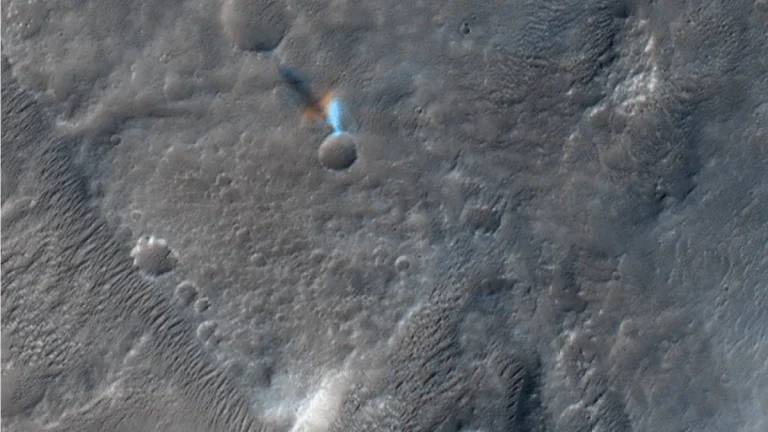
• Swirling dust devils expose hidden power of Martian winds

    For decades, spacecraft have photographed small spiraling columns of dust drifting across Mars. These dust devils form when sunlight heats the surface, causing warm air to rise through cooler layers and spin into tall, narrow vortices that can stretch hundreds of meters into the sky. The new study, led by Valentin Bickel from the University…
  • Discovery of water in 3I/ATLAS reveals chemistry shared across the galaxy

    A team of Auburn University physicists using NASA’s Neil Gehrels Swift Observatory has detected water’s ultraviolet fingerprint in interstellar comet 3I/ATLAS. The discovery, published on September 30, 2025, in The Astrophysical Journal Letters, marks the first confirmed ultraviolet detection of water from a comet that originated beyond our solar system.

  • Rogue planet devours its birth disk at record speed

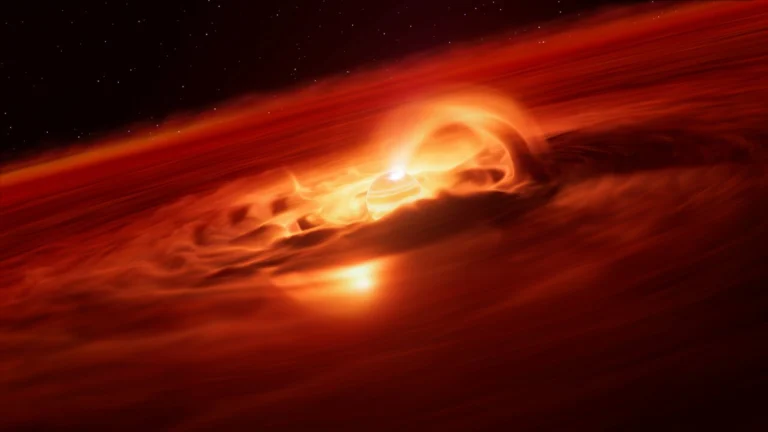
    Astronomers using the European Southern Observatory’s Very Large Telescope (VLT) in Chile confirmed an extraordinary accretion event in a free-floating planet known as Cha J11070768-7626326, or Cha 1107-7626. Located about 620 light-years (190 parsecs) away in the constellation Chamaeleon, this world is growing faster than any planet ever observed.

  • ESA’s Mars orbiters record interstellar comet 3I/ATLAS in once-in-a-lifetime encounter

    The European Space Agency’s (ESA) ExoMars Trace Gas Orbiter (TGO) and Mars Express spacecraft recorded images of interstellar comet 3I/ATLAS on October 3, 2025, from about 30 million km (18.6 million miles) away, marking the closest observation of the object from any spacecraft so far.