
This 700-m asteroid is spinning so fast it shouldn’t exist
Astronomers analyzing early commissioning data from the NSF–DOE Vera C. Rubin Observatory have identified the fastest-spinning asteroid ever confirmed at sizes larger than 500 m (0.3 miles). The object, designated 2025 MN45, was observed in April–May 2025 and reported in a peer-reviewed study published on January 7, 2026.
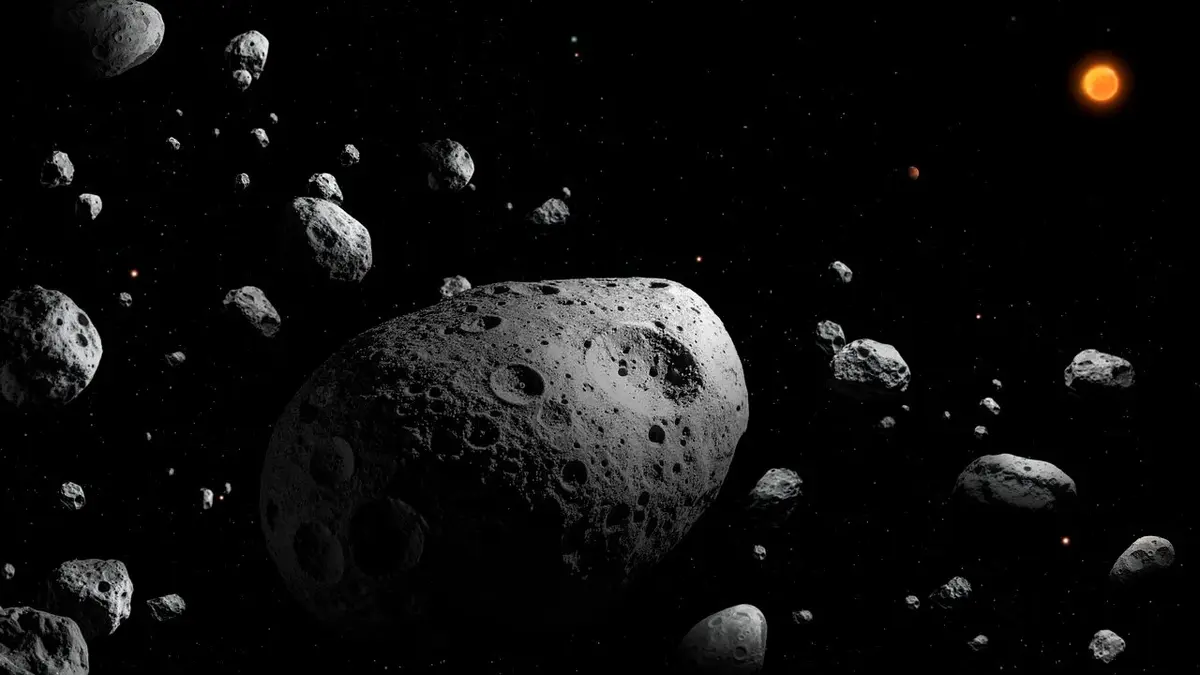
This artist’s illustration depicts 2025 MN45 — the fastest-rotating asteroid with a diameter over 500 meters that scientists have ever found. The asteroid is shown surrounded by many other asteroids, depicting its location within the main asteroid belt. The Sun and Jupiter are shown in the distance. Credit: NSF–DOE Vera C. Rubin Observatory/NOIRLab/SLAC/AURA/P. Marenfeld
Astronomers analyzing early commissioning data from the NSF–DOE Vera C. Rubin Observatory have identified the fastest-spinning asteroid ever reliably measured at sizes larger than 500 m (0.3 miles). The object, designated 2025 MN45, has an estimated diameter of about 710 m (0.44 miles) and completes one full rotation every 1.88 minutes, a speed far beyond what conventional asteroid models predict.
The discovery was made using observations collected in April and May 2025, months before Rubin’s main survey began. The results were published on January 7 in a peer-reviewed study and mark the first scientific paper to use data from the observatory’s LSST Camera, the largest digital camera ever built.
Among asteroids with well-sampled lightcurves and secure rotation measurements, no object of comparable size is known to rotate this fast. Earlier reports of extremely rapid rotators exist, but many rely on fragmentary observations and carry large uncertainties. In contrast, 2025 MN45 was observed hundreds of times across multiple nights and filters, allowing its rotation period to be confirmed with high confidence.
Rotation speed is a powerful probe of asteroid interiors. Most asteroids larger than a few hundred meters are thought to be rubble piles, loose collections of rocks held together mainly by gravity. For such bodies, there is a physical limit to how fast they can spin without flying apart. In the main asteroid belt between Mars and Jupiter, that limit corresponds to a rotation period of about 2.2 hours.
At 1.88 minutes, 2025 MN45 spins roughly 70 times faster than this gravitational limit. To survive such extreme rotation, the asteroid must possess substantial internal cohesion. Modeling presented in the study indicates that its strength must be comparable to solid rock rather than loosely bound debris. For comparison, rubble-pile asteroids are estimated to have strengths of tens to hundreds of pascals, lunar regolith reaches the kilopascal range, while solid rock has strengths measured in megapascals.
The estimated size of 2025 MN45 is derived from its brightness and assumes a typical geometric albedo of about 0.15, characteristic of common rocky asteroids. If its surface is significantly darker or more reflective, the true diameter could differ by roughly 20–30%. Even with that uncertainty, the asteroid remains far larger than most previously known ultra-fast rotators, which are typically tens to a few hundreds of meters across.
2025 MN45 is not an isolated case. The same dataset revealed 19 asteroids rotating faster than the traditional spin barrier. Of these, three complete a full rotation in less than five minutes. In total, the study reports reliable rotation periods for 76 asteroids drawn from more than 2 000 objects discovered during Rubin’s commissioning observations.
What makes this population especially striking is where it resides. Most previously known fast-spinning asteroids are near-Earth objects, which experience stronger thermal torques from sunlight that can gradually spin them up over time. The majority of the newly identified fast rotators, including 2025 MN45, orbit in the main asteroid belt. These bodies are generally older and more collisionally evolved, making the presence of large, ultra-fast rotators there particularly unexpected.
The discovery was enabled by the unusual observing cadence used during Rubin Observatory’s commissioning phase. Over roughly 10 hours spread across seven nights, the telescope repeatedly imaged the same region of sky with dense temporal sampling. This approach is ideal for detecting minute-scale brightness variations but is not representative of Rubin’s standard operations.
Rubin’s primary mission, the Legacy Survey of Space and Time, will repeatedly scan the southern sky over 10 years using a more regular and sparser cadence. While LSST will not typically capture such rapid rotations in a single week, the enormous volume of data collected over a decade is expected to reveal many more extreme objects statistically as observations accumulate.
All observations in this study were made with the LSST Camera, a 3.2-gigapixel instrument capable of imaging a 9.6 square degree field of view every 40 seconds. This combination of sensitivity, speed, and sky coverage allowed astronomers to measure subtle brightness changes in faint, distant asteroids that were previously beyond reach.
The existence of a large asteroid spinning once every two minutes challenges long-standing assumptions about asteroid structure and strength. It suggests that some asteroids retain coherent, rock-like interiors despite billions of years of collisions, or that certain impacts can produce unusually strong fragments capable of surviving extreme rotation.
Even before its main survey begins, Rubin Observatory has demonstrated its ability to uncover rare and unexpected objects within the Solar System. As full operations ramp up in 2026, astronomers expect many more discoveries that reshape our understanding of asteroid physics and the small-body population as a whole.
References:
1 NSF–DOE Vera C. Rubin Observatory spots record-breaking asteroid in pre-survey observations – SLAC – January 7, 2026
2 Lightcurves, Rotation Periods, and Colors for Vera C. Rubin Observatory’s First Asteroid Discoveries – Sarah Greenstreet, Zhuofu (Chester) Li, Dmitrii E. Vavilov, Devanshi Singh, Mario Jurić, Željko Ivezić, Siegfried Eggl, Alec Koumjian, Joachim Moeyens, Valerio Carruba – The Astrophysical Journal Letters – January 7, 2026 – https://iopscience.iop.org/article/10.3847/2041-8213/ae2a30 – OPEN ACCESS

I’m a science journalist and researcher at The Watchers, contributing to the Epicenter edition, where I cover peer-reviewed scientific research and emerging discoveries across Earth and space sciences. With a background in astronomy and a passion for environmental science, I’ve worked in shark and coral conservation in Fiji, conducting reef and shark-behavior research, contributing to mangrove restoration, and earning PADI Open Water and Coral Reef Certifications. I bring a blend of scientific rigor and storytelling to illuminate the discoveries shaping our planet and beyond.

Commenting rules and guidelines
We value the thoughts and opinions of our readers and welcome healthy discussions on our website. In order to maintain a respectful and positive community, we ask that all commenters follow these rules.