
Sudden debris cloud reveals new asteroid-scale collision around Fomalhaut
Astronomers using the NASA/ESA Hubble Space Telescope have identified the aftermath of two massive planetesimal collisions in the nearby Fomalhaut star system.
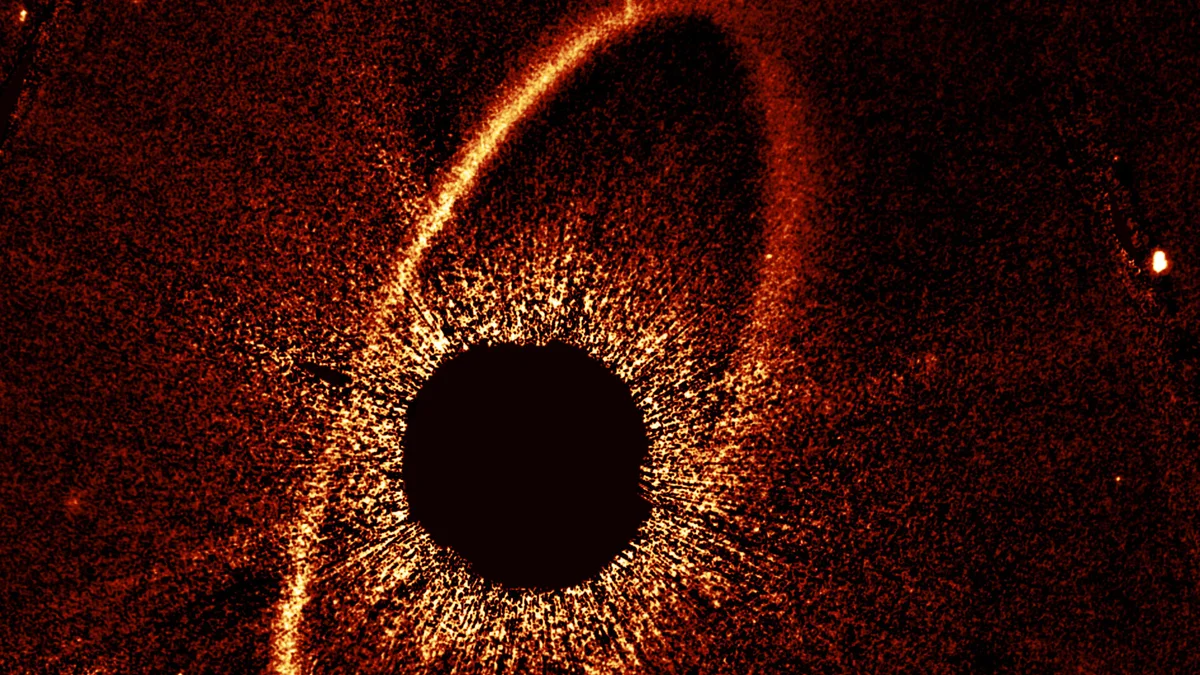
Fomalhaut cs1 and cs2. Credit: NASA, ESA, P. Kalas (UC Berkeley), J. DePasquale (STScI)
Astronomers have, for the first time, directly observed the aftermath of large asteroid-scale collisions occurring in an exoplanetary system.
Using long-term observations from the NASA/ESA Hubble Space Telescope, researchers identified a second expanding cloud of debris around the nearby star Fomalhaut, marking only the second such collision ever detected beyond the Solar System.
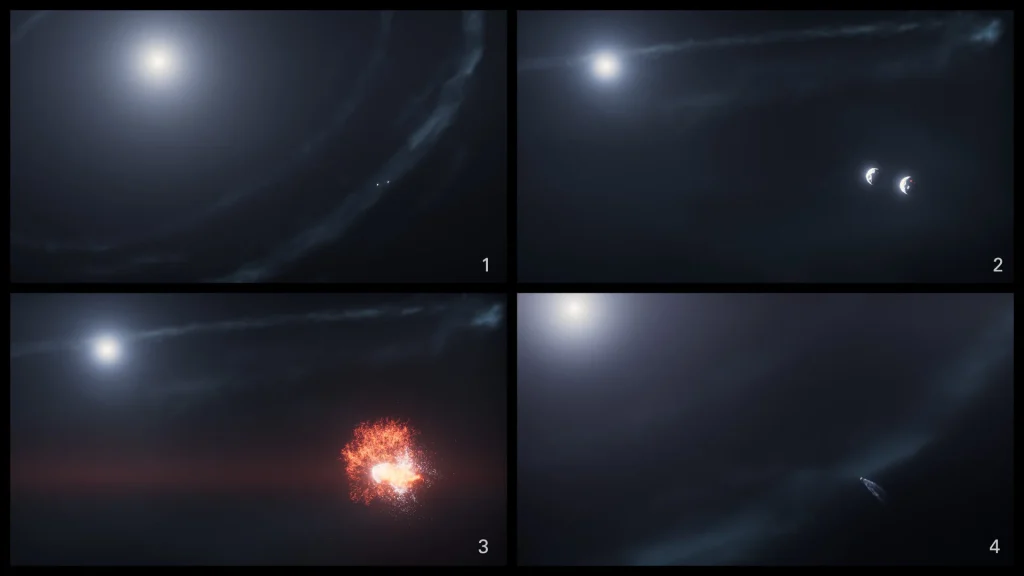
The newly detected object, dubbed circumstellar source 2 (cs2), appeared in Hubble images taken in 2023 and was absent in all earlier observations. Its sudden emergence strongly indicates a recent violent impact between two massive bodies. While the collision itself was not observed in real time, astronomers inferred the event from the abrupt appearance and subsequent expansion of the dust cloud between observation epochs.
“This is certainly the first time I’ve ever seen a point of light appear out of nowhere in an exoplanetary system,” said Paul Kalas of the University of California, Berkeley, the study’s principal investigator. He explained that the absence of the source in earlier data points to a recent collision that generated a vast cloud of reflective debris.
A nearby system in upheaval
Fomalhaut lies about 25 light-years from Earth and is one of the brightest stars visible in the southern sky. Located in the constellation Piscis Austrinus, also known as the Southern Fish, it is an A-type star that is more massive and more luminous than the Sun. The star is surrounded by several belts of dusty debris, forming one of the most well-defined debris disk systems known.
In 2008, astronomers using Hubble identified a candidate exoplanet orbiting Fomalhaut, making it the first stellar system with a possible planet detected in visible light. That object, known as Fomalhaut b, was later found to behave unlike a solid planet. Over time, its properties increasingly matched those of an expanding dust cloud rather than a gravitationally bound world.
Fomalhaut b is now interpreted as circumstellar source 1 (cs1), the debris produced by a collision between two large planetesimals roughly two decades ago. The discovery of cs2 in a similar orbital region provides compelling evidence that the system is experiencing repeated large-scale impacts.

Why two collisions so close together?
Both cs1 and cs2 are located near the inner edge of Fomalhaut’s outer debris disk, a broad ring of icy and rocky material orbiting tens of astronomical units from the star. One astronomical unit (AU) corresponds to about 150 million km (93 million miles).
If collisions between planetesimals were rare and randomly distributed, astronomers would expect such debris clouds to appear at unrelated locations across the disk. Instead, cs1 and cs2 are positioned unusually close to one another along the same portion of the debris belt, suggesting that the disk is dynamically disturbed.
Another puzzle is the short timescale over which the two events were observed. Previous theoretical models predicted that collisions energetic enough to generate visible debris clouds should occur only once every 100 000 years or longer in a mature debris disk.
“Here, in 20 years, we’ve seen two,” Kalas said. He added that if one could compress thousands of years of Fomalhaut’s history into a short time-lapse, the system would appear to sparkle with repeated flashes from collisions.
Echoes of the early Solar System
The level of activity seen around Fomalhaut resembles conditions thought to have existed in the Solar System during its first few hundred million years. During that period, gravitational interactions among the giant planets likely destabilized populations of planetesimals, triggering frequent collisions and reshaping planetary orbits.
Events such as the collision thought to have formed the Moon and the intense bombardment recorded on the Moon’s surface point to a violent early epoch. Observing similar processes in another system provides a rare external reference for models of Solar System evolution.
Fomalhaut may therefore represent a system caught in a transitional phase, where large populations of planetesimals are still being ground down through collisions rather than having settled into long-term stability.
What the debris clouds reveal
By analyzing the brightness, expansion rate, and orbital motion of cs1 and cs2, astronomers were able to estimate the properties of the original colliding bodies. Both debris clouds are consistent with impacts involving planetesimals approximately 30 km (19 miles) in diameter.
Objects of this size release enormous amounts of energy when they collide at orbital speeds of several km/s (a few miles/s). The resulting debris can remain detectable for decades as it slowly disperses, reflecting starlight and expanding outward under radiation pressure.
From the observed collision rate, the researchers inferred that the Fomalhaut debris disk may contain around 300 million similar-sized planetesimals. Such a vast population helps explain why collisions appear far more frequent than earlier models predicted.
A natural laboratory for planet formation
Because collisions expose the interior material of planetesimals, systems like Fomalhaut offer a unique opportunity to study the composition and structure of the building blocks of planets. The properties of the dust clouds provide indirect clues about what these objects are made of and how they formed.
Mark Wyatt of the University of Cambridge, a co-author of the study, described Fomalhaut as a natural laboratory for probing how planetesimals behave during collisions. These observations allow researchers to constrain not only sizes and numbers, but also the physical processes governing debris production and evolution.
Such information is extremely difficult to obtain by other means, as intact planetesimals are far too small and faint to observe directly at interstellar distances.
A caution for exoplanet hunters
The transient nature of cs1 and cs2 also carries important lessons for future exoplanet imaging missions. Dust clouds produced by large impacts can closely mimic the appearance of planets reflecting starlight, particularly in visible wavelengths.
“Fomalhaut cs2 looks exactly like an extrasolar planet reflecting starlight,” Kalas said. The long-lived nature of cs1 demonstrated that a dust cloud can masquerade as a planet for many years before its true nature becomes clear.
As future space telescopes aim to directly image Earth-sized planets, distinguishing between solid worlds and impact-generated debris will require careful analysis, multi-wavelength observations, and long-term monitoring.
Watching the system evolve
Astronomers have been granted additional Hubble observing time to track the evolution of cs2 over the next three years. They will monitor changes in its brightness, shape, and orbit as the debris cloud expands.
Because cs2 lies closer to the debris belt than cs1, it is more likely to encounter additional material. Such interactions could trigger an avalanche of secondary dust production, temporarily brightening the surrounding region of the disk.
Radiation pressure from Fomalhaut’s intense starlight is also expected to influence the cloud’s structure. Smaller dust grains are pushed outward more strongly than larger ones, potentially stretching the debris into an oval or comet-like shape over time.
Webb’s complementary view
The team also plans to observe cs2 using the Near-Infrared Camera (NIRCam) aboard the NASA/ESA/CSA James Webb Space Telescope. While Hubble observes primarily in visible light, Webb’s infrared sensitivity will allow astronomers to probe different aspects of the dust.
NIRCam can provide color information that reveals the size distribution and composition of the grains, including whether they contain water ice or other volatile materials. These measurements will help determine where in the disk the planetesimals formed and how their composition compares to icy bodies in the Solar System.
Together, Hubble and Webb offer a rare multi-spectral view of an actively evolving debris system, providing an unprecedented window into the processes that shape planetary systems over time.
References:
1 Hubble sees asteroids colliding around nearby star – ESA – December 18, 2025
2 A second planetesimal collision in the Fomalhaut system – Paul Kalas et al. – Science – December 18, 2025 – DOI: 10.1126/science.adu6266

I’m a science journalist and researcher at The Watchers, contributing to the Epicenter edition, where I cover peer-reviewed scientific research and emerging discoveries across Earth and space sciences. With a background in astronomy and a passion for environmental science, I’ve worked in shark and coral conservation in Fiji, conducting reef and shark-behavior research, contributing to mangrove restoration, and earning PADI Open Water and Coral Reef Certifications. I bring a blend of scientific rigor and storytelling to illuminate the discoveries shaping our planet and beyond.

“Radiation pressure”. Is that a term used by some to encompass nett ionising, non-ionising, vacuum field force, on what matter? But there’s variable permittivity, permeability, density refraction on any given two-dimensional area, then add a dynamic, charge-separated environment and with what tensor and space-time metric assumptions, including ‘gravity’ propagation.
Any electrostatic forces mentioned in the Cambridge paper? Dust, static, hard vacuum, high entropy low-equilibrium regimen local system, rotation and also galactic-plane considerations come to mind. Consider the dust on a vinyl record.
Yes, good JWST spectroscopy but of course. 99% of observed matter is plasma, hopefully we are beyond ‘it’s all about collisions, because gravity’.
Anyone seeing the ontological link between how gravity was conceived, then dark matter and dark energy circular-reasoning; but in a beautiful Universal natural simplicity, it’s all fields, interaction and projection with the medium, as above so below, Hermes had it, echoing from ‘the time before’, keep Watching. Thank you, Reet.