
SPHEREx delivers the most detailed infrared portrait of the entire sky
NASA’s SPHEREx space observatory completed its first all-sky infrared mosaic, six months after beginning systematic observations from Earth orbit, delivering the most spectrally detailed panoramic view of the universe ever produced.
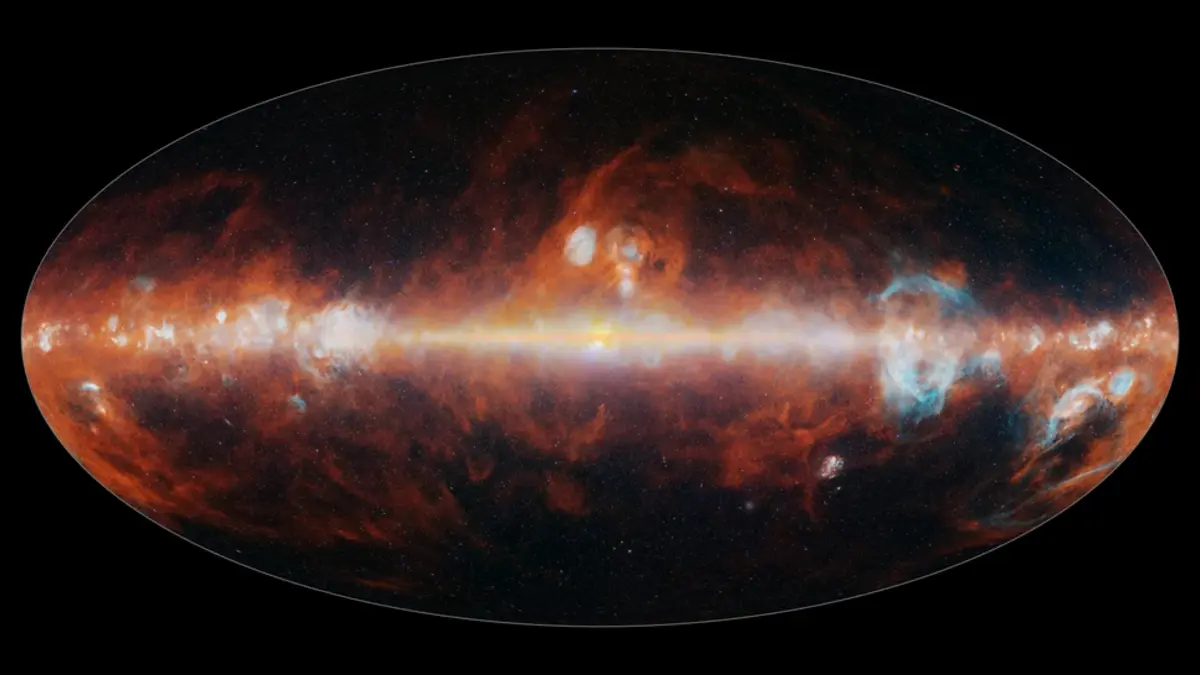
NASA’s SPHEREx has mapped the entire sky in 102 infrared colors, which are invisible to the human eye but can be used to reveal different features of the cosmos. This image features a selection of colors emitted primarily by stars (blue, green, and white), hot hydrogen gas (blue), and cosmic dust (red). Credit: NASA/JPL-Caltech
NASA’s SPHEREx observatory has completed its first full infrared mosaic of the entire sky, marking a major milestone for space astronomy. Finished in December 2025, the map represents six months of continuous observations and captures the universe in 102 distinct infrared wavelengths.
Rather than focusing on selected regions, SPHEREx observes every direction in space with the same instrument, sensitivity, and calibration. The result is a uniform spectral atlas that astronomers can use as a baseline for research across cosmology, galaxy evolution, and star formation.
The infrared sky revealed by SPHEREx looks radically different from optical views. Hot hydrogen gas dominates some regions, colder dust structures emerge in others, and stellar light becomes prominent where dust is sparse. These variations are tied directly to physical conditions in space rather than visual appearance.
Because the observations are repeated on a regular cadence, the map is not static. It is the first layer of a growing archive that will deepen with each additional all-sky scan, increasing sensitivity and scientific reach over time.
The mission is led by NASA and managed by the Jet Propulsion Laboratory in Southern California, with data made freely available to researchers and the public.
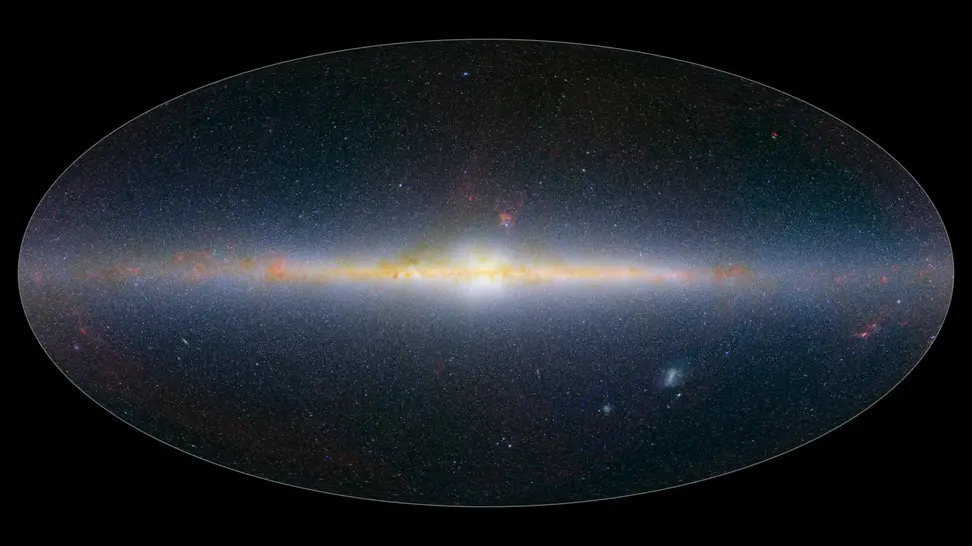
Seeing the universe through 102 infrared colors
Each of the 102 colors measured by SPHEREx corresponds to a narrow wavelength band in the infrared portion of the spectrum. Every band highlights different astrophysical processes, allowing scientists to separate overlapping structures that appear blended in conventional images.
Dense molecular clouds where stars and planets form glow strongly in specific infrared wavelengths while remaining invisible in others. Older stellar populations dominate different bands, and distant galaxies imprint subtle spectral signatures that shift with cosmic expansion.
This technique is known as spectroscopy, the process of breaking light into its component wavelengths. What makes SPHEREx unusual is that it applies spectroscopy uniformly across the entire sky rather than to isolated targets.
Earlier missions, such as Wide-field Infrared Survey Explorer, mapped the sky in infrared light but used only a small number of broad bands. At the other extreme, the James Webb Space Telescope provides extremely detailed spectra over very small fields of view.
SPHEREx bridges this gap by trading fine spatial detail for global coverage and rich spectral information, enabling science that depends on statistics and scale rather than individual objects.
How SPHEREx scans the entire sky
SPHEREx operates in a low Earth polar orbit, circling the planet about 14.5 times each day. Its orbit carries it from north to south over the poles, allowing the telescope to sweep long, continuous strips of sky.
During each orbit, the observatory collects thousands of exposures. On average, it records about 3 600 images per day along a single circular band of the sky. As Earth moves along its orbit around the Sun, the location of that band gradually shifts.
After roughly six months, this scanning pattern results in complete coverage of the celestial sphere, amounting to a full 360-degree view in all directions. This method ensures even coverage and minimizes observational gaps.
Routine sky mapping began in May 2025, and the first all-sky mosaic was assembled in December. Over its two-year primary mission, SPHEREx will repeat this process three more times, allowing the maps to be combined into deeper and more sensitive datasets.
A telescope designed for speed and scale
The ability to map the sky so quickly comes from SPHEREx’s distinctive optical design. The observatory uses six infrared detectors, each paired with a filter that contains a gradient of 17 wavelength bands.
As incoming light passes through these filters, different wavelengths fall onto different parts of each detector. This means that every single exposure captures all 102 spectral channels at once, rather than cycling through filters sequentially.
In practical terms, every all-sky map produced by SPHEREx is actually 102 overlapping maps, each highlighting a different slice of the infrared spectrum. This dramatically increases efficiency and ensures consistent spectral coverage.
Mission engineers designed this approach to maximize information return while keeping the spacecraft compact and stable. The result is a mid-sized mission capable of producing data volumes usually associated with much larger observatories.
NASA officials have described SPHEREx as an example of how focused design choices can unlock broad scientific capability without the complexity of flagship-class missions.
Mapping galaxies in three dimensions
One of SPHEREx’s most important scientific objectives is to measure distances to hundreds of millions of galaxies. While many of these galaxies are already known from optical surveys, most have only been mapped in two dimensions.
By analyzing how spectral features shift across its 102 infrared bands, SPHEREx can estimate galaxy distances and reconstruct their three-dimensional distribution across cosmic space. This enables precise measurements of how galaxies cluster on the largest scales.
The pattern of that clustering carries information about conditions in the early universe. Small variations reflect physical processes that occurred shortly after the Big Bang and influenced how matter later assembled.
Among these processes is cosmic inflation, a brief event during which the universe expanded by a trillion-trillionfold in an unimaginably short time. Although inflation cannot be observed directly, its fingerprints remain embedded in the large-scale structure of galaxies.
SPHEREx provides a new way to search for those fingerprints by combining vast sky coverage with consistent spectral measurements.
Tracing cosmic history and the ingredients for life
Beyond cosmology, SPHEREx offers insights into how galaxies evolved over the universe’s nearly 14 billion-year history. Infrared light is particularly sensitive to older stars and dust-obscured star formation, both of which are essential for understanding long-term galaxy growth.
Because the entire sky is observed with the same instrument, SPHEREx data avoid many systematic differences that complicate comparisons between separate surveys. This uniformity strengthens statistical studies of galaxy populations across time.
Closer to home, the mission also maps key compounds within the Milky Way. Many of the building blocks of planets and life exist as ice coating dust grains in cold molecular clouds.
Infrared spectroscopy can identify these ices, including water and simple organic molecules, even in regions where visible light cannot penetrate. Mapping their distribution provides a galaxy-wide inventory of where life-forming materials are concentrated.
This context helps guide future observations by more targeted missions, linking local chemical environments to the broader structure of the galaxy.
A foundation for decades of discovery
SPHEREx is designed as a community resource rather than a single-purpose experiment. Its datasets are released openly, allowing researchers worldwide to combine them with observations from other telescopes.
NASA officials have emphasized that the mission effectively produces 102 new maps of the entire sky, each containing unique information. This makes the archive relevant to nearly every field of astronomy.
As additional all-sky scans are completed, sensitivity will increase, and new phenomena will emerge. Subtle features that are invisible in the first map may become detectable as data are stacked and refined.
With its combination of global coverage, spectral richness, and open access, SPHEREx establishes a new reference frame for infrared astronomy. Its first cosmic map is not an endpoint but the foundation for a wide range of discoveries yet to come.
References:
1 NASA’s SPHEREx Observatory Completes First Cosmic Map Like No Other – NASA – December 18, 2025

I’m a science journalist and researcher at The Watchers, contributing to the Epicenter edition, where I cover peer-reviewed scientific research and emerging discoveries across Earth and space sciences. With a background in astronomy and a passion for environmental science, I’ve worked in shark and coral conservation in Fiji, conducting reef and shark-behavior research, contributing to mangrove restoration, and earning PADI Open Water and Coral Reef Certifications. I bring a blend of scientific rigor and storytelling to illuminate the discoveries shaping our planet and beyond.

Commenting rules and guidelines
We value the thoughts and opinions of our readers and welcome healthy discussions on our website. In order to maintain a respectful and positive community, we ask that all commenters follow these rules.