
Cloud-9 exposes a long-hidden population of starless dark matter relics
Astronomers using the NASA and European Space Agency Hubble Space Telescope have confirmed the first known starless, gas rich object dominated by dark matter, identifying Cloud-9 as a relic of early galaxy formation near the spiral galaxy Messier 94.
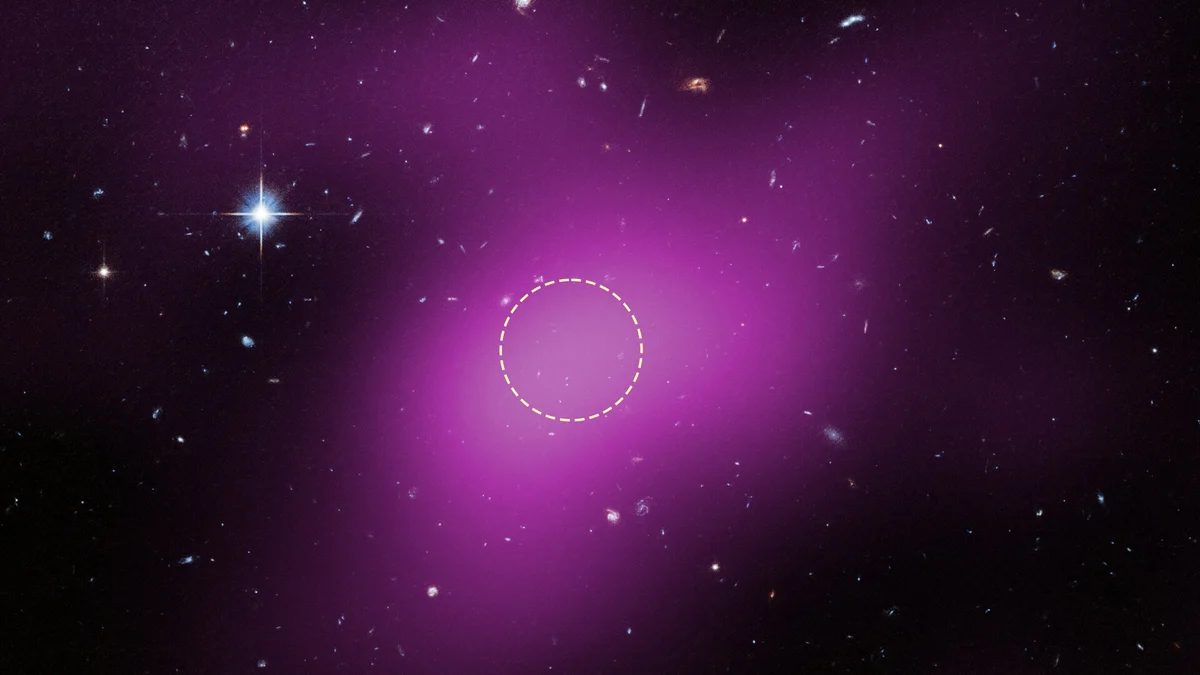
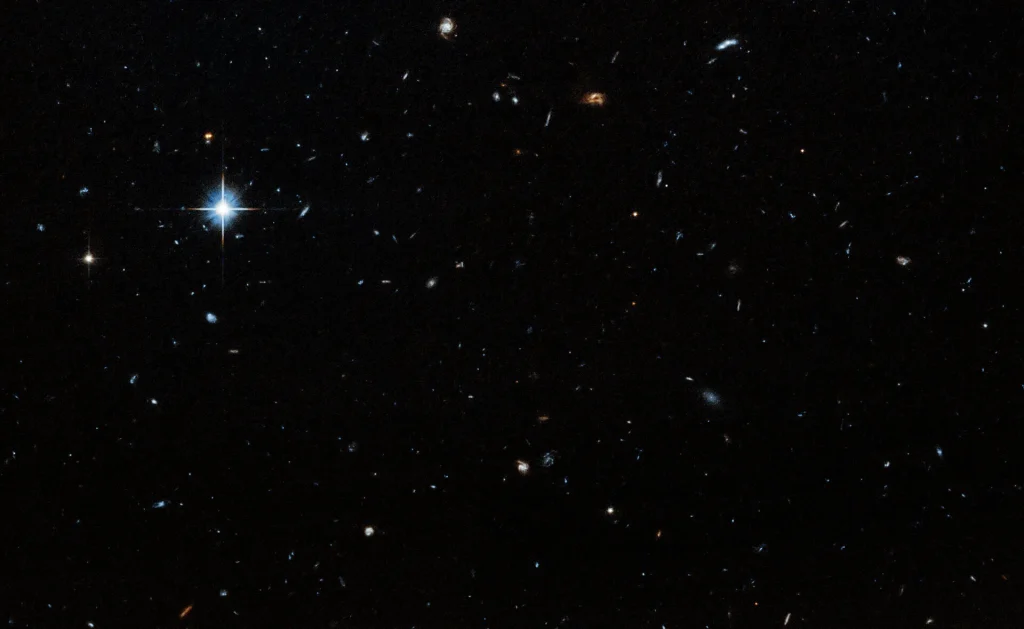
This image shows the location of Cloud-9, which is 2000 light-years from Earth. The diffuse magenta is radio data from the ground-based Very Large Array (VLA) showing the presence of the cloud. The dashed circle marks the peak of radio emission,which is where researchers focused their search for stars. Follow-up observations by the NASA/ESA Hubble Space Telescope’s Advanced Camera for Surveys found no stars within the cloud. The few objects that appear within its boundaries are background galaxies. Before the Hubble observations, scientists could argue that Cloud-9 is a faint dwarf galaxy whose stars could not be seen with ground-based telescopes due to the lack of sensitivity. Hubble’s Advanced Camera for Surveys shows that, in reality, the failed galaxy contains no stars. Credit: NASA, ESA. G. Anand (STScI), and A. Benitez-Llambay (Univ. of Milan-Bicocca); Image processing: J. DePasquale (STScI)
Astronomers using the NASA and the Hubble Space Telescope have confirmed the first known example of a completely starless, gas-rich object dominated by dark matter. The object, nicknamed Cloud-9, represents a relic of early galaxy formation that never became a galaxy, offering direct observational evidence for a long-standing prediction of modern cosmology.
“This is a tale of a failed galaxy,” said Alejandro Benitez-Llambay of the University of Milano-Bicocca in Italy, the study’s principal investigator. “In science, we usually learn more from the failures than from the successes. In this case, seeing no stars is what proves the theory right. It tells us that we have found in the local universe a primordial building block of a galaxy that hasn’t formed.”
Cloud-9 contains large amounts of neutral hydrogen gas but shows no evidence of any stellar population, even under the deepest scrutiny. This absence of stars is not due to observational limits. Hubble’s Advanced Camera for Surveys was able to probe deep enough to detect extremely faint stellar systems, definitively ruling out the possibility that Cloud-9 is simply a dim dwarf galaxy.
“This cloud is a window into the dark universe,” said Andrew Fox of the Association of Universities for Research in Astronomy and the Space Telescope Science Institute, speaking on behalf of ESA. “We know from theory that most of the mass in the universe is expected to be dark matter, but it’s difficult to detect this dark material because it doesn’t emit light. Cloud-9 gives us a rare look at a dark-matter-dominated cloud.”
The object belongs to a predicted class known as reionization-limited H I clouds, or RELHICs. The term H I refers to neutral hydrogen, while reionization-limited describes the physical process that prevented these objects from forming stars. After the early universe was flooded with intense ultraviolet radiation during cosmic reionization, only dark matter halos above a critical mass could cool their gas and ignite star formation. Halos just below that threshold retained gas but never formed stars, remaining dark for billions of years.
Cloud-9 appears to sit precisely in this narrow mass range. Radio observations show that its neutral hydrogen core is compact, cold, and nearly spherical, with a diameter of about 4 900 light-years. The total hydrogen mass is roughly 1 million times the mass of the Sun. Gas alone cannot hold such a structure together. When researchers modeled the balance between gas pressure and gravity, they found that Cloud-9 must be embedded in a dark matter halo with a mass of about 5 billion solar masses.
This makes Cloud-9 fundamentally different from most hydrogen clouds observed near the Milky Way, which tend to be larger, irregular, and shaped by local galactic processes. Cloud-9 is smaller, more symmetrical, and dynamically calm, with a narrow hydrogen line width of about 12 km/s (7 miles/s). These properties are consistent with gas resting in hydrostatic equilibrium inside a dark matter halo rather than being debris or a transient structure.
The cloud lies near the outskirts of the nearby spiral galaxy Messier 94 at a distance of about 4.4 megaparsecs, roughly 14 million light-years, from Earth. Its recession velocity closely matches that of M94, strongly indicating a physical association. High-resolution radio data reveal subtle distortions in the gas, suggesting interaction with the galaxy’s surrounding environment, possibly through ram-pressure effects.
“Among our galactic neighbors, there might be a few abandoned houses out there,” said Rachael Beaton of STScI, a member of the research team. The analogy reflects the nature of Cloud-9 as a structure that has mass, gas, and coherence, yet lacks the stars that normally define a galaxy.
Cloud-9 was first identified three years ago during a blind hydrogen survey conducted with the Five-hundred-meter Aperture Spherical Telescope in Guizhou, China. Follow-up observations with the Green Bank Telescope and the Very Large Array confirmed its compact radio signature. At that stage, astronomers could not rule out a faint stellar system. Only Hubble’s deep optical imaging made it possible to demonstrate conclusively that the object contains no stars.
Despite its evocative name, Cloud-9 carries no symbolic or cultural meaning. The designation was purely sequential, assigned as the ninth gas cloud cataloged during the FAST survey near Messier 94. Any association with the Western expression is coincidental.
The findings were published in The Astrophysical Journal Letters and presented at a press conference during the 247th meeting of the American Astronomical Society in Phoenix. Together, the radio and optical observations make Cloud-9 the most compelling example yet of a reionization-limited H I cloud.
Cloud-9 shows that galaxies are only part of the cosmic story. Vast numbers of dark matter halos are expected to exist without stars, invisible to traditional surveys that rely on starlight. By combining radio astronomy with deep space-based imaging, astronomers are now beginning to detect these missing structures directly. It stands as the first confirmed glimpse of this hidden population, preserving a fossil record of galaxy formation that stalled before it could begin.
References:
1 The First RELHIC? Cloud-9 is a Starless Gas Cloud – Gagandeep S. Anand, Alejandro Benítez-Llambay, Rachael Beaton, Andrew J. Fox, Julio F. Navarro, and Elena D’Onghia – The Astrophysical Journal Letters – November 10, 2025 – https://iopscience.iop.org/article/10.3847/2041-8213/ae1584 – OPEN ACCESS
2 Cloud-9: a new celestial object found by Hubble – ESA – January 5, 2026

I’m a science journalist and researcher at The Watchers, contributing to the Epicenter edition, where I cover peer-reviewed scientific research and emerging discoveries across Earth and space sciences. With a background in astronomy and a passion for environmental science, I’ve worked in shark and coral conservation in Fiji, conducting reef and shark-behavior research, contributing to mangrove restoration, and earning PADI Open Water and Coral Reef Certifications. I bring a blend of scientific rigor and storytelling to illuminate the discoveries shaping our planet and beyond.

Commenting rules and guidelines
We value the thoughts and opinions of our readers and welcome healthy discussions on our website. In order to maintain a respectful and positive community, we ask that all commenters follow these rules.