
JWST reveals the first confirmed runaway supermassive black hole
Astronomers using the James Webb Space Telescope have confirmed the first known case of a supermassive black hole expelled from its host galaxy, identifying a fast moving object generating a supersonic bow shock in a galaxy system about 8.8 billion light years away.
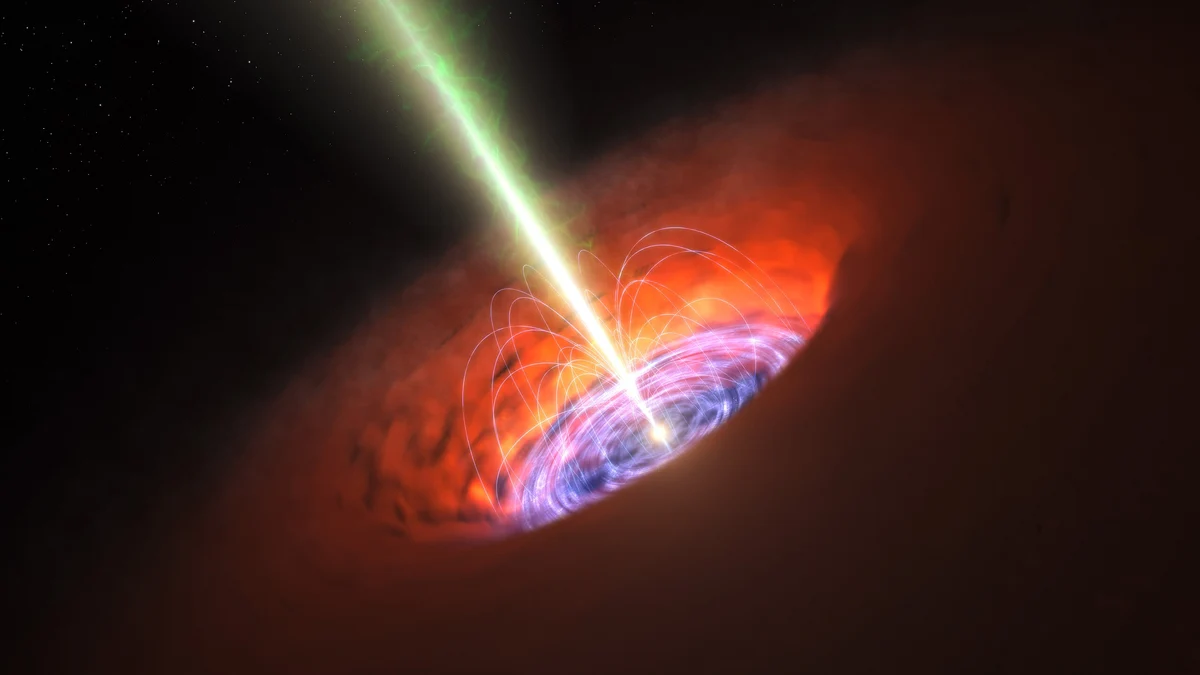
This artist’s impression shows the surroundings of a supermassive black hole, typical of that found at the heart of many galaxies. The black hole itself is surrounded by a brilliant accretion disc of very hot, infalling material and, further out, a dusty torus. There are also often high-speed jets of material ejected at the black hole’s poles that can extend huge distances into space. Observations with ALMA have detected a very strong magnetic field close to the black hole at the base of the jets and this is probably involved in jet production and collimation. Credit: ESO/L. Calçada
For more than 50 years, theoretical studies have argued that supermassive black holes can escape their host galaxies under extreme conditions. These ideas were widely accepted in simulations but lacked direct observational confirmation. Until now, every candidate could also be explained by more conventional galactic structures.
The new JWST observations change that situation decisively. The study identifies a compact object moving at extreme speed through circumgalactic gas and producing signatures that cannot be replicated by any known galaxy-scale process. The evidence is no longer circumstantial.
At the heart of the discovery is a uniquely sharp velocity pattern observed at the tip of a long linear structure. The data show behavior expected only when gas is shocked by a fast-moving massive object rather than orbiting under gravity.
This result marks a turning point in astrophysics. A long-standing prediction about the fate of black holes during galaxy mergers has moved from theory into direct observation.
A velocity signature gravity cannot produce
The most decisive observation is a velocity gradient of about 600 km/s (370 miles/s) across a region only 1 km (0.6 miles) wide. This gradient was measured using JWST’s NIRSpec Integral Field Unit, which maps motion and composition of gas simultaneously.
If this velocity pattern were caused by gravity alone, the central object would need to have a mass of about 10 billion–100 billion solar masses. That mass is far larger than what the host galaxy can support and far beyond any known black hole in such an environment.
Because of this, the study rules out multiple alternative explanations. The structure cannot be an edge-on galaxy, a stripped dwarf galaxy, tidal debris, or gas bound to a stationary black hole. None of these scenarios can reproduce the observed kinematics.
By eliminating these possibilities, the analysis leaves only one viable explanation. A compact object is moving supersonically through diffuse gas, compressing it violently and producing the observed velocity structure.
A bow shock that seals the case
When an object moves faster than the speed of sound through a medium, it generates a bow-shaped shock front. This phenomenon is well known in aerodynamics and stellar astrophysics and has a distinctive geometry and velocity pattern.
JWST resolved a curved shock structure exactly at the leading edge of the linear feature. Gas at this location shows abrupt changes in velocity, ionization state, and temperature that match models of a strong supersonic bow shock.
Behind the shock, the gas flows downstream into a narrow wake where pressure is lower. The morphology and motion of this gas align precisely with predictions for a massive object plowing through the circumgalactic medium.
The presence of a resolved bow shock transforms the interpretation from suggestive to conclusive. No static or gravitationally bound system can generate this combination of structure and motion.
A black hole moving at extreme speed
By modeling the geometry of the bow shock and the observed gas velocities, researchers derived the speed of the object responsible. The runaway black hole is moving at approximately 950 km/s (590 miles/s).
The trajectory is tilted about 30° toward Earth rather than lying flat in the plane of the sky. This orientation explains both the projected length of the wake and the observed velocity pattern along it.
This speed exceeds typical escape velocities of large galaxies. Once accelerated to this velocity, the black hole could no longer remain bound to its original host.
Such extreme speeds strongly support gravitational wave recoil as the ejection mechanism. Asymmetric emission of gravitational waves during a black hole merger naturally produces velocity kicks of this magnitude.
A wake that creates stars far from galaxies
The long linear structure trailing the black hole is not inert debris. It is an active environment where new stars are forming tens of thousands of light-years away from any galaxy.
Gas pressure drops sharply behind the bow shock. Shocked circumgalactic gas cools rapidly, condenses, and accumulates in the wake of the moving black hole.
Turbulent mixing continuously feeds fresh material into this low-pressure region. Over tens of millions of years, dense clumps form and collapse under their own gravity.
Observations show regions dominated by shock-excited emission alongside areas powered by young stars. This demonstrates that star formation can proceed far outside traditional galactic disks under the right physical conditions.
Confirmation of a 50-year-old prediction
Theoretical work in the early 1970s showed that black holes could receive powerful velocity kicks during mergers. These ideas were grounded in conservation of momentum and gravitational dynamics, but could not be tested observationally at the time.
This discovery provides direct validation of those predictions. It demonstrates that black hole mergers can have long-lasting and large-scale consequences for galaxy evolution.
The result also connects electromagnetic astronomy with gravitational wave physics. The same processes that generate gravitational wave signals detected today can eject black holes entirely from galaxies.
Although the event occurred billions of years ago, it confirms that gravitational wave recoil is not a rare theoretical curiosity but a real and influential cosmic process.
An invisible black hole revealed through motion
Despite the dramatic effects, the black hole itself is not directly visible. There is no bright point source of radiation from accretion at its location.
X-ray and radio observations show no strong active nucleus associated with the object. Instead, all detected emission arises from gas shocked and heated by motion.
The bow shock is powered by kinetic energy rather than radiation. This is why JWST’s spatially resolved spectroscopy was essential for the discovery.
By mapping gas velocities and ionization states in detail, astronomers inferred the presence of the black hole without ever seeing it directly.
A preview of discoveries to come
If one runaway supermassive black hole has been found, others likely exist. Most would be extremely difficult to detect without high-resolution, high-sensitivity observations.
Future wide-field surveys by Euclid and the Nancy Grace Roman Space Telescope will provide ideal data sets for systematic searches.
Identifying more examples would allow astronomers to measure how often black holes are ejected and how fast they travel. This would place new constraints on galaxy merger rates and black hole growth.
The confirmation of this first runaway object opens an entirely new observational window on one of the most extreme outcomes of cosmic evolution.
References:
1 JWST Confirmation of a Runaway Supermassive Black Hole via its Supersonic Bow Shock – Pieter van Dokkum et al. – Arxiv – December 3, 2025 – https://doi.org/10.48550/arXiv.2512.04166 – OPEN ACCESS

I’m a science journalist and researcher at The Watchers, contributing to the Epicenter edition, where I cover peer-reviewed scientific research and emerging discoveries across Earth and space sciences. With a background in astronomy and a passion for environmental science, I’ve worked in shark and coral conservation in Fiji, conducting reef and shark-behavior research, contributing to mangrove restoration, and earning PADI Open Water and Coral Reef Certifications. I bring a blend of scientific rigor and storytelling to illuminate the discoveries shaping our planet and beyond.

Commenting rules and guidelines
We value the thoughts and opinions of our readers and welcome healthy discussions on our website. In order to maintain a respectful and positive community, we ask that all commenters follow these rules.