
Two massive space rock collisions detected around Fomalhaut
Hubble Space Telescope observations have identified two transient debris clouds produced by separate planetesimal collisions in the Fomalhaut planetary system, located about 25 light-years from Earth, with the second event detected in 2023. The findings indicate that objects previously interpreted as candidate exoplanets are instead the dusty aftermath of rare, high-energy impacts within the system’s debris belt.
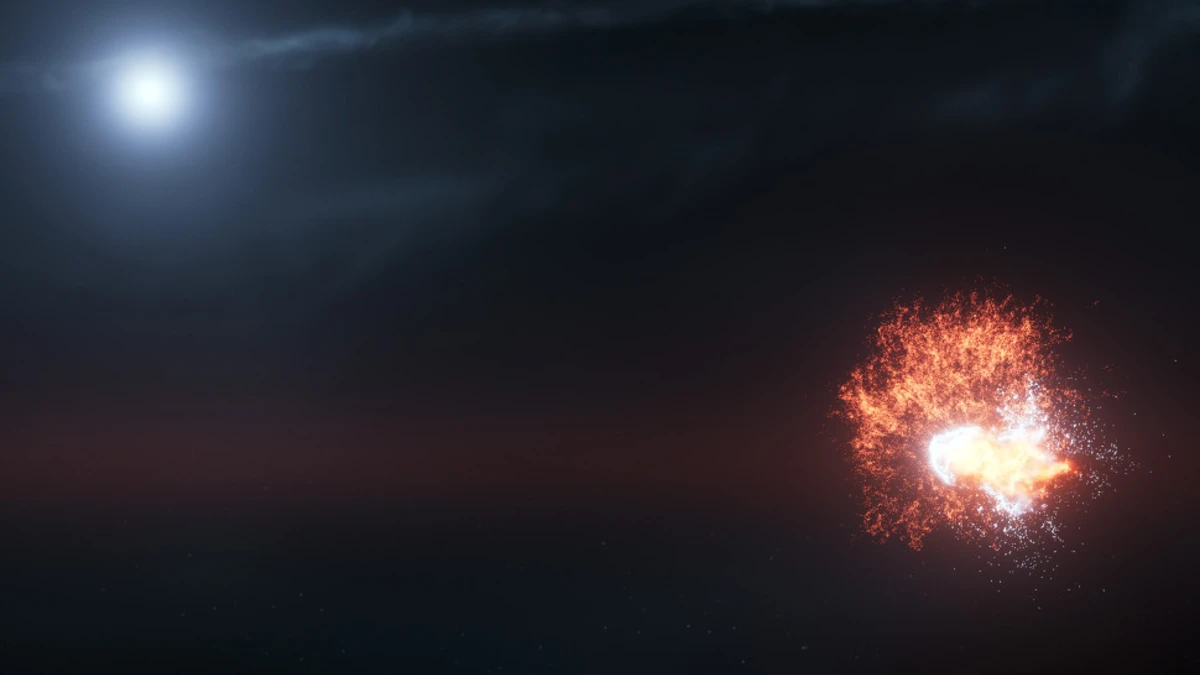
This artist’s concept shows the violent collision of two massive objects in orbit around the star Fomalhaut. Credit: NASA, ESA, STScI, Ralf Crawford (STScI)
Observations from the Hubble Space Telescope have captured the aftermath of two separate planetesimal collisions in the debris disk surrounding the nearby star Fomalhaut. The system lies at a distance of approximately 25 light-years from Earth in the constellation Piscis Austrinus and is known for its extensive and dynamically active dust belts.
The first transient source, historically labeled Fomalhaut b, was initially interpreted as a potential exoplanet when it was detected in 2004. Subsequent observations showed the object fading and eventually disappearing, behavior inconsistent with a planetary body. Analysis suggested it was instead an expanding cloud of dust produced by a high-velocity collision between two planetesimals.
In 2023, a second point source appeared in a different location within the same debris belt. The new source exhibited brightness and positional characteristics closely resembling the earlier detection of Fomalhaut b, indicating a similar origin. Researchers designated the two sources as Fomalhaut cs1 and Fomalhaut cs2, interpreting both as impact-generated debris clouds.
According to the study team, such collisions between large planetesimals are expected to occur on timescales of 100 000 years or longer in debris disks like Fomalhaut’s. Detecting two events within roughly 20 years provides a rare observational constraint on collision rates and dynamical processes within young planetary systems.
The debris clouds are thought to consist of fine dust particles produced when rocky bodies tens of kilometers in size collided at high relative velocities. As the dust expands, it reflects starlight, temporarily mimicking the appearance of a planet in direct imaging observations.
The findings also highlight a potential challenge for exoplanet imaging campaigns. Large, long-lived dust clouds can masquerade as planets for extended periods, complicating the interpretation of reflected-light detections around nearby stars.
Follow-up observations are planned using the James Webb Space Telescope. Its Near-Infrared Camera is expected to provide spectral and color information unavailable to Hubble, allowing researchers to constrain dust grain size, composition, and the presence of volatiles such as water ice within the debris clouds.
The study was supported by the National Aeronautics and Space Administration and provides the first confirmed detection of multiple planetesimal collisions observed in real time outside the Solar System.
References:
1 Cosmic crash caught on camera – Northwestern News – December 18, 2025

I’m a science journalist and researcher at The Watchers, contributing to the Epicenter edition, where I cover peer-reviewed scientific research and emerging discoveries across Earth and space sciences. With a background in astronomy and a passion for environmental science, I’ve worked in shark and coral conservation in Fiji, conducting reef and shark-behavior research, contributing to mangrove restoration, and earning PADI Open Water and Coral Reef Certifications. I bring a blend of scientific rigor and storytelling to illuminate the discoveries shaping our planet and beyond.

Commenting rules and guidelines
We value the thoughts and opinions of our readers and welcome healthy discussions on our website. In order to maintain a respectful and positive community, we ask that all commenters follow these rules.