
New class of exoplanet orbiting a red-dwarf star discovered via Hubble Space Telescope
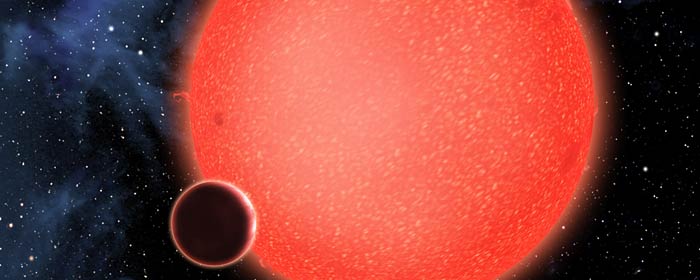
Image credit: NASA, ESA / D. Aguilar (Harvard-Smithsonian Center for Astrophysics) (Artist representation)
Observations made by the NASA/ESA Hubble Space Telescope have come up with a new class of planet, a waterworld enshrouded by a thick, steamy atmosphere. It’s smaller than Uranus but larger than Earth.
An international team of astronomers led by Zachory Berta of the Harvard-Smithsonian Center for Astrophysics (CfA) made the observations of the planet GJ 1214b.
“GJ 1214b is like no planet we know of,” Berta said. “A huge fraction of its mass is made up of water.”
The ground-based MEarth Project, led by CfA’s David Charbonneau, discovered GJ 1214b in 2009. This super-Earth is about 2.7 times Earth’s diameter and weighs almost seven times as much. It orbits a red-dwarf star every 38 hours at a distance of 2 million kilometres, giving it an estimated temperature of 230 degrees Celsius.
Berta and his co-authors, who include Derek Homeier of ENS Lyon, France, used Hubble’s Wide Field Camera 3 (WFC3) to study GJ 1214b when it crossed in front of its host star. During such a transit, the star’s light is filtered through the planet’s atmosphere, giving clues to the mix of gases.
“We’re using Hubble to measure the infrared colour of sunset on this world,” Berta explained.
Hazes are more transparent to infrared light than to visible light, so the Hubble observations help to tell the difference between a steamy and a hazy atmosphere.
They found the spectrum of GJ 1214b to be featureless over a wide range of wavelengths, or colours. The atmospheric model most consistent with the Hubble data is a dense atmosphere of water vapour.
Since the planet’s mass and size are known, astronomers can calculate the density, of only about 2 grams per cubic centimetre. Water has a density of 1 gram per cubic centimetre, while Earth’s average density is 5.5 grams per cubic centimetre. This suggests that GJ 1214b has much more water than Earth does, and much less rock.
As a result, the internal structure of GJ 1214b would be extraordinarily different from that of our world.
“The high temperatures and high pressures would form exotic materials like ‘hot ice’ or ‘superfluid water’, substances that are completely alien to our everyday experience,” Berta said.
 Hubblesite.org
Technical facts:
| About the Object |
|
Theorists expect that GJ 1214b formed further out from its star, where water ice was plentiful, and migrated inward early in the system’s history. In the process, it would have passed through the star’s habitable zone, where surface temperatures would be similar to Earth’s. How long it lingered there is unknown.
GJ 1214b is located in the constellation of Ophiuchus (The Serpent Bearer), and just 40 light-years from Earth. Therefore, it’s a prime candidate for study by the NASA/ESA/CSA James Webb Space Telescope, planned for launch later this decade.
Learn more: Hubblesite.org

Teo Blašković founded The Watchers in 2011 and edited it until 2026, covering seismic and volcanic activity, extreme weather, space weather and near-Earth objects. Articles on this page are his archive.
Earlier reporting
Nothing on Watchers was published in the last 24 hours. These are older articles.
- Right about now, Voyager 1 is crossing a line no human-made object has ever reached, a full light-day from Earth, which means a message NASA sends tonight won't arrive until tomorrow night, and the spacecraft's answer won't make it home until the night after that
- On October 22, 2017, a single flash of lightning stretched 515 miles from eastern Texas to near Kansas City, a distance that takes eight hours to drive, and nobody realized how far it had gone until scientists went back through the satellite data years later Epicenter
- CPC posts a slight risk of heavy rain from the Gulf Coast to the Northeast urban corridor November 25-29, and a moderate risk of West Coast wind and Sierra snow on November 25
- Florida's east coast faces a moderate flash flood risk Wednesday through Friday, with 4 to 8 inches of rain forecast and the St. Johns River near Cocoa already in major flood at 17.13 feet

It is good to “see” as far as 40 l.y, but we are far from the Sun about 8 l.min. How can that happen to this day science does not know what causes the Earth’s own spin. All previous allegations are invalid and unscientific. All based only on illogical assumptions. Show me where my dominion published mathematical proof of the cause.
Here’s something for mathematicians, physicists and astronomers. Help me solve my equation to calculate the eccentricity of the planet. It is invariant and for the Earth it corresponds on five decimals. Try!
Here’s the formula:
ln {[(1 + e) / (1-e)] ^ [(1-e ^ 2) / (1-e)]} = 1
where e is the eccentricity-