
Hurricane Isaias leaves at least six dead, hundreds of thousands without power after Florida landfall
At least six people died after Hurricane Isaias made landfall near Destin, Florida, as a Category 2 hurricane at about 20:30 LT on October 9 (01:30 UTC on October 10). Approximately 408 000 customer accounts remained without power across Florida, Alabama, Georgia and Mississippi shortly before 13:00 UTC on October 11, while the post-tropical cyclone continued producing flooding and wind hazards farther northeast.
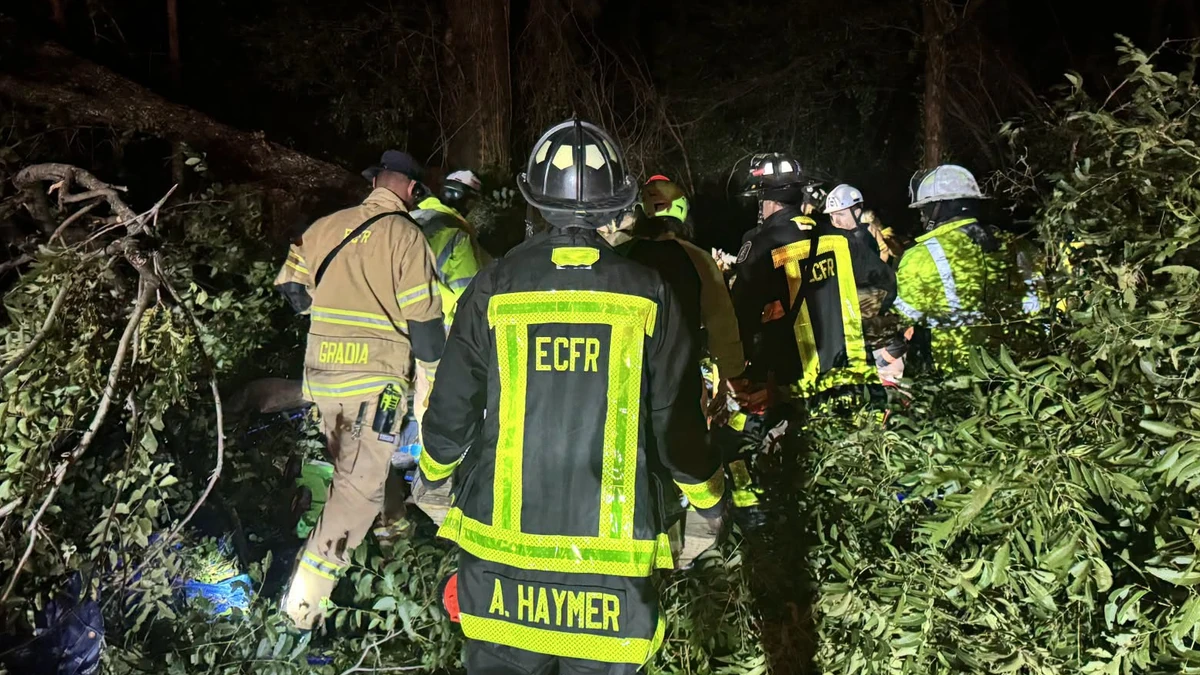
Fire operatives clearing trees downed Escambia County following Hurricane Isaias's landfall near Destin , Florida on October 9, 2026. Credit: Escambia County Fire and Rescue
Two deaths were confirmed in Escambia County, Florida. A woman died when a tree fell on her home, while a man died from carbon-monoxide poisoning after a generator was operated inside a garage.
Four members of the man’s family, ranging in age from 4 to 72, were taken to hospitals with injuries that were not considered life-threatening.
In Alabama, one person died after a tree fell on a home in Birmingham’s Huffman area. A second storm-related death occurred in a vehicle crash involving a downed tree in Barbour County, according to the Alabama Emergency Management Agency.

At 12:55 UTC on October 11, PowerOutage.us showed 407 517 tracked customer accounts without power across four states. The total included 320 053 in Florida, 76 503 in Alabama, 8 995 in Georgia and 1 966 in Mississippi.
The figures represent a live snapshot and will change as utilities restore service and revise their reports.
Florida officials said nearly 400 Florida State Guard personnel had been deployed for route clearance, damage assessments, logistics and other recovery operations. Utility crews continued working to restore electricity across the hardest-hit communities.
In a 19:30 LT update on October 10, Pensacola and Escambia County officials said a precautionary boil-water notice remained in effect. Water service had been restored to three local hospitals and Pensacola Beach, while Pensacola International Airport was scheduled to resume regular commercial service on October 11.

The National Hurricane Center said Isaias made landfall near 30.4°N 86.5°W with maximum sustained winds of 165 km/h (105 mph) and a minimum central pressure of 971 hPa. The center crossed the coast about 65 km (40 miles) east of Pensacola and 80 km (50 miles) west-northwest of Panama City while moving north at 31 km/h (19 mph).
A NOAA National Ocean Service gauge at Panama City Beach measured a water level of 1.7 m (5.6 feet) above mean higher high water around landfall. NHC described the measurement as an approximation of inundation at that location.
The strongest observed winds were concentrated across the western Florida Panhandle. A WeatherFlow station near Santa Rosa Sound measured sustained winds of 146 km/h (91 mph) and a gust of 187 km/h (116 mph), while a WeatherSTEM station near Pensacola recorded a gust of 161 km/h (100 mph).
A preliminary NWS Mobile report listed a peak gust of 188 km/h (117 mph) about 5 km (3 miles) east-southeast of Oriole Beach. Gusts reached 187 km/h (116 mph) at Santa Rosa Sound and 183 km/h (114 mph) at Milton.

Heavy rainfall produced significant flash flooding across parts of the western Florida Panhandle. During the storm, NWS Mobile estimated 203–305 mm (8–12 inches) of rain across parts of Okaloosa and Walton counties, with peak rates of 76–127 mm/h (3–5 inches/h).
A Preliminary report issued on October 10 listed 294 mm (11.56 inches) of rainfall near Mary Esther, 245 mm (9.65 inches) near Shalimar and 244 mm (9.6 inches) near Valparaiso due to the Hurricane. A Flash Flood Emergency was issued for southern and coastal Okaloosa County during the storm.
At 04:00 LT (09:00 UTC) on October 11, the Weather Prediction Center placed Post-Tropical Cyclone Isaias near 35.4°N 85.9°W, about 105 km (65 miles) southeast of Nashville, Tennessee. Maximum sustained winds were 35 km/h (25 mph), minimum pressure was 1 010 hPa, and the system was moving northeast at 37 km/h (23 mph).
Flood Watches remained in effect for coastal portions of the Carolinas and the Blue Ridge of the central and southern Appalachians. Wind Advisories covered parts of the southeastern United States and southern Appalachians.
WPC forecast an additional 25–76 mm (1–3 inches) of rain, with localized totals near 127 mm (5 inches), across the central Appalachians and Mid-Atlantic. Isolated flash and urban flooding remained possible, while significant river flooding in the western Florida Panhandle was expected to crest on October 11.
A couple of tornadoes were possible across the Piedmont and Coastal Plain of Virginia and North Carolina. Strong wind gusts also remained possible across the southern Appalachians, particularly over elevated terrain.
Isaias became the first hurricane of the 2026 Atlantic season on October 7. NOAA’s National Environmental Satellite, Data, and Information Service said its formation marked the latest first Atlantic hurricane of a season on record since at least 1905, when that season’s first hurricane also formed on October 7.
Update
October 14, 2026
Florida Governor Ron DeSantis said on October 13 that six storm-related deaths had been confirmed in Florida, raising the minimum documented toll across Florida and Alabama from four to at least eight. Alabama authorities had previously reported two deaths.
Florida’s total included the two Escambia County fatalities reported above and four additional deaths associated with post-storm or secondary effects. DeSantis described the additional cases as a tree-related accident during cleanup, a vehicle crash at an intersection where the traffic signal was not operating, and storm-related interruptions to the medical treatment of two people.
The combined toll is based on separate state reports and may change as authorities continue reviewing storm-related deaths.
The Executive Office of the Governor said power had been restored to 95% of customers in areas affected by Isaias after nearly 450 000 outages at the height of the storm. Eleven points of distribution were operating across Escambia, Santa Rosa, Walton and Washington counties, supplying water, shelf-stable meals, ice, tarps and other essential items.
Approximately 2 013 Florida National Guard soldiers and airmen remained activated across the impact area. Their missions included search and rescue, route clearance, ground and air reconnaissance, humanitarian assistance, flood mitigation and protection of critical infrastructure.
Florida officials said all state-owned bridges had been inspected and were open, while 98% of traffic signals in the storm-affected area were operational. All commercial-service airports and seaports in the state were also open.
References:
1 Hurricane Isaias Tropical Cyclone Update – NOAA/NHC – October 9, 2026
2 Highest Wind Reports, preliminary – NWS – October 10, 2026
3 Hurricane Isaias 24-hour precipitation reports, preliminary – NWS – October 10, 2026

I am an Assistant Editor and Severe Weather & Science Journalist at The Watchers, specializing in real-time severe weather coverage, geophysical event reporting, and research-driven scientific analysis. You can reach me at rishav(at)watchers(.)news.

Commenting rules and guidelines
We value the thoughts and opinions of our readers and welcome healthy discussions on our website. In order to maintain a respectful and positive community, we ask that all commenters follow these rules.