
Cedar Canyon Fire burns 251 ha (620 acres) near Hitchcock, Oklahoma, injures 5
A wind-driven wildfire ignited near Hitchcock in Blaine County, Oklahoma, at approximately 14:30-15:30 LT on March 26, 2026, burning 251 ha (620 acres) and reaching 70% containment by March 29. The fire, caused by a rekindled permitted burn, injured multiple firefighters and prompted localized evacuations that were later lifted.
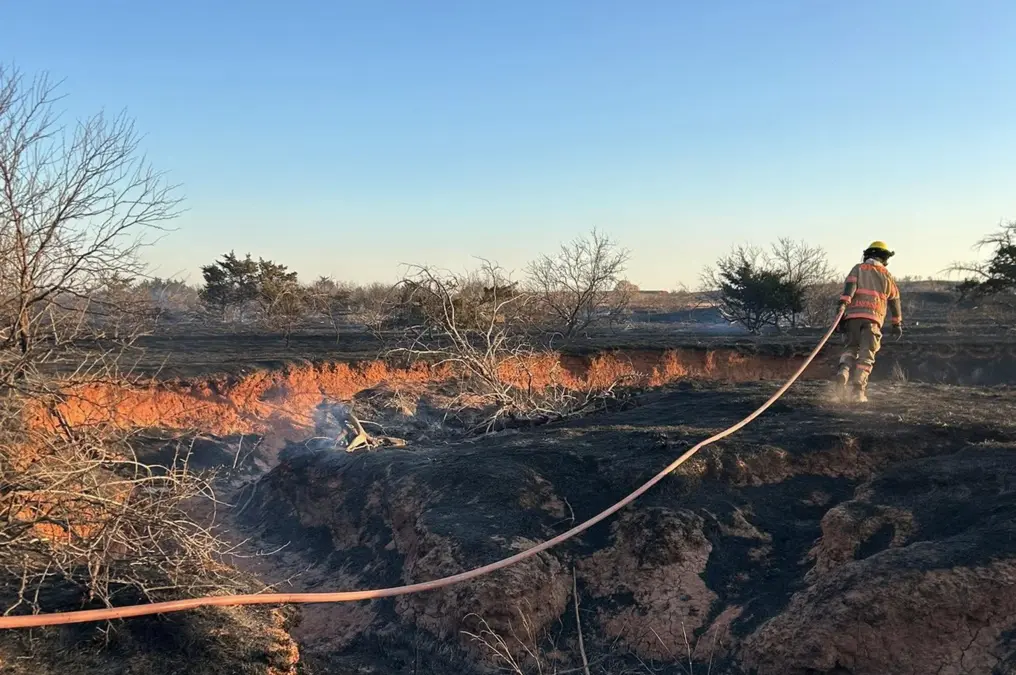
Image credit: Dillon Nickel/Blaine County
The Cedar Canyon Fire ignited at approximately 14:30–15:30 LT on March 26, in Blaine County, Oklahoma, about 4.8–6.4 km (3–4 miles) north of Hitchcock and roughly 10 km (6 miles) southwest of Okeene. The fire originated from a rekindled permitted controlled burn, according to the Oklahoma Department of Agriculture, Food and Forestry (ODAFF) / Oklahoma Forestry Services (OFS).
The fire spread through grass and rangeland fuels under warm, dry, and windy conditions. Winds exceeding 50 km/h (30 mph) and temperatures in the low 30s°C (upper 80s to low 90s°F) supported rapid fire spread and resistance to control during initial attack.
By March 28, the fire had burned 251 ha (620 acres) and reached 70% containment. Fire growth was no longer reported, and crews shifted to mop-up and patrol operations.
The response was led by Oklahoma Forestry Services, supported by task forces from Kingfisher, Logan, and Major counties. Heavy equipment was used to establish fire breaks, and aerial resources from the Oklahoma National Guard supported suppression efforts on March 26–27. Multiple homes were successfully protected during suppression operations. No structure losses were reported in official state summaries.
Five firefighters were reported injured during operations on March 27 in official situation reports. Injuries included a cardiac event requiring air evacuation, burn injuries requiring transport to a burn center, a head injury, and minor heat-related injuries.
Support operations included the American Red Cross, which provided food and supplies to responders, and Pafford Medical Services, which supported on-scene medical care and transport. Localized evacuations were issued on March 26 as the fire advanced under wind-driven conditions and were later lifted as containment improved.
The Cedar Canyon Fire developed during a broader wildfire outbreak across Oklahoma on March 26. In Blaine County, the Coyote Fire near Greenfield prompted additional evacuations and a multi-agency response. Other fires reported by Oklahoma Emergency Management included the Fairlawn Fire near Cushing and the Charter Oak Fire near Meridian in Logan County.
Additional large fires reported by OFS during the same period included the Big Toe Fire in Pittsburg County, which burned 489 ha (1 208 acres) and reached 90% containment; the Old Kentucky Fire in Sequoyah County at 288 ha (712 acres) with 85% containment; the Buffalo Pasture Fire in Adair County at 164 ha (406 acres) with 75% containment; and the Coleman Hollow Fire in Mayes County at 42 ha (104 acres) with 90% containment.
Statewide fire conditions remained elevated through March 28–29 due to dry fuels and continued warm, breezy weather. Fine-dead fuel moisture dropped to 2–5% in parts of northwestern Oklahoma, increasing ignition potential and suppression difficulty.
Fire weather conditions were forecast to persist early in the week of March 30, with wind gusts potentially exceeding 65 km/h (40 mph) across western and north-central Oklahoma. A cold front expected on March 31 may bring rainfall, primarily to eastern Oklahoma, with uncertain impact on fire conditions in central and western areas.
An Interagency Fuels and Fire Behavior Advisory remained in effect across Oklahoma and neighboring states. Initial attack success remained high, although conditions continued to support large fire potential.
References:
1 Fire Situation Report – ODAFF – March 29, 2026

I’m a science journalist and researcher at The Watchers, contributing to the Epicenter edition, where I cover peer-reviewed scientific research and emerging discoveries across Earth and space sciences. With a background in astronomy and a passion for environmental science, I’ve worked in shark and coral conservation in Fiji, conducting reef and shark-behavior research, contributing to mangrove restoration, and earning PADI Open Water and Coral Reef Certifications. I bring a blend of scientific rigor and storytelling to illuminate the discoveries shaping our planet and beyond.

Commenting rules and guidelines
We value the thoughts and opinions of our readers and welcome healthy discussions on our website. In order to maintain a respectful and positive community, we ask that all commenters follow these rules.