
Widespread flooding and landslides affect 2 million people across northern Morocco
Severe flooding and landslides triggered by a series of Atlantic storms since late January 2026 have killed 43 people and displaced around 300 000 across northern Morocco. The hardest-hit areas include Sahel al-Gharb, Fez-Meknes, and the Rabat-Salé-Kénitra corridor, where heavy rainfall and overflowing rivers inundated 110 000 ha (272 000 acres) of farmland and damaged infrastructure.
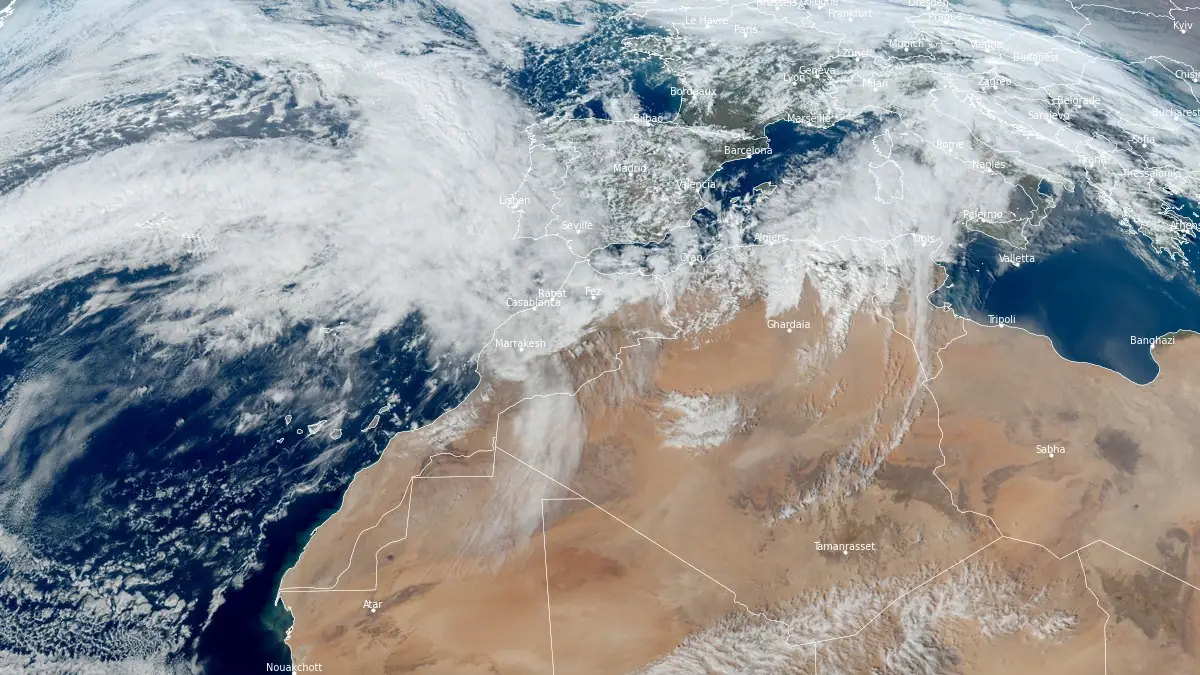
Storm Leonardo satellite image acquired at 14:10 UTC on February 3, 2026. Credit: EUMETSAT/Meteosat, RAMMB/CIRA, The Watchers
A series of strong Atlantic low-pressure systems brought intense rainfall to northern and central Morocco between late January and mid-February 2026, triggering widespread floods and landslides.
According to the International Federation of Red Cross and Red Crescent Societies (IFRC), the events resulted in 43 fatalities, 23 injuries, and the displacement of approximately 300 000 people, affecting around 2 million individuals nationwide, as of February 12.
The heaviest impacts were recorded across the Sahel al-Gharb plain and the Fez-Meknes region, as well as the Rabat-Salé-Kénitra corridor around Ksar el-Kebir. Further south, coastal communities near Safi experienced flash floods and landslides as heavy rain fell on saturated ground.
Flooding was exacerbated by the overflow of the Loukkos and Oued El Makhazine rivers, which inundated low-lying farmland and disrupted transport routes. Local authorities reported roughly 110 000 ha (272 000 acres) of agricultural land under water.
The Government of Morocco declared the worst-affected provinces disaster zones and launched a 3 billion dirham (USD 330 million) recovery plan to restore infrastructure, support displaced families, and rehabilitate damaged crops. France 24 described the flooding as the worst Morocco has experienced since 2010.
Floods were caused by a series of deep Atlantic lows tracking eastward toward the western Mediterranean, bringing persistent moist air and repeated rainfall bursts over northern Morocco. The storms produced accumulated precipitation well above seasonal averages and triggered secondary hazards such as slope failures and infrastructure erosion in hilly terrain.
According to regional meteorological data, several locations recorded three-day rainfall totals comparable to the entire monthly mean.
Morocco has experienced several major floods of comparable scale in the past. The March 2010 Gharb plain floods displaced over 60 000 people and inundated 90 000 hectares (222 000 acres) of farmland. In December 2025, floods in Safi killed 37 people after record rainfall and coastal runoff inundated residential areas. Earlier events in the Tangier region in 2023 caused urban flooding but fewer casualties.

I'm a dedicated researcher, journalist, and editor at The Watchers. With over 20 years of experience in the media industry, I specialize in hard science news, focusing on extreme weather, seismic and volcanic activity, space weather, and astronomy, including near-Earth objects and planetary defense strategies. You can reach me at teo /at/ watchers.news.

Commenting rules and guidelines
We value the thoughts and opinions of our readers and welcome healthy discussions on our website. In order to maintain a respectful and positive community, we ask that all commenters follow these rules.