
Victoria sets new all-time temperature record of 48.9°C (120°F) amid severe heatwave, Australia
Temperatures across southeastern Australia reached record levels on January 27, 2026, with the Bureau of Meteorology confirming a new all-time high of 48.9°C (120°F) at Walpeup and Hopetoun in Victoria. The readings surpassed the previous state record of 48.8°C (119.8°F) set in 2009, amid severe to extreme heatwave conditions extending across Victoria, South Australia, and inland New South Wales.
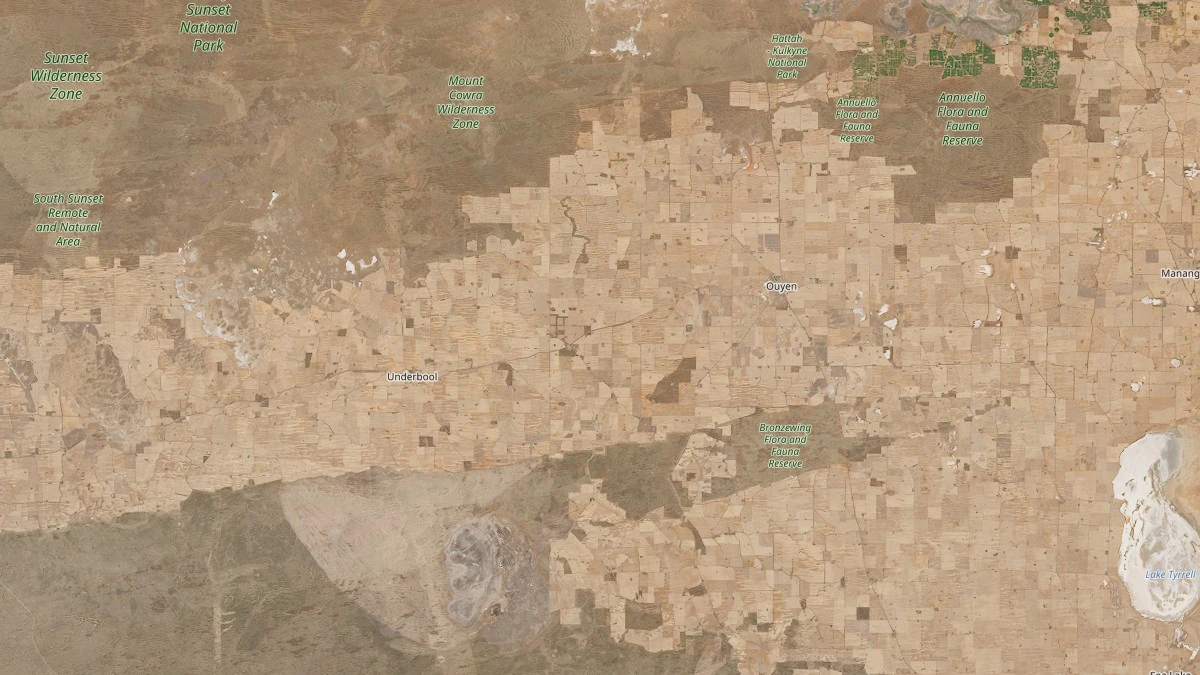
Satellite image showing clear-sky conditions over northwestern Victoria, centered on Walpeup, on January 27, 2026. Credit: Copernicus EU/Sentinel-2, The Watchers
The Bureau of Meteorology (BoM) confirmed Victoria recorded its highest observed temperature on record on January 27, when 48.9°C (120°F) was measured at both Walpeup and Hopetoun in the state’s northwest. The values exceeded the previous Victorian record of 48.8°C (119.8°F), registered at Hopetoun on February 7, 2009.
Statewide BoM data showed maximum temperatures exceeding 45°C (113°F) across large parts of the Mallee and Wimmera districts, with many locations registering their highest values in more than a decade.
In South Australia, Ceduna reached 49.5°C (121°F), setting a new all-time record for that location, while Renmark peaked at 49.6°C (121°F). Similar extremes were recorded across inland New South Wales and southwestern Queensland, where several towns reported maximums between 45 and 48°C (113–118°F). Overnight temperatures remained unusually high in many areas, providing limited relief from the persistent heat.
The heatwave is being driven by a stationary high-pressure ridge over central Australia, which has maintained clear skies and light northerly airflow, transporting hot continental air southward into Victoria and New South Wales.
Forecast guidance released by the Bureau before the peak of the event indicated that the northern Victorian districts could experience near-record maximums approaching 49°C (120°F), which were later confirmed by observation.

BoM’s heatwave warning bulletins for this period classified conditions as “severe to extreme” across southeastern Australia, while maps released on January 26 showed extensive regions of extreme heatwave severity from South Australia’s Riverland and Mallee into northwestern Victoria and southwestern New South Wales.
Maximum temperatures are expected to remain well above average for several days, with extreme fire danger ratings in multiple districts. Authorities are urging residents to be aware of the risk of heat stress, fire danger, and the need to follow health and safety recommendations.
A change in weather is on the horizon, but BoM is still focusing on very high temperatures, elevated fire dangers, peaking in Victoria and South Australia, and extreme levels in some areas.
A particular concern is a large bushfire in the Otway Ranges National Park. “We are seeing that bushfire today, and that could expand quite significantly with temperatures reaching the mid 40s [C], as well as those gusty winds coming through from the north and then from the south-west,” meteorologist Jonathan How said.

Conditions along the southern coast are forecast to moderate on Wednesday, January 28, with maximum temperatures near 23°C (73°F) in Melbourne and around 31–33°C (88–91°F) in Adelaide. Further north, where the cool change is not expected to extend, extreme heat is forecast to persist, with temperatures reaching up to 50°C (122°F) across parts of outback Queensland.

Teo Blašković founded The Watchers in 2011 and edited it until 2026, covering seismic and volcanic activity, extreme weather, space weather and near-Earth objects. Articles on this page are his archive.
Published in the last 24 hours
- Weather radar tracked meteorites falling into Cape Cod Bay after a 1.1-kiloton fireball over Massachusetts on 30 May 2026; researchers have now traced its orbit almost out to Jupiter. Epicenter
- 10 named storms, one hurricane for the first time since 1925: Why has the Atlantic been so quiet in 2026 Epicenter
- Amazon fire hotspots rise 82.6% in October 2026 as El Niño intensifies Epicenter
- In 2005, a driver near Russia's Chulyshman River picked up a stone to wedge under his car wheel and kept it for 20 years; the Meteoritical Bulletin has now approved it as the Altai Republic's first meteorite. Epicenter
