
EF-2 tornado hits downtown Geneva, Alabama, strongest since December 2000
An EF-2 tornado struck the city of Geneva in southeastern Alabama on January 25, 2026, causing structural damage across parts of the city and nearby areas. This is the strongest tornado to hit the area since December 2000.
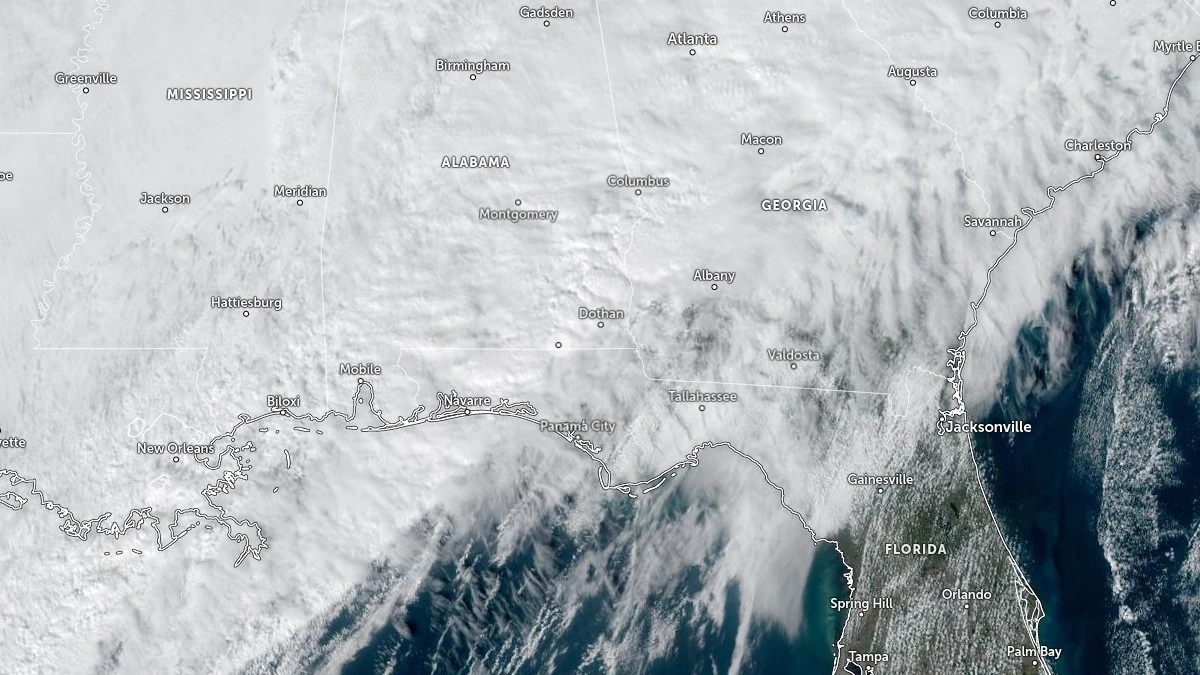
Satellite image centered over Geneva, Alabama, at 19:30 UTC (13:30 CST) on January 25, 2026, showing the storm system that produced the EF-2 tornado affecting the city. Credit: NOAA/GOES-East, Zoom Earth, The Watchers
A damaging tornado struck the city of Geneva, Alabama, at 13:29 CST (19:29 UTC) on January 25, as severe thunderstorms impacted portions of southeastern Alabama and the western Florida Panhandle. The event was part of a convective system that generated multiple tornadoes across the region during the early afternoon.
According to the National Weather Service (NWS) office in Tallahassee, the tornado in Geneva County was rated EF-2 on the Enhanced Fujita scale, with estimated peak winds of 185 km/h (115 mph). The tornado remained on the ground for about 4 minutes, producing a 5.9 km (3.66 miles) path with a maximum width of 823 m (900 yards).
The tornado first touched down in a western Geneva neighborhood, causing EF-1 damage between Campbell and Magnolia Avenues. EF-2 damage occurred downtown along Commerce Street, where roofing material was peeled from three adjacent low-rise buildings. After crossing a swampy area, a large number of trees were snapped on both sides of the State Route 52 bridge over the Choctawhatchee River.
The tornado continued eastward, causing sporadic damage along McDougald Street, Spring Creek Road, and East County Road 4 before lifting near Spring Creek. Both EF-2 damage points corresponded to maximum estimated winds of 185 km/h (115 mph).
Damage indicators along the track included partial roof loss to well-built structures, snapped and uprooted trees, and localized structural impacts consistent with EF-2 intensity. Power outages occurred across parts of the city, with line crews working through the evening to restore service. No fatalities or injuries were reported.
The Geneva tornado was one of four confirmed by NWS Tallahassee during the January 25 outbreak. An EF-1 tornado in northeast Houston County, Alabama, produced winds of 142 km/h (88 mph) and remained on the ground for 14.2 km (8.80 miles) between Pleasant Plains and Columbia.
Another, brief EF-0 tornado developed in southwest Houston County near Madrid, lifting the roof of a manufactured home before dissipating. Farther south, an EF-1 tornado occurred in Walton County, Florida, with peak winds of 153 km/h (95 mph) and a 1.8 km (1.09 mile) track.
The previous tornado comparable to the January 25 EF-2 in the area occurred on December 16, 2000, when an F2 twister moved through the Devco and Bellwood communities in Geneva County.
That tornado remained on the ground for about 8 km (5 miles) and reached a maximum width of around 90 m (100 yards). It damaged or destroyed nearly 100 homes, destroyed five mobile homes, and caused one fatality and nine injuries. About 6 000 homes and businesses lost power, and Geneva County was later declared a federal disaster area.
The 2000 event was part of a wider regional outbreak that produced 24 tornadoes across the southeastern United States, including an F4 tornado in Tuscaloosa, Alabama, that killed 11 people.

I’m a science journalist and researcher at The Watchers, contributing to the Epicenter edition, where I cover peer-reviewed scientific research and emerging discoveries across Earth and space sciences. With a background in astronomy and a passion for environmental science, I’ve worked in shark and coral conservation in Fiji, conducting reef and shark-behavior research, contributing to mangrove restoration, and earning PADI Open Water and Coral Reef Certifications. I bring a blend of scientific rigor and storytelling to illuminate the discoveries shaping our planet and beyond.

Commenting rules and guidelines
We value the thoughts and opinions of our readers and welcome healthy discussions on our website. In order to maintain a respectful and positive community, we ask that all commenters follow these rules.