
Another Arctic blast forecast for the weekend as life-threatening cold continues across the Eastern U.S.
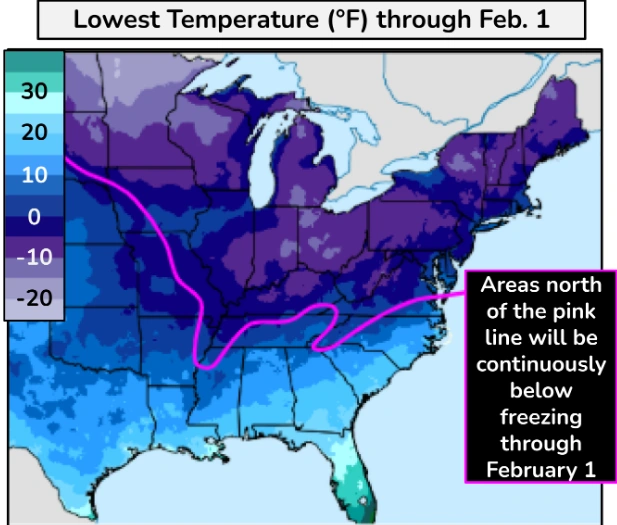
Life-threatening cold and wind chills are forecast to continue across the eastern half of the Lower 48 during the final week of January into early February. Another surge of Arctic air is forecast to spread from the Plains into the East and Southeast between Friday and Saturday, January 30–31, bringing a renewed threat of additional record low temperatures, including across parts of Florida.

Satellite image of the eastern USA at 16:20 UTC on January 27, 2026. Credit: NOAA/Goes-19, Zoom Earth, The Watchers
Life-threatening cold and dangerous wind chills are forecast to persist across the eastern United States through the coming weekend.
The Great Lakes region, the Northeast, and parts of the Midwest will see continuous below-freezing temperatures through Sunday, February 1, increasing the risk of hypothermia and frostbite. Wind chills in the Upper Ohio Valley dropped into the -29 to -23°C range (-20s°F) on Monday night.
Another Arctic blast is forecast to intensify the cold over the coming weekend. The Arctic air mass will spread from the Plains to the East and Southeast from Friday into Saturday, with record low temperatures expected as far south as Florida.
“This could be the coldest temperature seen in several years for some places and the longest duration of cold in several decades,” the National Weather Service (NWS) said.
Below-normal temperatures are expected to persist across the eastern United States into the middle of next week before beginning to moderate.
Residents have been advised to protect plants and pets from the extreme cold, leave taps dripping, and check pipes to prevent freezing.
Extreme Cold Warnings have already been issued for parts of northeastern Texas, northern Louisiana, southern Alabama, northwestern Florida, and southwestern Georgia. Warnings are also in effect for parts of the Middle Mississippi Valley, Ohio Valley, and the Mid-Atlantic.

Rishav Kothari is Editor-in-Chief of The Watchers, where he runs the newsroom and covers earthquakes, volcanoes, severe weather and space weather.
Published in the last 24 hours
- In September 1859, a solar storm lit up the night sky so brightly that gold miners in the Rocky Mountains woke up after midnight and started cooking breakfast, convinced the aurora glowing over their camp was the sunrise Epicenter
- A patch of warm Pacific water that could become the strongest El Niño in more than 70 years sits thousands of miles from any American town, yet it is already the main reason NOAA expects a wetter winter across the South and a milder one across the North
- A 19-year-old Nebraska teacher reportedly tied her pupils together with twine and led them to safety through a blizzard in January 1888 Epicenter
- NASA built the Opportunity rover to last 90 days on Mars, and Martian winds helped keep it alive for nearly 15 years by blowing dust off its solar panels, until a planet-wide dust storm in 2018 blocked sunlight and silenced the rover Epicenter
