
Multiple Earth-directed CMEs expected to trigger G1 geomagnetic storm and aurora at high latitudes
Multiple coronal mass ejections (CMEs) launched from Active Region 4334 on January 8, 2026, are expected to deliver a glancing blow to Earth between late January 10 and early January 11, according to the U.S. Space Weather Prediction Center (SWPC). The interaction of several CMEs and a coronal hole high-speed stream is forecast to cause isolated G1 – Minor geomagnetic storm conditions. Aurora may become visible across high latitudes, including the northern tier of the United States, such as northern Michigan and Maine.
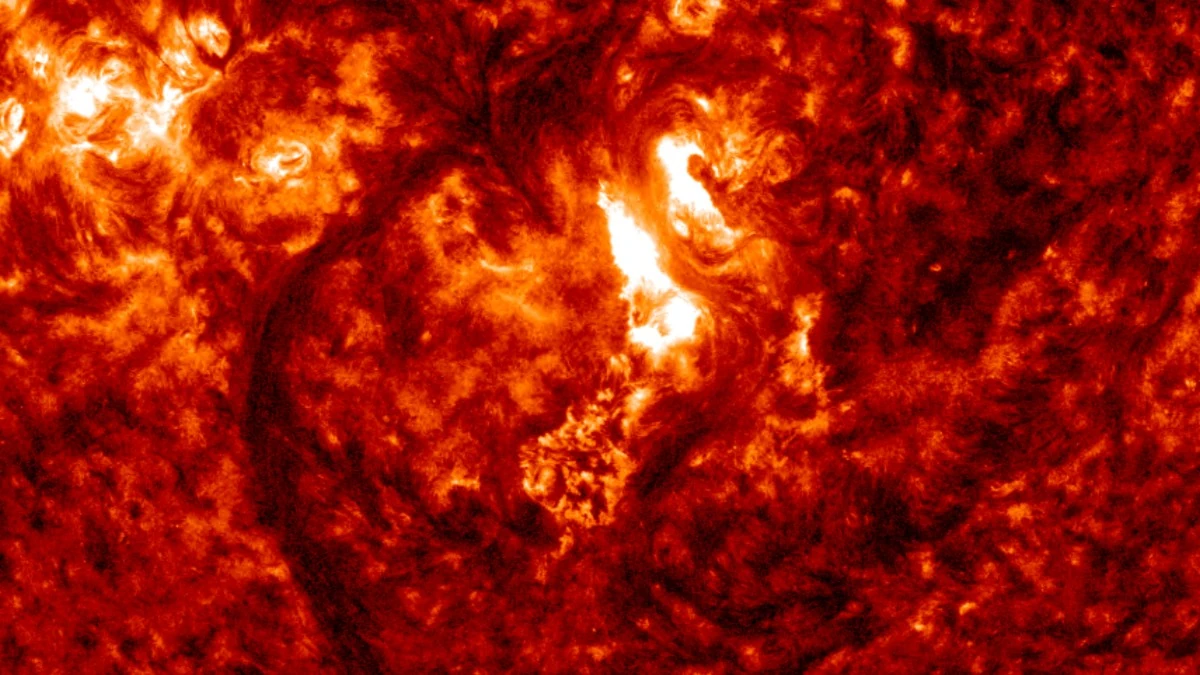
Filament eruption at 17:30 UTC on January 8, 2026. Credit: NASA/SDO, The Watchers
Solar activity on January 8, 2026, was characterized by a series of eruptions from Active Region (AR) 4334, located near S16W20, and neighboring AR 4336 at S10E15.
The most significant event began at approximately 16:30 UTC when a U-shaped filament south of these regions erupted, triggering a sympathetic, long-duration C5.6 solar flare that peaked at 17:30 UTC, the largest over the past 24 hours.
The filament eruption produced a Type IV radio sweep, consistent with energetic electron emission and expanding plasma. A CME was first detected in SOHO/LASCO C2 coronagraph imagery at approximately 17:00 UTC.
Earlier that day, a C2.7-class flare from AR 4334 peaked at 16:09 UTC, also producing a CME visible in LASCO C2 at about 17:05 UTC.
The two CMEs appear to have merged in coronagraph imagery, and modeling suggests they may have overtaken an earlier CME linked to a C4.4/Sf flare recorded at 05:45 UTC.

A later C3.4 flare at 19:56 UTC generated a Type II radio burst with an estimated shock speed of 855 km/s, followed by a narrow, southward CME first seen around 00:00 UTC on January 9. This event likely represented the remaining section of the filament eruption.
Image and propagation analysis continue as further data become available from the Solar and Heliospheric Observatory (SOHO) and the Solar Dynamics Observatory (SDO).
The SWPC reported elevated solar wind parameters ahead of CME arrival, with the total magnetic field strength (Bt) increasing from 8 nT to 16 nT and the Bz component fluctuating between ±10 nT over the past 24 hours. Solar wind speeds rose from approximately 400 km/s to 550 km/s due to combined coronal hole and prior CME influences.
Forecast models indicate that the interacting CME structure could produce a glancing blow late January 10 or early January 11, coinciding with enhanced background solar wind. The geomagnetic field is expected to range from unsettled to active, with isolated G1 – Minor storm conditions possible.
Under the NOAA G-scale, a G1 – Minor geomagnetic storm can cause weak power grid fluctuations at high latitudes, minor impacts on satellite operations, and visible aurora primarily poleward of 60° geomagnetic latitude, including northern U.S. locations such as northern Michigan and Maine.

Solar activity overall is expected to remain low, with a 20% chance of M-class flares through January 11. No solar radiation storms are anticipated, though the >2 MeV electron flux is expected to reach high levels by January 11 as solar wind speeds remain elevated.
References:
1 Forecast Discussion – NOAA/SWPC – Issued at 12:30 UTC on January 9, 2026

I'm a dedicated researcher, journalist, and editor at The Watchers. With over 20 years of experience in the media industry, I specialize in hard science news, focusing on extreme weather, seismic and volcanic activity, space weather, and astronomy, including near-Earth objects and planetary defense strategies. You can reach me at teo /at/ watchers.news.

Commenting rules and guidelines
We value the thoughts and opinions of our readers and welcome healthy discussions on our website. In order to maintain a respectful and positive community, we ask that all commenters follow these rules.