
Seven shallow earthquakes strike near Randolph, New Jersey in under 18 hours
Morris County, New Jersey experienced a sequence of seven shallow earthquakes over an 18-hour period on July 21, 2025, with magnitudes ranging from M0.7 to M2.0 and all events occurring at a depth of approximately 5 km (3 miles).
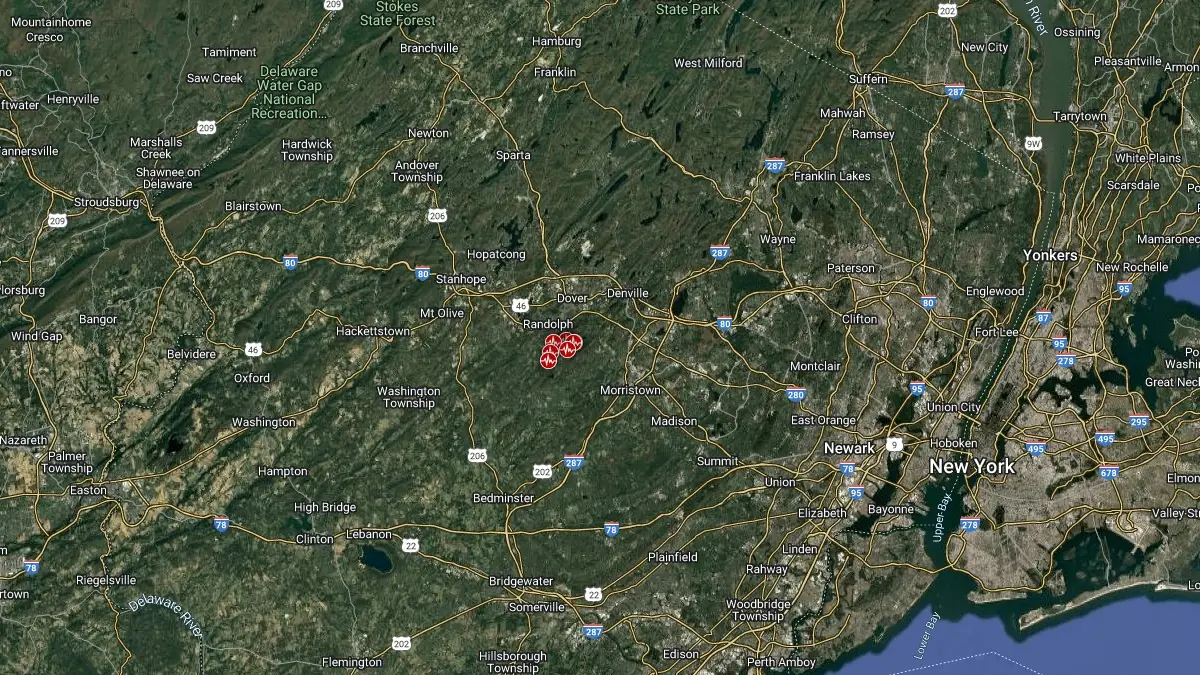
A sequence of seven minor earthquakes occurred in Morris County, New Jersey on July 21 (LT), forming a localized swarm of shallow seismic activity near Randolph and Mendham. The first event, a M1.6 earthquake, struck at 05:40 EDT (09:40 UTC) at a depth of 5 km (3 miles). Over the next 18 hours, six additional tremors were recorded.
The strongest event occurred at 21:00 EDT (01:00 UTC on July 22), measuring M2.0 and located approximately 3 km (1.8 miles) southeast of Randolph. The final quake of the sequence, a M1.1, occurred at 23:25 EDT (03:25 UTC), 4 km (2.5 miles) southeast of Randolph.
All events were recorded at depths close to 5 km (3 miles), according to the United States Geological Survey (USGS).
Residents reported loud booms and felt light shaking in homes, with several 911 calls placed to local emergency services. The Morris County Office of Emergency Management confirmed there were no reports of injuries or structural damage.
The affected area lies near the Ramapo Fault system, a known source of intraplate seismicity in the northeastern United States. Although not considered a highly active seismic region, earthquake swarms and isolated tremors do occur intermittently.
According to the USGS, this swarm is not directly related to the M4.8 earthquake that struck New Jersey on April 5, 2024. That event was followed by a typical aftershock sequence, unlike the behavior observed in the current swarm.

Teo Blašković founded The Watchers in 2011 and edited it until 2026, covering seismic and volcanic activity, extreme weather, space weather and near-Earth objects. Articles on this page are his archive.
Published in the last 24 hours
- Strong El Niño reinforces above-normal winter precipitation outlook across southern and eastern U.S.
- A fog linked to about 12 000 excess deaths in London in 1952 puzzled scientists for decades, until researchers reconstructed how coal smoke formed acidic haze Epicenter
- In 2012, cameras filming a thunderstorm in western China caught ball lightning by accident, and its 1.64-second glow carried iron, silicon, and calcium from the soil it rose out of Epicenter
