
Gravity mapping reveals unexpected interior structures of the Moon and Vesta
Scientists are using subtle changes in gravity to reveal the hidden interiors of the Moon and asteroid Vesta. By tracking spacecraft movements, they’ve created detailed maps that uncover thermal differences on the Moon and a surprisingly uniform structure inside Vesta. This method opens new doors for exploring distant worlds without landing on them.

NASA’s Dawn mission obtained this image of the giant asteroid Vesta on July 24, 2011. The spacecraft spent 14 months orbiting the asteroid, capturing more than 30 000 images and fully mapping its surface. Credit: NASA/JPL-Caltech/UCLA/MPS/DLR/IDA
By studying gravity data from orbiting spacecraft, scientists can now uncover details about a planet or moon’s internal structure without landing on it. The National Aeronautics and Space Administration (NASA) has recently applied this method to both the Moon and the asteroid Vesta.
A new study published on May 14 in Nature presents an updated gravity model of the Moon. It accounts for small changes in the Moon’s gravity during its elliptical orbit around Earth. These changes cause the Moon to flex slightly under Earth’s tidal forces in a process known as tidal deformation. This response to tidal stress helps researchers better understand the structure of the Moon’s deep interior.
With their new model, the team created the most detailed gravity map of the Moon so far. This can help future missions navigate and keep time more accurately on the lunar surface. They built the map using data from NASA’s Gravity Recovery and Interior Laboratory (GRAIL) mission. This endeavor tracked the movement of two spacecraft, Ebb and Flow, as they orbited the Moon between December 2011 and December 2012.
A separate study published on April 23 in Nature Astronomy analyzed the asteroid Vesta, the second-largest body in the asteroid belt. Using radio tracking data from NASA’s Deep Space Network and imagery from the Dawn mission (July 2011–September 2012), researchers concluded that Vesta’s interior is more uniform than expected, with only a small or potentially absent iron core.
Both studies were led by Ryan Park, who heads the Solar System Dynamics Group at NASA’s Jet Propulsion Laboratory (JPL) in Southern California. The team used NASA supercomputers to map gravity changes across the Moon and Vesta. This helped them learn more about the makeup of each body and how objects in the solar system may have evolved over time in their physical state.
Park explained that gravity is a distinct and essential feature of a planetary body that can reveal details about its deep interior. He added that their method doesn’t rely on surface data, only on precise tracking of a spacecraft’s motion to gain a global picture of what lies beneath.
Mapping the moon’s asymmetrical interior
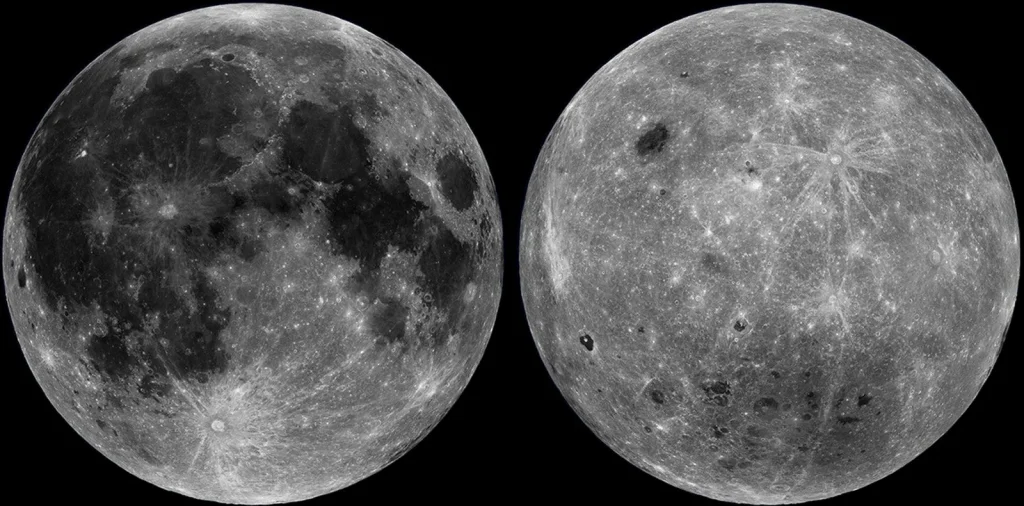
This study looked deep into the Moon’s interior using data from NASA’s GRAIL mission, which measured small changes in the Moon’s gravity caused by Earth’s tidal pull. The team focused on a measurement called k3 (degree-3 Love number), which describes how much the Moon flexes in response to those forces. The result was about 72% more than what a perfectly symmetrical Moon should have. This showed that the Moon’s near side and far side have different internal makeups, with the biggest difference found in the mantle layer beneath the surface.
To understand what was causing this, the researchers built models of the Moon’s interior and tested how it would respond to tidal forces. One of the most important factors in these models is the shear modulus, which measures how stiff or flexible the rock is. The results showed that the mantle on the Moon’s near side is about 2–3% softer than the one on the far side. This difference goes well below the surface, with the strongest contrast found around 600 km (370 miles) down. The crust is too thin and stiff to account for it, and the core has negligible influence.
They then tried to find out what was causing the near side to be softer. Changing the rock’s makeup or adding more water didn’t work. That’s because these changes would shift the Moon’s center of mass far more than what’s actually seen.
But a temperature difference made sense. Their models showed that if the near side is around 100 to 200°K (-173.1°C to -73°C) warmer than the far side, it would explain the extra flexing. That extra heat likely comes from radioactive elements like thorium and uranium. These elements are mostly concentrated in the crust and upper mantle on the near side, in the Procellarum region.
The heat makes the rock softer and may still be keeping parts of the mantle partially melted. This helps explain why the volcanic plains are mostly on the near side and why deep moonquakes happen there. Melted rock weakens the surrounding material, making it easier for tidal forces to trigger quakes. The same heat that shaped the surface is still affecting the Moon’s interior today.
The study employs a method known as tidal tomography, using tidal deformation to infer internal structure, offering a new tool for planetary science.
New information reveals Vesta’s mixed composition
In their study of Vesta, Park’s team used Dawn’s tracking and imaging data to determine the asteroid’s moment of inertia, a parameter that reflects how mass is distributed within a body. The results suggested that Vesta’s interior is more homogeneous than previously believed.
If the mass is mostly near the surface, the moment of inertia will be higher. If it’s concentrated closer to the center, the value will be lower. The results challenged expectations. Vesta’s internal structure appeared much more uniform than models of a layered, fully differentiated body had predicted.
This finding doesn’t fit with the long-standing idea that Vesta, like Earth, had fully separated three layers. Here findings suggest Vesta is only partially differentiated, with most of its mass still evenly distributed. The team estimated that Vesta has a thin crust of 47 km (30 miles), a denser mantle beneath it, and a very small core of about 45 km (28 miles).
The density difference between the core and mantle turned out to be much smaller than expected. That limited contrast made it difficult to reconcile with the idea of a clearly defined, heavy metal core surrounded by less dense rock.
To figure out how Vesta got this way, the team explored two ideas. One is that Vesta formed late, after most of the heat from short-lived radioactive elements had gone. Without that heat, it couldn’t fully melt and separate into layers. Some melting may have happened near the surface, but not deep enough to form a large core.
The second idea is that Vesta came from a bigger body that had already formed layers. A massive collision could have shattered that planet, and the pieces may have come back together to form Vesta. If that happened, material from the crust, mantle, and core would have been mixed into one body.
The second idea fits well with what we see in the rocks linked to Vesta. These Howardite Eucrite Diogenite (HED) meteorites reveal a history of magmatic activity, but they don’t carry clear signs of material from deep inside.
The makeup of Vesta seems more like a mix of different materials. It’s similar to meteorites that contain both metal and silicate clasts pressed together (better known as mesosiderites). A makeup like this would help explain why Vesta’s rotation and gravity point to a largely uniform interior, with only limited internal layering.
This study shows that we don’t need to land on a planetary body or drill into it to understand what’s inside. Scientists observed subtle changes in Vesta’s gravity and spin. These shifts helped them understand how mass is arranged inside the asteroid. These techniques are useful for studying distant or small bodies that are hard to explore directly. Future missions to Psyche, Apophis, and the Didymos system should continue using this approach to learn more about other unexplored worlds.
References:
1 A small core in Vesta inferred from Dawn’s observations – R. S. Park, A. I. Ermakov, et al. – Nature Astronomy – April 23, 2025 – DOI https://www.nature.com/articles/s41550-025-02533-7 – OPEN ACCESS
2 Thermal asymmetry in the Moon’s mantle inferred from monthly tidal response – R. S. Park, A. Berne, et al. – Nature – May 14, 2025 – DOI https://www.nature.com/articles/s41586-025-08949-5 – OPEN ACCESS

My passions include trying my best to save a dying planet, be it through carpooling or by spreading awareness about it. Research comes naturally to me, complemented by a keen interest in writing and journalism. Guided by a curious mind and a drive to look beyond the surface, I strive to bring thoughtful attention and clarity to subjects across Earth, sciences, environment, and everything in between.

Commenting rules and guidelines
We value the thoughts and opinions of our readers and welcome healthy discussions on our website. In order to maintain a respectful and positive community, we ask that all commenters follow these rules.