
Water released from hydrous minerals identified as a viable trigger for slow earthquakes
Researchers have identified a geological mechanism that may explain why slow earthquakes occur in recurring cycles, concluding that episodic dehydration of hydrous minerals can generate intermittent pulses of fluid capable of triggering slow-slip events in subduction zones. The findings, published in Geology on June 18, 2026, combine field observations from New Caledonia with thermodynamic and mechanical modelling to explain how water released during metamorphism may initiate these elusive earthquakes.
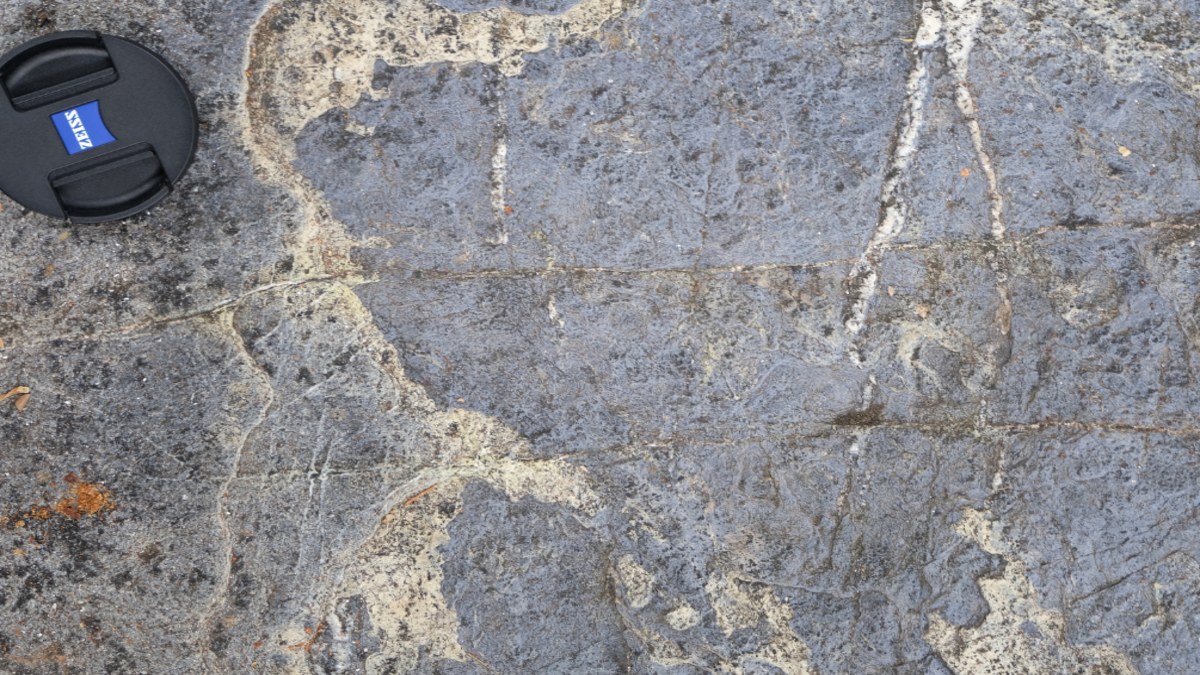
Close-up of a rock sampled from New Caledonia. Credit: UNE
Slow-slip earthquakes last anywhere from seconds to years and release energy much more gradually than conventional earthquakes. They rarely produce noticeable ground shaking but recur repeatedly within many subduction zones, where one tectonic plate descends beneath another, making them an important focus of research into fault behavior and seismic hazards.
A study led by Dr. Timothy Chapman of the University of New England proposes that episodic dehydration of hydrous minerals provides a viable mechanism for triggering these recurring events. Published in Geology, the research combines field observations from New Caledonia with thermodynamic modeling and microstructural analysis to examine how water is released from minerals as they undergo metamorphism at depths associated with slow-slip activity.
The researchers focused on the breakdown of lawsonite, a water-rich mineral that becomes unstable as temperature and pressure increase during subduction. Rather than releasing water continuously, the reaction progresses in punctuated stages. Each increment absorbs heat before liberating fluid into surrounding rocks, producing alternating periods of slow reaction and rapid fluid release that the authors argue match the episodic nature of slow earthquakes.
According to the study, these bursts of fluid temporarily increase pore-fluid pressure while reducing the effective strength of surrounding rocks. Under suitable geological conditions, only a small additional force may be required to initiate slip. Dr. Chapman compared this threshold to the weight of a filled bathtub, illustrating how little extra stress may be needed once pore-fluid pressure has built up. The authors also argue that contrasting fluid production between metabasalt and metapelite creates permeability contrasts that help localize zones where slip can occur repeatedly.
To test the proposed mechanism, the researchers examined blueschist rocks exposed in northeastern New Caledonia, where ancient high-pressure rocks preserve evidence of deformation that occurred during subduction tens of millions of years ago. Microscopic analysis revealed repeated generations of mineral veins, fracture patterns, and growth textures that the team interpreted as evidence of intermittent fluid flow and multiple deformation episodes rather than a single continuous event.
The geological observations closely match the behavior of modern slow earthquakes. The authors conclude that repeated cycles of dehydration and fluid release can generate episodic fracturing and slip over timescales ranging from days to years, consistent with the recurrence observed in active subduction zones. They suggest the same processes may also explain why slow-slip activity often migrates through sections of plate boundaries instead of occurring as a single isolated event.
The study does not conclude that episodic dehydration explains every slow earthquake. Instead, it identifies the mechanism as a viable trigger operating within specific geological environments that may interact with other recognized controls, including tectonic stress, pore-fluid pressure, and variations in rock permeability.
Understanding the physical processes governing slow earthquakes is important because billions of people live in regions influenced by subduction zones, while many coastal communities, including those in Australia, remain exposed to earthquake-generated tsunamis. Although the findings do not provide a method for predicting earthquakes, they improve scientific understanding of the conditions under which slow-slip events develop and recur, knowledge that ultimately contributes to long-term seismic hazard assessment
The researchers say further work will focus on measuring the scale of deformation associated with individual slow-slip episodes and understanding how localized fluid-release processes interact with larger tectonic forces operating across entire plate boundaries. They note that identifying geological evidence of ancient slow earthquakes remains exceptionally challenging because these short-lived events are preserved within rocks that formed over millions of years.
References:
1 Research uncovers the trigger behind slow earthquakes – University of New England – June 29, 2026
2 Punctuated energetics of dehydration contributes to slow earthquake phenomena – Timothy Chapman et al. – Geology – June 18, 2026 – https://doi.org/10.1130/G54149.1 – OPEN ACCESS

I’m a science journalist and researcher at The Watchers, contributing to the Epicenter edition, where I cover peer-reviewed scientific research and emerging discoveries across Earth and space sciences. With a background in astronomy and a passion for environmental science, I’ve worked in shark and coral conservation in Fiji, conducting reef and shark-behavior research, contributing to mangrove restoration, and earning PADI Open Water and Coral Reef Certifications. I bring a blend of scientific rigor and storytelling to illuminate the discoveries shaping our planet and beyond.

Commenting rules and guidelines
We value the thoughts and opinions of our readers and welcome healthy discussions on our website. In order to maintain a respectful and positive community, we ask that all commenters follow these rules.