
Interstellar comet 3I/ATLAS preserves a chemical record from the Milky Way’s earliest planetary systems
The interstellar comet 3I/ATLAS formed in an exceptionally cold, relatively metal-poor stellar nursery as long as 10 to 12 billion years ago, according to observations by NASA’s James Webb Space Telescope and a study published in Nature on June 22, 2026. Measurements of unusually high deuterium in water and exceptionally low abundances of carbon-13 compared to carbon-12 distinguish the object from every comet measured in the Solar System, providing a rare glimpse into the chemistry of one of the Galaxy’s earliest planetary systems.

Hubble Space Telescope view of interstellar comet 3I/ATLAS, captured with the Wide Field Camera 3. Credit: Image: NASA, ESA, David Jewitt (UCLA), Joseph DePasquale (STScI)
Interstellar objects are the only physical samples from planetary systems beyond our own that can be studied directly. Unlike exoplanets, whose compositions must be inferred remotely, these rare visitors preserve the chemistry of their parent systems and carry it into the Solar System, where astronomers can examine them in unprecedented detail.
As interstellar comet 3I/ATLAS moved away from the Sun in December 2025, astronomers seized a rare opportunity to observe it with NASA’s James Webb Space Telescope. Freshly warmed by its close solar passage, the comet’s ancient ice had sublimated into a bright coma of gas, creating ideal conditions for detailed spectroscopic observations. Recognizing the scientific importance of the object, Webb’s observing schedule was interrupted so researchers could use its Near-Infrared Spectrograph (NIRSpec) to investigate the comet’s chemical composition.
Discovered by the NASA-funded Asteroid Terrestrial-impact Last Alert System (ATLAS), 3I/ATLAS is the third confirmed interstellar object to pass through the Solar System. Unlike ordinary comets, it formed around another star before being ejected into interstellar space, eventually crossing our planetary neighborhood billions of years later.
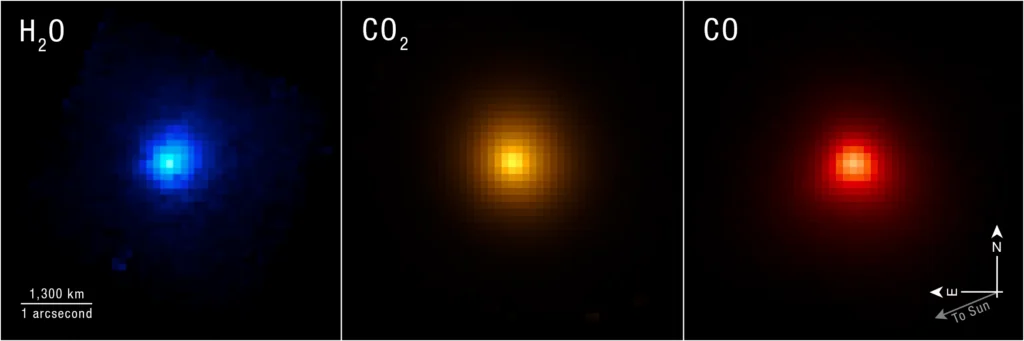
“This was a unique opportunity to study an ancient object from the distant galaxy, probably pre-dating our Sun and solar system,” said Martin Cordiner of NASA’s Goddard Space Flight Center, lead author of the study. “On the one hand, we get direct insight into that distant time and place, and on the other, we learn something about how unusual our own solar system may be.”
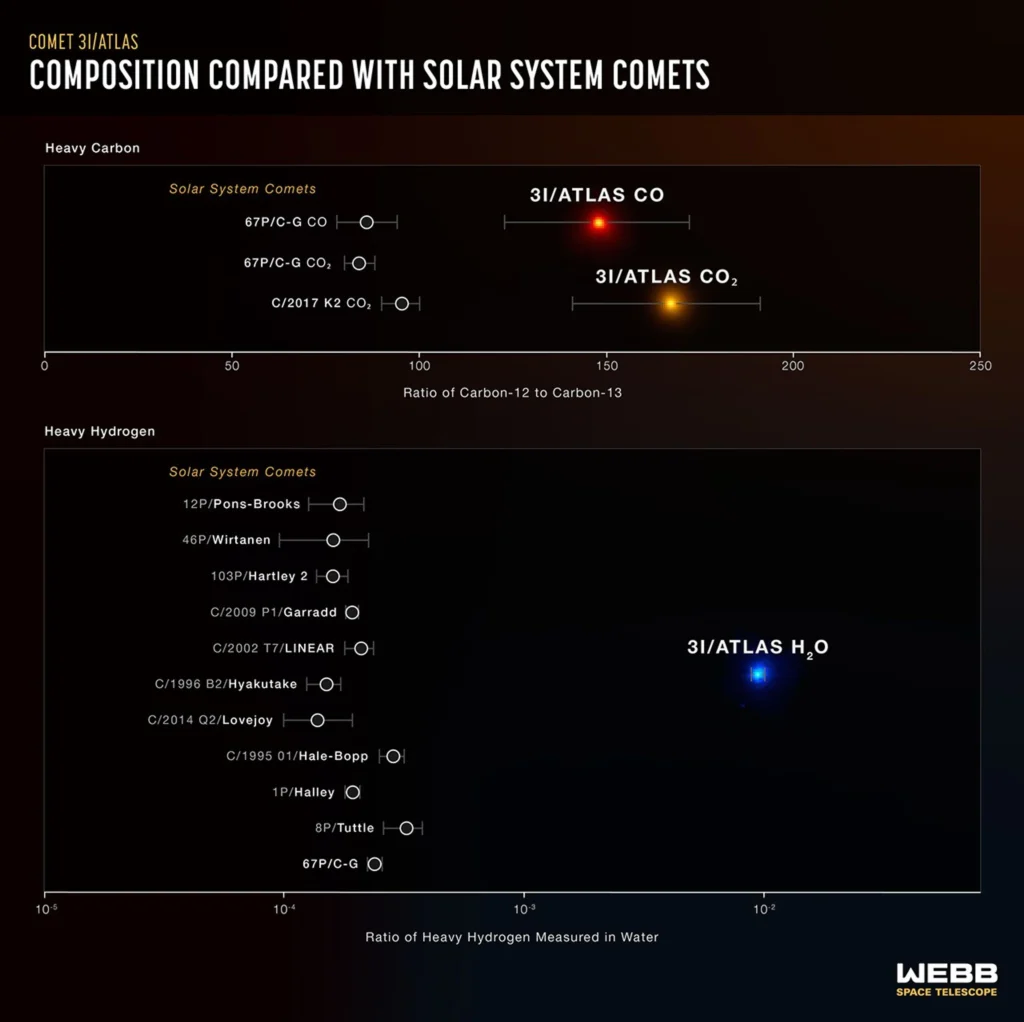
Using NIRSpec, researchers simultaneously measured isotopes in water, carbon dioxide and carbon monoxide released from the comet’s coma. They found a deuterium-to-hydrogen ratio in water of (0.98 ± 0.06)%, more than an order of magnitude higher than in known Solar System comets and roughly 30 times greater than typical cometary values. Carbon isotope measurements yielded ¹²C/¹³C ratios of 141-191 for carbon dioxide and 123-172 for carbon monoxide, well above values measured in Solar System objects, nearby interstellar clouds and protoplanetary disks.
Together, these isotope ratios point to formation at temperatures below about -243 °C (-406 °F) in a relatively metal-poor environment. At such low temperatures, water forms rapidly on the surfaces of dust grains, efficiently incorporating deuterium into the growing ice.
Astrochemical models show that enhanced ultraviolet radiation and elevated cosmic-ray ionization accelerate these reactions, with deuterium enrichment approaching 1% expected where cosmic-ray fluxes exceed today’s local Galactic environment by at least an order of magnitude. According to the researchers, these conditions are consistent with intense star-forming regions in the early Milky Way.
The carbon isotope measurements provide an independent record of the comet’s age. As generations of stars evolve, they enrich the interstellar medium with carbon-13 produced during stellar nucleosynthesis. Material that formed earlier therefore contains proportionally less carbon-13 than younger planetary systems.
Comparing 3I/ATLAS’s carbon isotope ratios with models of Galactic chemical evolution led the research team to estimate that the comet accreted approximately 10 to 12 billion years ago, during the Universe’s cosmic noon, when star formation reached its highest rate. By comparison, the Sun formed about 4.5 billion years ago, making 3I/ATLAS a relic from a much earlier generation of planetary formation.
The isotope measurements also indicate that the comet experienced little thermal processing after its formation. Its water ice formed in a deeply frozen environment and largely avoided the prolonged warming that would have reduced its deuterium content through reprocessing. The combination of exceptionally high deuterium enrichment, elevated ¹²C/¹³C ratios, and a relatively metal-poor natal environment points to an ancient planetary system whose chemistry has remained remarkably well preserved for billions of years.
Webb also revealed substantial changes in the comet’s activity during its passage through the inner Solar System. Compared with observations obtained several months earlier, the carbon dioxide-to-water ratio decreased by roughly a factor of seven, while carbon monoxide became increasingly abundant. The coma evolved from being dominated by carbon dioxide before perihelion to being dominated by carbon monoxide afterward, reflecting a pronounced change in volatile outgassing as the comet moved away from the Sun.
NASA’s accompanying comparison of isotope measurements highlights just how unusual 3I/ATLAS is. Solar System comets cluster around much lower deuterium abundances and carbon isotope ratios, whereas 3I/ATLAS occupies a distinctly separate region in both datasets, indicating that it formed under physical and chemical conditions unlike those that produced the icy bodies orbiting the Sun today.
A complementary study led by Cyrielle Opitom of the University of Edinburgh used the European Southern Observatory’s Very Large Telescope to analyze carbon and nitrogen isotopes in cyanide released from 3I/ATLAS, providing an independent investigation of the comet’s chemical composition alongside Webb’s observations.
“For us as scientists, finding these rare isotopes is fascinating, but the bigger picture here is looking at the possibilities of prebiotic chemistry elsewhere in the galaxy,” said Stefanie Milam of NASA’s Goddard Space Flight Center and a co-author of the study. “So far, we know of only one place in the vast cosmos where chemical ingredients led to life – our solar system, our Earth. Analysis of these interstellar objects is a major step towards learning how common, or uncommon, the conditions for the evolution of life are in the universe.”
References:
1 NASA’s Webb Finds Clues to Ancient, Distant Origin of Comet 3I/ATLAS – NASA Webb Mission Team – June 22, 2026
2 Isotopic Evidence for a Cold and Distant Origin of 3I/ATLAS – Martin Cordiner, Nathan X. Roth, Marco Micheli, Geronimo Villanueva, Davide Farnocchia, Steven Charnley, Nicolas Biver, Dominique Bockelée-Morvan, Dennis Bodewits, Colin Orion Chandler, Maria N. Drozdovskaya, Kenji Furuya, Michael S. P. Kelley, Stefanie N. Milam, John W. Noonan, Cyrielle Opitom, Megan E. Schwamb and Cristina A. Thomas – Nature – June 22, 2026 – https://doi.org/10.1038/s41586-026-10771-6 – OPEN ACCESS

I’m a science journalist and researcher at The Watchers, contributing to the Epicenter edition, where I cover peer-reviewed scientific research and emerging discoveries across Earth and space sciences. With a background in astronomy and a passion for environmental science, I’ve worked in shark and coral conservation in Fiji, conducting reef and shark-behavior research, contributing to mangrove restoration, and earning PADI Open Water and Coral Reef Certifications. I bring a blend of scientific rigor and storytelling to illuminate the discoveries shaping our planet and beyond.

Commenting rules and guidelines
We value the thoughts and opinions of our readers and welcome healthy discussions on our website. In order to maintain a respectful and positive community, we ask that all commenters follow these rules.