
Thousands evacuated, several missing in Buenos Aires Province floods
Torrential rains struck northern Buenos Aires Province, Argentina, between May 16 and 18, 2025, forcing over 7 500 people to evacuate and leaving several others missing. The storms brought more than 400 mm (16 inches) of rainfall, flooding towns, closing major highways, and disrupting the regional soybean harvest.
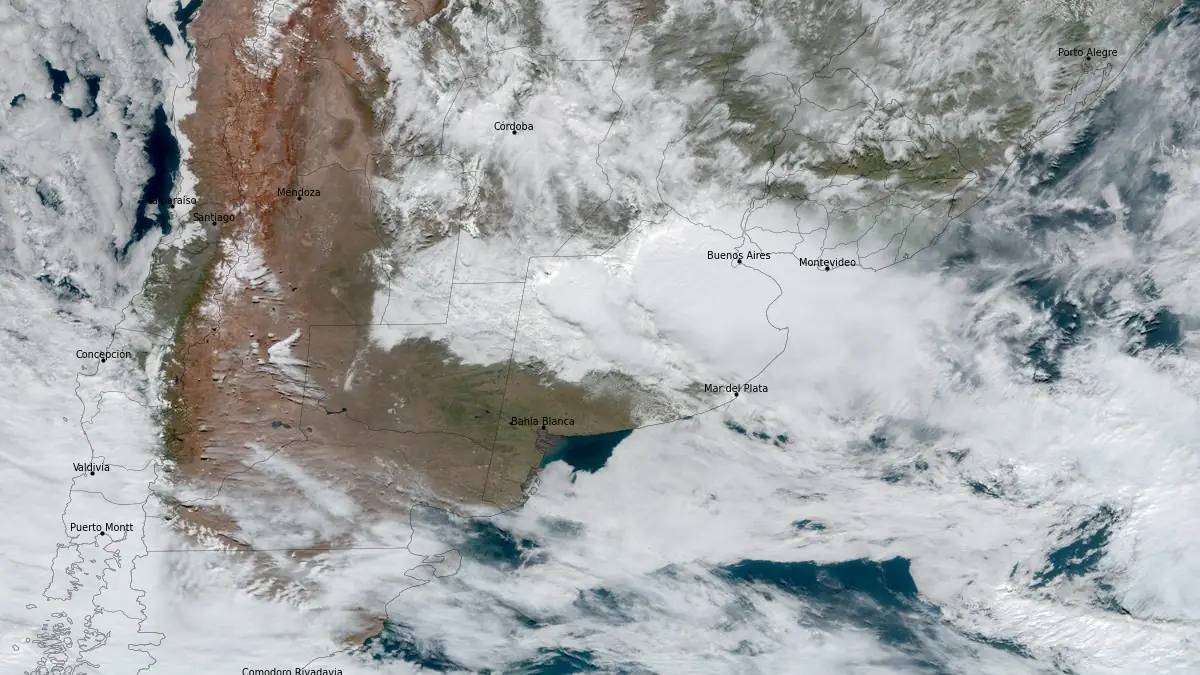
Image credit: NOAA/GOES-East, RAMMB/CIRA, The Watchers. Acquired at 15:40 UTC on May 16, 2025
Torrential rains began affecting northern Buenos Aires Province in Argentina on May 16, causing widespread flooding. More than 400 mm (16 inches) of rain fell over the next two days in areas such as Zárate, Campana, Salto, and Arrecifes, submerging homes and roads.
Over 7 500 people have been evacuated across 30 municipalities, with Campana and Salto reporting the highest numbers. Evacuation centers, including gyms, clubs, and churches, currently house 3 166 people, while others have sought refuge with family members. In Campana’s San Cayetano neighborhood, 1 300 residents were evacuated due to severe flooding.
The National Meteorological Service (SMN) reissued a Red alert on the evening of May 17 for 15 municipalities, including San Nicolás, Ramallo, and Luján. An Orange alert remains in effect for central and northern Buenos Aires Province, with more rainfall expected. Rivers and streams continue to rise as they move toward the Paraná River.
At least five people have been reported missing, including three livestock workers from Rojas, a 38-year-old man from Campana, and a 71-year-old, last seen on Route 41 in his Renault Kwid.
Flooding has caused major disruptions to regional infrastructure, leading to the closure of the Zárate–Brazo Largo Bridge and sections of National Routes 8 and 9. Several provincial roads, including RP 191, RP 31, and RP 41, are also impassable. Authorities are urging residents to avoid all non-essential travel.
The storms have severely disrupted Argentina’s agricultural sector, with flooded fields and damaged infrastructure causing significant delays to the harvest in Buenos Aires Province, a key producer of soybean, corn, and wheat. The prolonged disruption is threatening overall crop yields.
Buenos Aires Governor Axel Kicillof is leading the emergency response. On May 17, he visited affected areas, including San Antonio de Areco and Salto. Aerial surveys of Zárate and Campana were conducted to coordinate with ministers and mayors. The province has deployed heavy machinery, boats, and emergency supplies to support rescue efforts.
National and provincial forces are assisting with relief operations. The Argentine Navy, Federal Police, and Coast Guard have deployed personnel, vehicles, and boats to evacuate residents. A total of 216 provincial police officers, 99 volunteer firefighters, and 20 Civil Defense agents are supporting the operation.
The City of Buenos Aires, despite receiving 170–190 mm (6.7–7.5 inches) of rain, avoided major flooding. Mayor Jorge Macri deployed 2 300 agents to manage stormwater systems. The city is also sending aid, including boats and supplies, to more severely affected provincial municipalities.
In the Los Álamos neighborhood of La Matanza, flooding reached 1.5 m (5 feet), affecting 500 families. More than 200 residents were evacuated. There are urgent needs for water, bleach, mattresses, and food. Local organizations are collecting donations to support affected families.
NGO TECHO Argentina is mobilizing aid for informal settlements in Greater Buenos Aires. Donation centers in Morón, Quilmes, Martínez, and La Plata are accepting nonperishable food, hygiene products, and clothing.
A bus carrying 44 passengers, including a baby, had been stranded on Route 9 near Zárate since midnight on May 16. Water entered the vehicle, but all passengers remained safe. More than 30 buses, many carrying children, were also trapped by floodwaters, prompting rescue operations.
Volunteers are preparing food and transporting supplies, with local churches and organizations providing aid. The bishop reported 1 200 evacuees in Campana by midday on May 17.
As of May 18, flooding remains severe in Zárate, Campana, and Salto, with emergency services maintaining high alert levels. While no new rainfall extremes are forecast, scattered showers are possible on May 19, and floodwaters may take several days to fully recede. Authorities continue to advise caution and limited travel in affected areas.

I’m a science journalist and researcher at The Watchers, contributing to the Epicenter edition, where I cover peer-reviewed scientific research and emerging discoveries across Earth and space sciences. With a background in astronomy and a passion for environmental science, I’ve worked in shark and coral conservation in Fiji, conducting reef and shark-behavior research, contributing to mangrove restoration, and earning PADI Open Water and Coral Reef Certifications. I bring a blend of scientific rigor and storytelling to illuminate the discoveries shaping our planet and beyond.

Commenting rules and guidelines
We value the thoughts and opinions of our readers and welcome healthy discussions on our website. In order to maintain a respectful and positive community, we ask that all commenters follow these rules.