
Solar activity increasing as large active region rotates into view
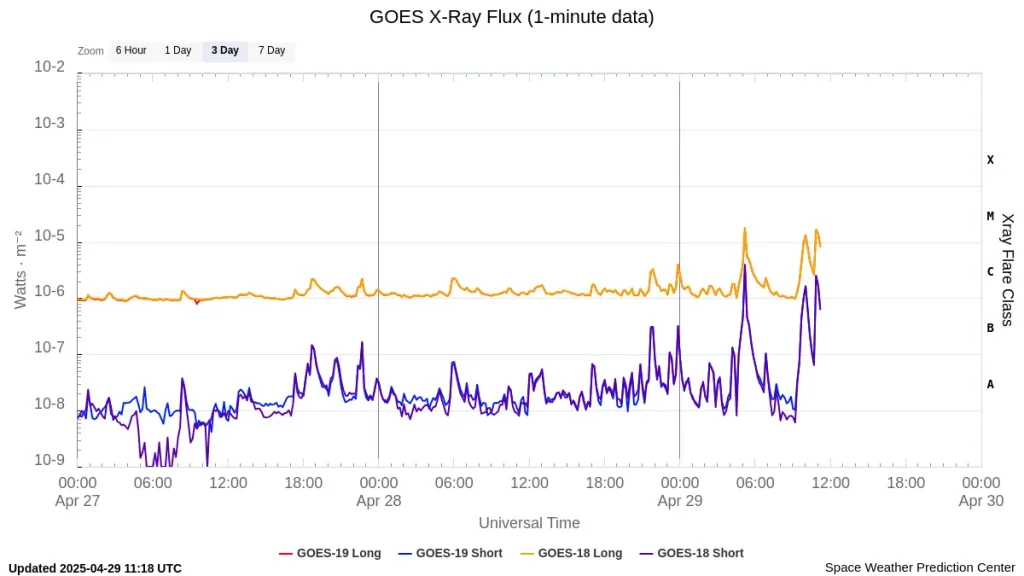
Solar activity increased on April 29, 2025, with three M-class solar flares recorded during the first half of the UTC day as large Active Region 4079 rotated into Earth’s view. Region 4079, formerly designated AR 4055, underwent significant growth while on the far side of the Sun and is expected to be the primary source of solar activity in the coming days.

Active Region 4079 at 10:45 UTC on April 29, 2025. Credit: NASA SDO/HMI
Active Region 4079, formerly designated AR 4055, is rotating into Earth’s view after undergoing significant growth while on the far side of the Sun. Solar activity increased on April 29, 2025 (UTC), with three M-class flares recorded during the first half of the day, including one from Region 4079. Forecasts suggest that Region 4079 will likely be the primary contributor to notable solar activity in the coming days.
Flaring from Region 4079 started with a C3.2 flare at 21:52 UTC on April 28, followed by C1.7, C1.6, and C3.9 flares before the end of the UTC day. Activity continued into April 29 with a C1.7 at 04:19, a C1.6 at 04:40, and a C2.4 at 04:56 UTC. Flaring then intensified, with an M1.7 flare from Region 4079 at 05:13 UTC, an M1.3 flare from Region 4068 at 10:02 UTC, and an M1.6 flare from Region 4078 at 10:57 UTC.
The last M-class flare before today occurred eight days ago, at 18:37 UTC on April 21, and was classified as M1.9.
There are currently 10 numbered regions on the Earth-facing side of the Sun. The most likely candidates for notable flaring are Region 4070, with a Beta-Gamma magnetic configuration, and the newly numbered Region 4079, classified as Beta.
SWPC forecasters expect low solar activity with a 15% chance of M-class flaring through April 30, increasing to 20% on May 1.


A partial filament eruption centered near S30W30 was observed in SDO AIA 304 imagery beginning at approximately 07:12 UTC on April 28. A subsequent narrow coronal mass ejection (CME) was observed in SOHO LASCO C2 coronagraph imagery at approximately 08:48 UTC. Modeling indicated that the CME missed Earth to the south.
The greater than 2 MeV electron flux reached moderate levels during the 24 hours ending at 00:30 UTC today, while the greater than 10 MeV proton flux remained at background levels.
The greater than 2 MeV electron flux is expected to remain at normal to moderate levels through May 1, while the greater than 10 MeV proton flux is expected to continue at background levels.
Solar wind parameters remained slightly enhanced over the past 24 hours due to the waning influence of a positive polarity coronal hole high speed stream (CH HSS). The total magnetic field strength ranged from 5 to 9 nT. The Bz component was primarily northward, with brief southward deflections reaching -3 to -5 nT. Solar wind speeds gradually decreased from approximately 450 km/s to 375 km/s. Phi was predominantly in a positive solar sector.

A slightly enhanced solar wind environment is expected to persist through April 29, with a return to mostly ambient conditions expected between April 29 and May 1.
The geomagnetic field is expected to remain at mostly quiet to unsettled levels on April 29, with a chance for an isolated active period under the influence of waning positive polarity CH HSS effects. Mostly quiet conditions are forecast from April 30 through May 1.

I'm a dedicated researcher, journalist, and editor at The Watchers. With over 20 years of experience in the media industry, I specialize in hard science news, focusing on extreme weather, seismic and volcanic activity, space weather, and astronomy, including near-Earth objects and planetary defense strategies. You can reach me at teo /at/ watchers.news.

Commenting rules and guidelines
We value the thoughts and opinions of our readers and welcome healthy discussions on our website. In order to maintain a respectful and positive community, we ask that all commenters follow these rules.