
New algorithm aims to improve space weather forecasting
A new study shows that the latitude of solar coronal holes and the Sun’s B0 angle significantly influence high-speed solar wind streams, potentially improving the accuracy of space weather forecasts. The research introduces a predictive algorithm based on L5-L1 observations to enhance forecasting capabilities.
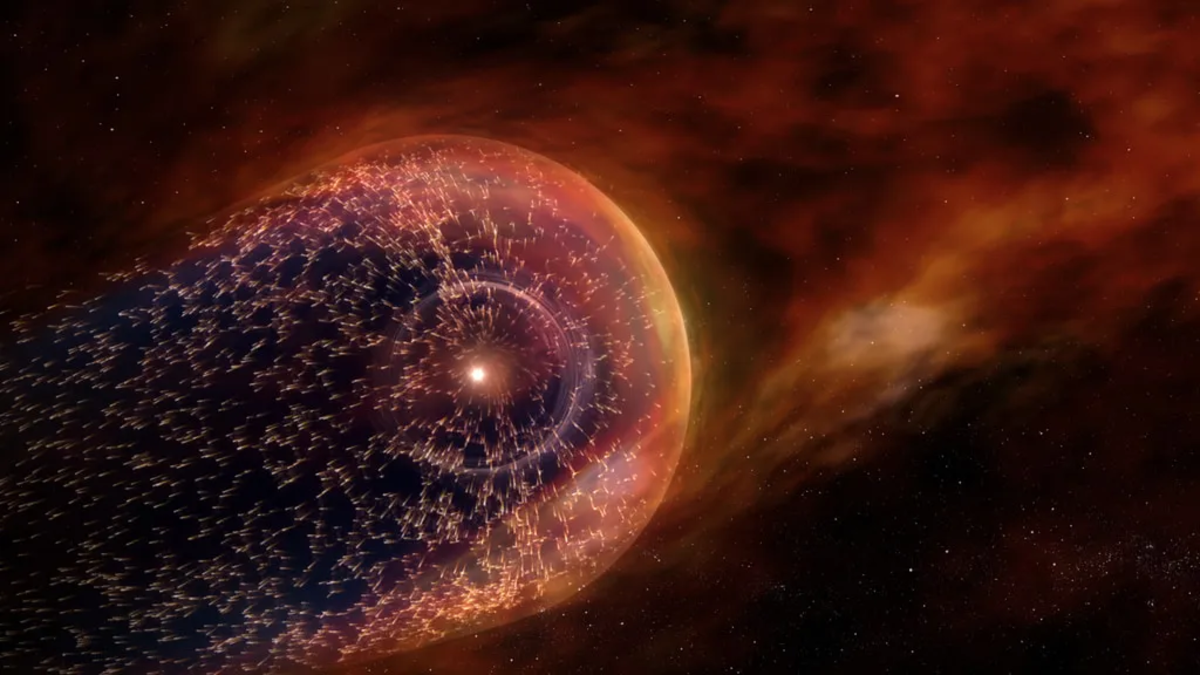
An artist's concept depicts the heliosphere. Image credit: NASA’s Goddard Space Flight Center Conceptual Image Lab
A study published on April 15, 2025, by Tatiana Podladchikova and colleagues from the Skolkovo Institute of Science and Technology, University of Graz, Kanzelhöhe Observatory, and Columbia University shows that the latitude of coronal holes, particularly smaller ones, and the heliographic B0 angle influence high-speed solar wind stream (HSS) velocities.
Coronal holes are low-density coronal regions where open magnetic fields allow charged particles to escape at 400–800 km/s (250–500 miles per second). Smaller coronal holes at higher latitudes produce narrower streams, causing velocity variations across the heliosphere.
The researchers developed a predictive algorithm to forecast HSSs at the L1 Lagrangian point using L5 point data, located 60° behind Earth in its orbit. The algorithm incorporates coronal hole area, latitude, and B0 angle differences between L5 and L1 to adjust velocity predictions. Archival STEREO mission data, with STEREO-B simulating L5 and STEREO-A or Earth as L1, were used for accurate results.

The study improved prediction accuracy, reducing the root mean square error from 75.4 km/s (47 miles per second) to as low as 58 km/s (36 miles per second) in some cases. The correlation coefficient for solar wind velocity predictions reached 0.88. These results were consistent across multiple datasets, covering various STEREO observation periods and Earth-based measurements.
The algorithm provided HSS prediction lead times of 1.5 to 6.8 days, depending on the separation angle and solar wind speed. In the 2008 STEREO-B to STEREO-A setup, lead times ranged from 3.04 to 6.67 days, outperforming shorter configurations like STEREO-B to Earth. This supports early warnings for geomagnetic storms caused by HSSs.
The findings align with the proposed Vigil mission, an L5-based space weather observatory. L5’s position offers an early view of coronal holes before they rotate toward Earth, enhancing forecasting capabilities. The algorithm’s robustness was validated across varying solar activity and spacecraft configurations.
Smaller coronal holes produce non-uniform solar wind streams, leading to greater velocity discrepancies between observation points. Larger coronal holes distribute solar wind more evenly due to a saturation effect, noting that open magnetic fields in coronal holes accelerate charged particles, shaping the heliosphere.
References:
1 Simulating high-speed solar wind streams from coronal holes using an L5-L1 configuration of lagrangian points – Tatiana Podladchikova, Astrid M. Veronig et al. – Scientific Reports – April 15, 2025 – https://doi.org/10.1038/s41598-025-97246-2 – OPEN ACCESS

I’m a science journalist and researcher at The Watchers, contributing to the Epicenter edition, where I cover peer-reviewed scientific research and emerging discoveries across Earth and space sciences. With a background in astronomy and a passion for environmental science, I’ve worked in shark and coral conservation in Fiji, conducting reef and shark-behavior research, contributing to mangrove restoration, and earning PADI Open Water and Coral Reef Certifications. I bring a blend of scientific rigor and storytelling to illuminate the discoveries shaping our planet and beyond.

Commenting rules and guidelines
We value the thoughts and opinions of our readers and welcome healthy discussions on our website. In order to maintain a respectful and positive community, we ask that all commenters follow these rules.