
Apollo 17 lunar soil experiment confirms solar wind creates hydroxyl on the Moon
A NASA experiment using Apollo 17 lunar soil shows that solar wind can generate hydroxyl—molecules consisting of one oxygen and one hydrogen atom—on the Moon’s surface. While not water itself, hydroxyl formation is a key part of the Moon’s hydration cycle. The study simulated 80 000 years of solar wind exposure to better understand hydrogen mobility in lunar minerals.
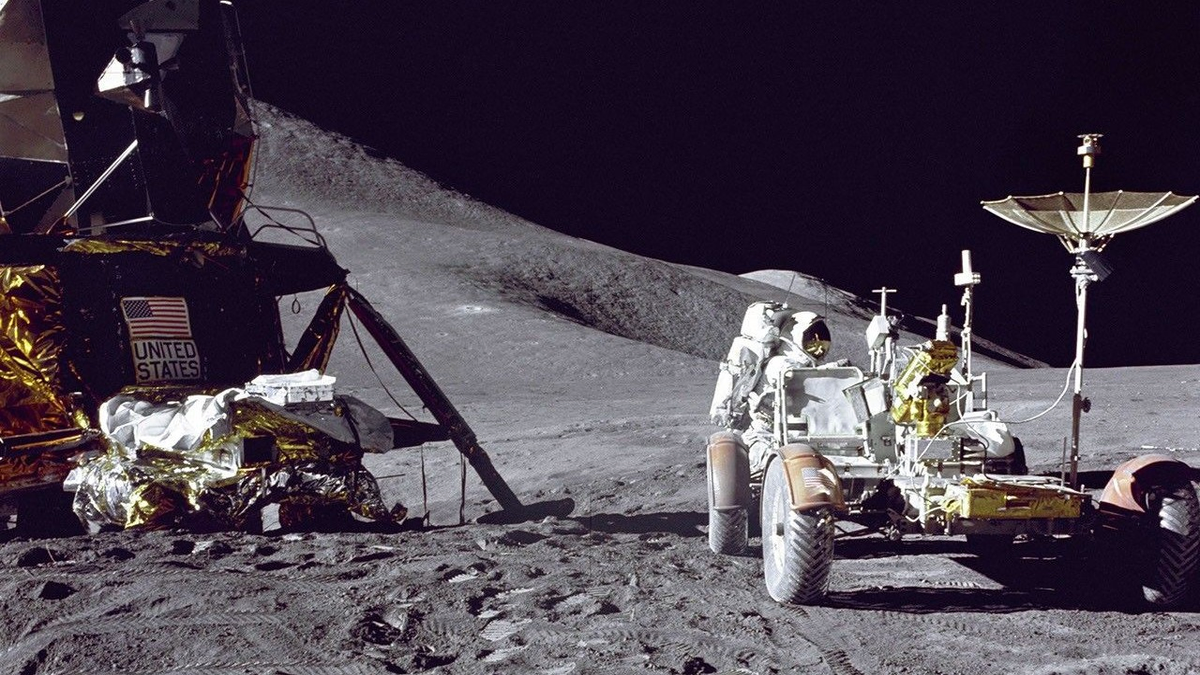
Image credit: NASA
NASA’s recent laboratory experiment, based on a study published March 17, 2024, in Journal of Geophysical Research: Planets, shows that solar wind—a stream of charged particles from the Sun—can generate hydroxyl on the Moon’s surface. While not molecular water, hydroxyl (OH) formation plays a key role in the Moon’s hydration processes.
Led by Li Hsia Yeo at NASA’s Goddard Space Flight Center, the study used Apollo 17 lunar dust samples. These findings could support NASA’s Artemis program, targeting sustainable lunar exploration.
The experiment involved baking Apollo 17 samples to remove pre-existing water, then exposing them to a simulated solar wind in a custom airless chamber. A spectrometer detected a 3-micron infrared signal, indicating hydroxyl (OH) and water (H2O) formation. This process mimics how solar wind protons react with lunar regolith’s oxygen-bearing minerals.
Samples baked at 900°C (1 652°F) showed water formation, unlike those baked at 500°C (932°F), indicating the need to remove terrestrial water and residual hydroxyls. The finding aligns with a 1960s hypothesis suggesting that solar wind could form water on the Moon.
Conducted in a high-vacuum chamber to prevent contamination, the simulation replicated 80 000 years of solar wind exposure. The setup included a 2 keV hydrogen ion beam and Diffuse Reflectance Infrared Fourier Transform Spectroscopy (DRIFTS) to monitor water formation in real-time. This marks the first in situ measurement of hydroxylation in lunar samples during irradiation.
The study observed broad absorption bands at 2.9–3.0 μm, consistent with spacecraft data from missions like EPOXI and M³. Mature soil (LS 78421) showed a shallower band at ~2.9 μm, while immature soil (LS 73131) had a deeper band at ~3.0 μm. These variations reflect the lunar regolith’s complex mineralogy and space weathering effects.
Water formation varies daily on the Moon, with stronger signals in cooler morning periods and at night. Heating samples to 127°C (260°F), simulating lunar daytime temperatures, reduced the 3-micron band intensity. Subsequent re-irradiation caused the band to regrow, so it may have hydrogen diffusion or desorption during heating.
The experiment estimated hydrogen diffusion activation energies of 0.7 eV for LS 78421 and 0.76 eV for LS 73131, based on a 20 nm implantation depth. These values are higher than previous estimates of 0.5 eV from spacecraft data. This discrepancy suggests local soil variations may influence hydrogen mobility.
A 2016 discovery by NASA’s LADEE mission noted water release during meteor showers, supporting the role of micrometeorite impacts. The Moon’s lack of a magnetic shield, unlike Earth, allows direct solar wind interaction with the surface. This exposure facilitates the chemical reactions observed in the experiment.
The experimental setup used a Nicolet iS50 FTIR spectrometer with ZnSe windows and a liquid nitrogen-cooled MCT-A detector. Spectra were processed using Hapke’s (1993) single scattering albedo and Milliken and Mustard’s (2005) continuum removal methods. The techniques ensured reliable water quantification.
References:
1 Can Solar Wind Make Water on Moon? NASA Experiment Shows Maybe – NASA – April 15, 2025
2 Hydroxylation and Hydrogen Diffusion in Lunar Samples: Spectral Measurements During Proton Irradiation – Li Hsia Yeo, Anastasis Georgiou et al. – Journal of Geophysical Research: Planets – March 17, 2025 – https://doi.org/10.1029/2024JE008334 – OPEN ACCESS

I’m a science journalist and researcher at The Watchers, contributing to the Epicenter edition, where I cover peer-reviewed scientific research and emerging discoveries across Earth and space sciences. With a background in astronomy and a passion for environmental science, I’ve worked in shark and coral conservation in Fiji, conducting reef and shark-behavior research, contributing to mangrove restoration, and earning PADI Open Water and Coral Reef Certifications. I bring a blend of scientific rigor and storytelling to illuminate the discoveries shaping our planet and beyond.

Commenting rules and guidelines
We value the thoughts and opinions of our readers and welcome healthy discussions on our website. In order to maintain a respectful and positive community, we ask that all commenters follow these rules.