
Mercury’s iron-rich core formed after an ancient hit-and-run collision with a protoplanet
A recent study proposes that Mercury’s unusually large iron core formed after a grazing collision with a similar-sized protoplanet stripped away much of its rocky mantle. The theory is supported by simulations and past mission data, with further observations expected from the BepiColombo mission in November 2026.

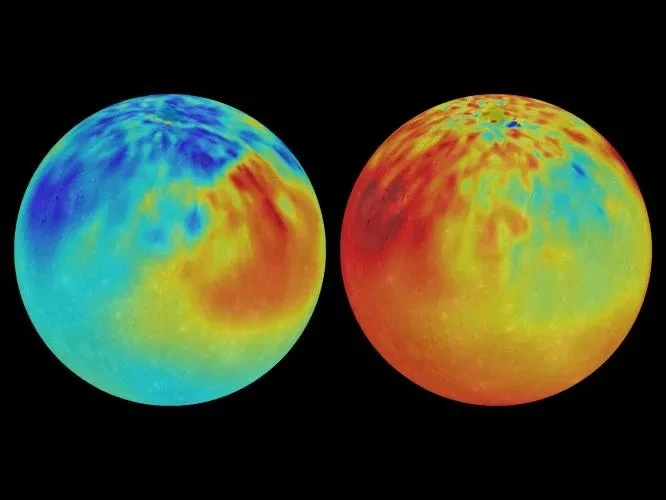
NASA’s MESSENGER spacecraft captured Mercury’s subtle true colors (left) and enhanced mineral contrasts (right) using specialized filters. Image credit: NASA/JHUAPL/Carnegie Inst. of Washington.
Mercury, the smallest planet in the solar system, has long puzzled scientists due to its unusually dense composition. Its iron-rich core accounts for approximately 60–70% of its total mass—significantly higher than that of Earth, Venus, or Mars. NASA’s MESSENGER mission, which orbited Mercury from 2011 to 2015, confirmed this high core-to-mass ratio and also found that the planet’s surface is rich in volatile elements such as potassium, sulfur, and sodium.
To explain this unusual internal structure, a recently published study by Patrick Franco and colleagues from the Paris Institute of Planetary Physics proposes a “hit-and-run” collision scenario.
According to the authors, a grazing impact with a protoplanet of comparable mass occurred tens of millions of years after the solar system formed. This collision likely stripped away much of Mercury’s outer silicate mantle, leaving behind its disproportionately large iron core.
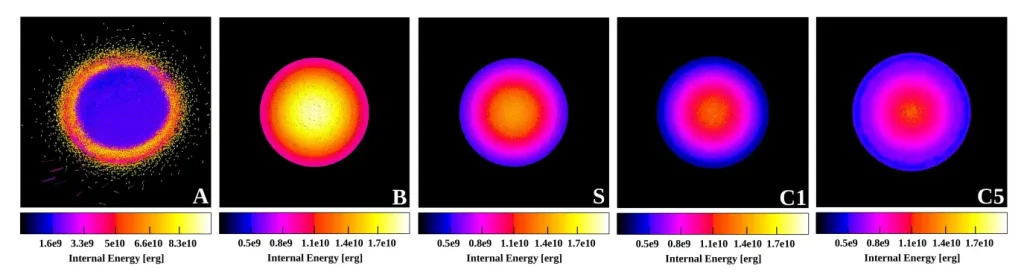
The research used Smoothed Particle Hydrodynamics (SPH) to simulate the collision. The setup involved a proto-Mercury of 0.13 Earth masses (2.36 times Mercury’s current mass) colliding with a target 1.5–-4.5 times its mass at velocities 2.8–-3.8 times the mutual escape velocity. These simulations produced a remnant with a mass of 0.052–0.056 Earth masses and an iron fraction of 65–75%, closely matching Mercury’s composition.
The hit-and-run model suggests the collision occurred in a crowded region between Venus and Earth’s orbits, implying Mercury may have formed farther out and migrated inward. This aligns with N-body simulations indicating similar-mass collisions were common, occurring in about 20% of dynamically excited protoplanetary disks.
In contrast, traditional models needing a small impactor or a massive target are less likely, occurring in under 2% of cases.
A separate study by Alice Chau et al., published in 2018, explored multiple giant impact scenarios using the GASOLINE SPH code with the Tillotson Equation of State. This helped in modeling the behavior of materials under the extreme conditions generated during such massive impacts.
It tested single impacts, hit-and-run collisions, and multiple impacts, finding that head-on collisions at 30 km/s (19 miles per second) or multiple grazing impacts at 20–30 km/s (12–19 miles per second) could achieve Mercury’s iron-to-rock ratio of 60–75%. The study noted that hotter, less relaxed targets enhance mantle stripping efficiency.
Chau’s research showed the role of impact parameters, such as angles (0.3–-0.65) and velocities (3–-5 times the escape velocity), in achieving Mercury-like outcomes.
It found that multiple collisions, particularly two to four impacts at moderate conditions, are better than a single high-energy event. The study also found that while the composition of the impactor changes the quantity of the material that gets thrown out during the collision, it causes a negligible change in the planet’s iron composition.
The presence of volatile elements on Mercury’s surface—like potassium and thorium—points to a grazing collision that happened relatively late in the planet’s history. If the impact had occurred earlier, those materials would’ve likely been vaporized. But MESSENGER’s data shows that they were retained, even with Mercury being so close to the Sun.
The BepiColombo mission, launched in 2018, is a joint effort by the Japan Aerospace Exploration Agency (JAXA) and the European Space Agency (ESA) scheduled to reach Mercury in November 2026. The mission aims to investigate the planet’s surface, magnetic field, and internal structure in detail. Its observations may provide critical evidence to support or challenge the proposed hit-and-run collision theory.
Other theories suggest that Mercury might have formed without a major collision, such as forming from iron-rich material in the early solar system, or losing its mantle gradually through repeated smaller impacts. However, these ideas are seen as less likely because they are rare in computer simulations or require specific extreme conditions.
The research also compared findings with earlier studies, such as Benz et al. (2007) and Asphaug & Reufer (2014), noting slight variations due to different equations of state or numerical methods. For instance, Chau’s study reported a remnant mass of 0.74 Mercury masses compared to Benz’s 0.92, with both achieving similar iron fractions.
References:
1 Forming Mercury by a grazing giant collision involving similar mass bodies – Patrick Franco, Fernando Roig, Othon C. Winter, Rafael Sfair, Christoph Burger, Christoph M. Schäfer – arXiv – March 4, 2025 – https://doi.org/10.48550/arXiv.2503.02826 – OPEN ACCESS
2 Forming Mercury by Giant Impacts – Alice Chau, Christian Reinhardt, Ravit Helled, Joachim Gerhard Stadel – arXiv – August 7, 2018 – https://doi.org/10.48550/arXiv.1808.02448 – OPEN ACCESS

I’m a science journalist and researcher at The Watchers, contributing to the Epicenter edition, where I cover peer-reviewed scientific research and emerging discoveries across Earth and space sciences. With a background in astronomy and a passion for environmental science, I’ve worked in shark and coral conservation in Fiji, conducting reef and shark-behavior research, contributing to mangrove restoration, and earning PADI Open Water and Coral Reef Certifications. I bring a blend of scientific rigor and storytelling to illuminate the discoveries shaping our planet and beyond.

Hmm. Silicon is missing, we don’t know why. But iron and silicon come from same process in stars, Mercury could have simply been part of a different layer within the exploding progenitor star, or even “partner star” since our Sun is there. Even crazier, the exploding star remnant could have had some mechanical process of removal of its silicon shell, especially as it cooled & cracked, leaving behind iron and these other volatiles. Comets bringing in volatiles is quite possible, i dunno if and how it fits with a numeric interpretations, or how they’d even determine concentrations below the surface.