
Impulsive X2.0 solar flare erupts from the Sun’s northwest limb
An impulsive solar flare measuring X2.0 erupted from Active Region 4001 at 19:27 UTC on February 23, 2025. The event started at 19:22 and ended at 19:34 UTC. A coronal mass ejection (CME) was produced but the location of this region does not favor Earth-directed CMEs.

X2.0 solar flare on February 23, 2025. Credit: NASA SDO/AIA, Helioviewer, The Watchers
This is the fourth and the strongest solar flare so far this year, following X1.2 on January 3, and X1.1 and X1.8 on January 4.
A coronal mass ejection (CME) was produced, but the location of the responsible region on the northwest limb does not favor Earth-directed CMEs.
However, the northwest limb favors solar radiation storms, meaning there is an increased chance of high-energy proton events from this and further activity of this region.
The flare was associated with a short-lived R3–Strong radio blackout on the dayside of Earth, affecting high-frequency (HF) radio communication, particularly over the Pacific Ocean and parts of the Americas.
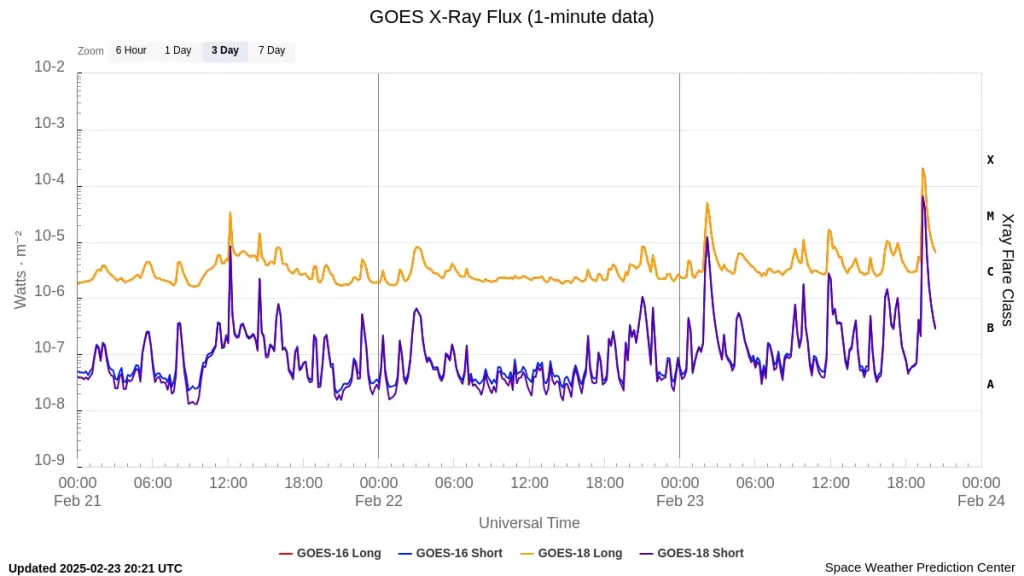


Solar activity remained at moderate levels in 24 hours to 12:30 UTC today, with Region 4001 producing the strongest flare of the period—an M4.9 flare at 02:13 UTC on February 23. Region 3998 generated an impulsive M1.0 flare, while Region 4000 showed signs of decay. No Earth-directed CMEs were detected.
There is a chance for minor to moderate radio blackouts (R1-R2) and a slight chance for stronger events (R3 or greater) through February 25.
Energetic particle flux remained at normal to moderate levels, with a slight chance for a minor proton storm (S1) through February 25.
Solar wind conditions were weakly enhanced, with speeds between 300–350 km/s and intermittent southward Bz components. A weak coronal hole high-speed stream (CH HSS) influence is expected on February 24 and 25, with a possible glancing impact from a CME that left the Sun on February 19.
Geomagnetic conditions were quiet to unsettled over the past 24 hours and are expected to remain so over the next few days, with potential minor disturbances from CH HSS and CME influences.
References:
1 Forecast Discussion – SWPC – 12:30 UTC on February 23, 2025

I'm a dedicated researcher, journalist, and editor at The Watchers. With over 20 years of experience in the media industry, I specialize in hard science news, focusing on extreme weather, seismic and volcanic activity, space weather, and astronomy, including near-Earth objects and planetary defense strategies. You can reach me at teo /at/ watchers.news.

Thank you for sharing all these beautiful images!