
Eruption risk increases as magma accumulation reaches critical volume at Svartsengi, Iceland
Magma accumulation beneath Svartsengi has reached a critical volume, matching the levels observed during the last eruption on November 20, 2024. A volcanic eruption could occur at very short notice, potentially within days or weeks, according to the Icelandic Meteorological Office (IMO).
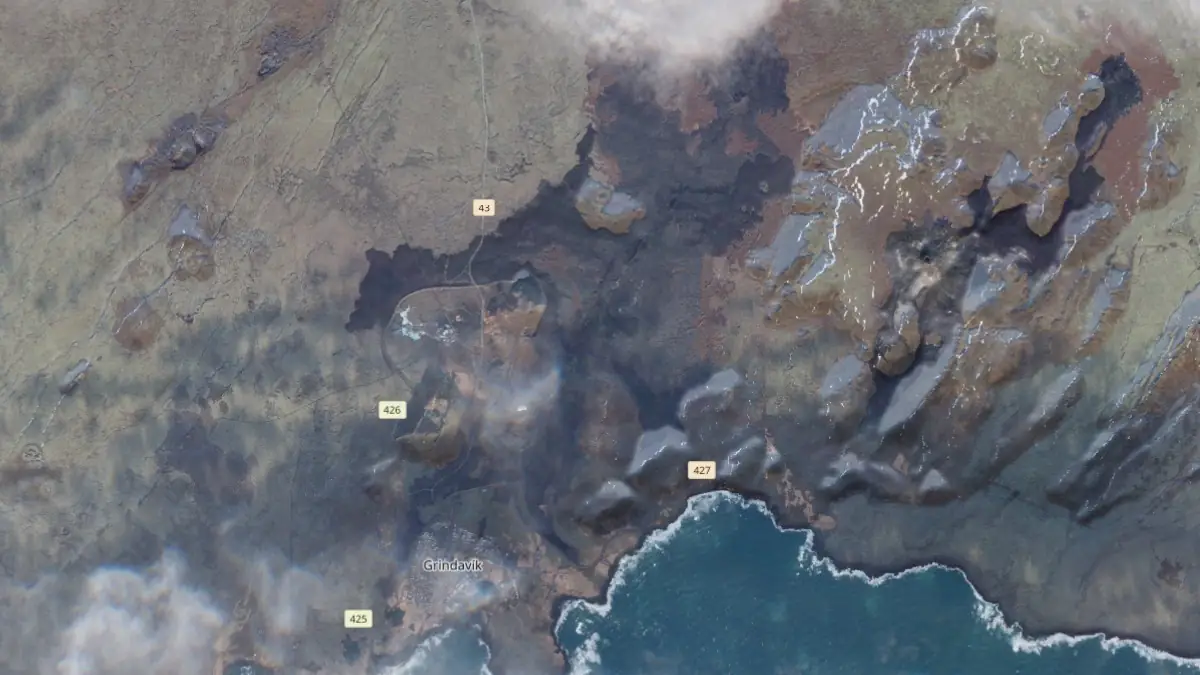
Image credit: CopernicusEU/Sentinel-2, The Watchers
Magma accumulation beneath Svartsengi has reached a critical volume, matching the levels observed during the last eruption. A volcanic eruption could occur at very short notice, potentially within days or weeks, according to the Icelandic Meteorological Office (IMO).
The most likely eruption site is between Sundhnúkur and Stóra-Skógfell. The latest risk assessment has upgraded the hazard levels in three areas, with the Sundhnúk crater series now classified as “high” risk.
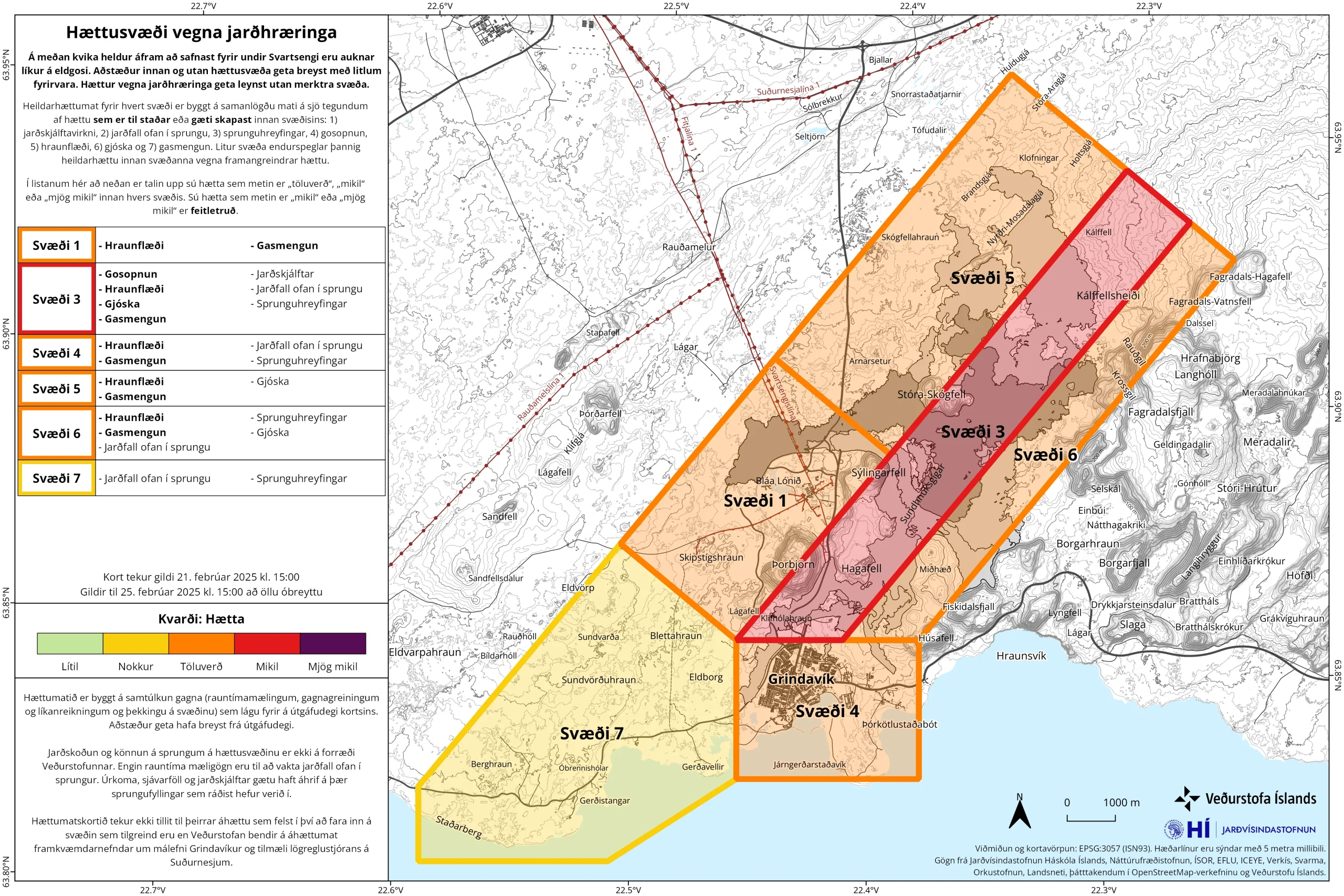
The IMO has revised its hazard assessment which remains in effect until February 25. The risk level has increased in three areas. The hazard in Area 1 (Svartsengi) and Area 5 has been raised from “moderate” (yellow) to “considerable” (orange). The hazard in Area 3, the Sundhnúkur crater row, has been raised from “considerable” (orange) to “high” (red).
Given the repeated eruptions at the Sundhnúk crater series since December 2023, the probability of another event has increased. The ongoing volcanic activity has reduced crustal tension, leading to fewer and smaller earthquakes before eruptions, because of which an eruption may occur with little warning, potentially as short as 30 minutes.
Signs of magma approaching the surface include intense small earthquake swarms in the Sundhnúk crater series, pressure changes in HS Orka’s boreholes in Svartsengi, fiber optic cable deformations, and real-time surface deformations recorded by GPS measurements.
Several earthquakes were recorded in the area between Sundhnúkur and Stóra-Skógfell at approximately 19:50 LT (19:50 UTC) on February 20, 2025.
The tremors, lasting a few minutes, could signal the beginning of a magma movement. The 24 hour monitoring system of the IMO has not detected any additional evidence confirming an eruption at this time. A similar pattern of seismic activity was observed on November 4, 2024, preceding an eruption that began on November 20, 2024.
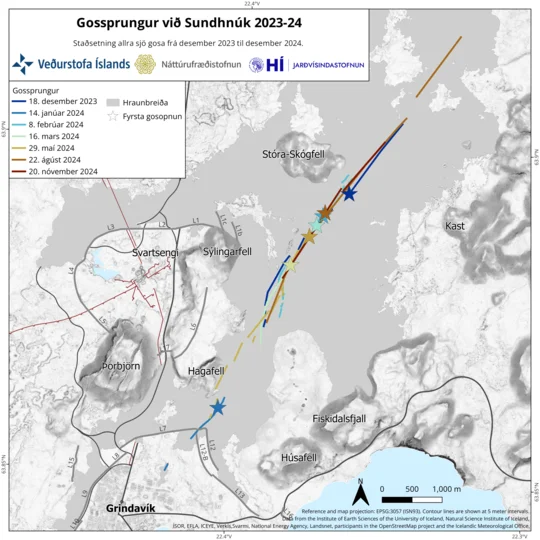
If an eruption occurs, magma is most likely to emerge between Sundhnúkur and Stóra-Skógfell, as seen in six of the seven eruptions since 2023. The exception was in January 2024, when magma first emerged south of Hagafell.
The severity and reach of an eruption will depend on whether the volcanic fissures extend north or south. If an eruption occurs in an unfavorable wind direction, gas pollution could pose hazards within a 1 km (0.62 miles) radius. Lava could reach Grindavíkurvegur at Þorbjörn and/or Svartsengi beyond current defenses in under 1.5 hours.
If lava encounters groundwater or flows into water bodies, localized explosive activity could occur. An eruption south of or near Hagafell could result in lava reaching Nesvegur and Suðurstrandarvegur within 1.5 hours. If lava flow is extensive, it could block all land escape routes from Grindavík in approximately 6 hours.
The Reykjanes volcanic system, located at the southwestern tip of the Reykjanes Peninsula, is part of a neovolcanic rift zone where the Mid-Atlantic Ridge emerges above sea level. It consists of basaltic crater rows, shield volcanoes, and fissure vents.
Historical eruptions date back to the 12th century, with both subaerial and submarine eruptions recorded. The most recent eruption at Sundhnúkur which began on November 20, 2024, lasted 18 days before ending on December 8, 2024. The system is known for repeated eruptive cycles and remains a focal point of geological research because of its active nature and location within the UNESCO-listed Reykjanes Global Geopark.
References:
1 Increased risk of volcanic eruption at Sundhnúk crater range – IMO – February 21, 2025
2 Reykjanes – GVP – Accessed on February 21, 2025

Rishika holds a Master’s in International Studies from Stella Maris College, Chennai, India, where she earned a gold medal, and an MCA from the University of Mysore, Karnataka, India. Previously, she served as a Research Assistant at the National Institute of Advanced Studies, Indian Institute of Science, Bengaluru, India. During her tenure, she contributed as a Junior Writer for Europe Monitor on the Global Politics website and as an Assistant Editor for The World This Week. Her work has also been published in The Hindu newspaper, showing her expertise in global affairs. Rishika is also a recipient of the Women Empowerment Award at the district level in Haryana, India, in 2022.

Commenting rules and guidelines
We value the thoughts and opinions of our readers and welcome healthy discussions on our website. In order to maintain a respectful and positive community, we ask that all commenters follow these rules.