
Study finds statistical link between solar activity and rainfall variability
A long-term statistical study has confirmed a direct correlation between rainfall variability in India and solar activity features such as sunspots, solar flares, and solar prominences. Researchers analyzed 5 consecutive solar cycles (1964 – 2019) and found that rainfall levels shift predictably with solar fluctuations, impacting seasonal and annual precipitation patterns across India.

Image credit: The Watchers
- Researchers analyzed 5 solar cycles, from 1964 to 2019, and found a strong correlation between India’s rainfall variability and solar activity features like sunspots, solar flares, and prominences.
- Rainfall patterns followed a cyclic trend similar to solar cycles, with periodicities of 2.5 and 3.5 years influencing seasonal and annual precipitation levels.
- The study suggests that solar activity plays an important role in rainfall distribution, impacting climate patterns and long-term weather trends across India.
Researchers from Kumaun University and Graphic Era Deemed University obtained data spanning 5 solar cycles (20 to 24) from 1964 to 2019 from the Indian Meteorological Data Center and solar activity databases maintained by NOAA’s National Geophysical Data Center.
The research analyzed all-India homogenous rainfall (RF) data and compared it with 3 major solar activity features (SAF), sunspot number (SN), solar flare (SF), and solar active prominence (SAP).
The rainfall data were divided into 4 seasonal periods for detailed analysis. The January to February period represents the winter months. The March to May period corresponds to the pre-monsoon months.
The June to September period marks the southwest monsoon months. The October to December period covers the northeast monsoon months.
The statistical tools used included the Fast Fourier Transform (FFT) for identifying periodic trends, regression analysis for correlation assessments, and probability distribution functions to determine the most likely rainfall amounts.
Annual and seasonal variability
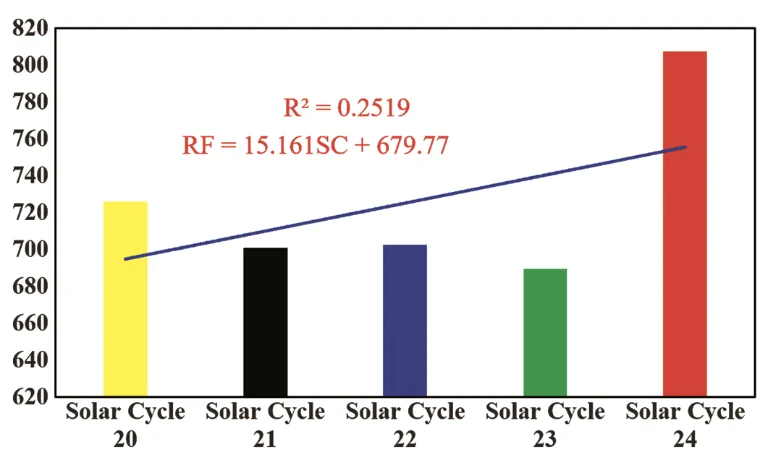
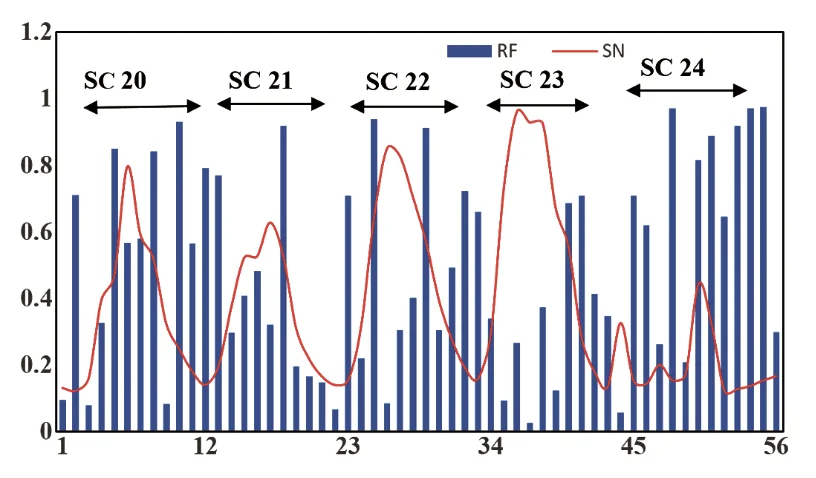
The study found that rainfall varied distinctly across different phases of solar cycles, with a positive trend observed from solar cycle 20 to 24, culminating in the highest recorded rainfall during solar cycle 24.
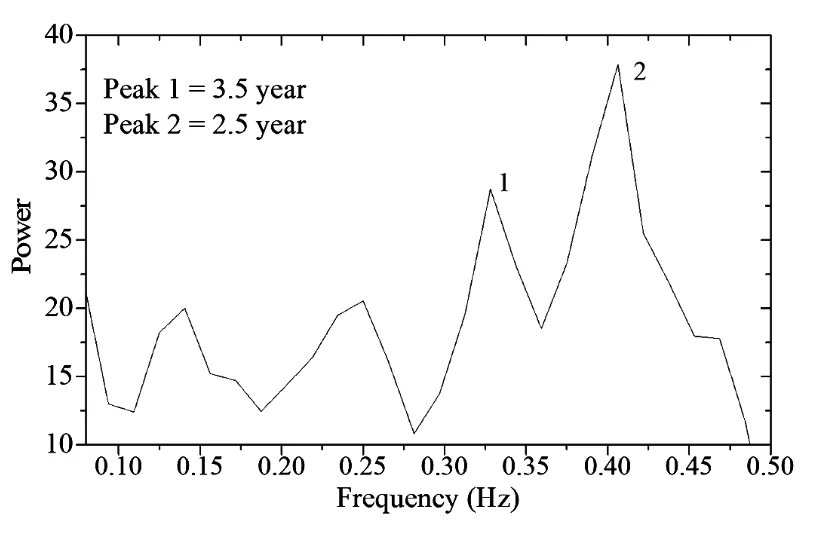
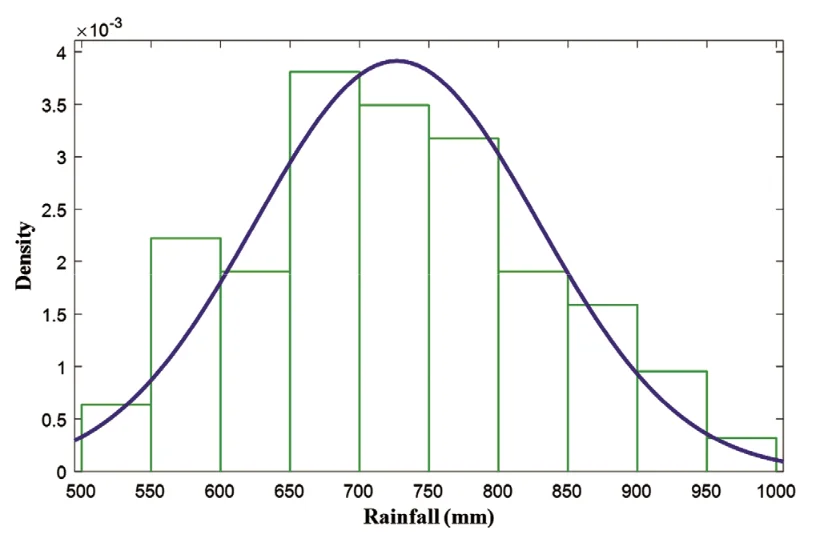
The analysis of annual rainfall variation over the 55-year period identified two dominant periodicities of 2.5 and 3.5 years, along with other cycles ranging between 2 and 10 years. Additionally, a normal probability distribution analysis showed that rainfall levels between 700 and 750 mm (27.6 to 29.5 inches) were the most frequently observed during this period.
The correlation analysis between rainfall and solar activity features showed varying coefficients across different seasons, indicating weak to moderate relationships depending on the time of year.
The annual correlation coefficients were -0.06 for SN (Sunspot Number), 0.044 for SF (Solar Flux), and 0.022 for SAP (Solar Activity Parameter), suggesting no strong overall connection between these solar parameters and yearly rainfall patterns.
During the winter months (January and February), the correlation coefficients were 0.027 for SN, 0.014 for SF, and 0.037 for SAP, indicating a weak positive relationship between solar activity and rainfall and suggesting that during winter, slight increases in solar activity may be linked to small increases in rainfall, though the relationship is not statistically strong.
In the pre-monsoon period (March to May), the results showed a moderate negative correlation for sunspot numbers (-0.10) but a moderate positive correlation for solar flux (0.11) and SAP (0.13), suggesting that during this period, higher sunspot activity tends to be associated with reduced rainfall, whereas increased solar flux and SAP values are linked to higher rainfall levels.
During the monsoon season (June to September), the correlation coefficients were -0.003 for SN, -0.02 for SF, and 0.014 for SAP, suggesting almost no significant relationship between solar activity and rainfall. This implies that monsoon rainfall is likely dominated by other atmospheric and oceanic factors, such as monsoon circulation patterns, the El Niño-Southern Oscillation (ENSO), and regional climatic conditions, rather than direct solar influences.
In contrast, the post-monsoon period (October to December) showed the strongest negative correlation for sunspots (-0.21), indicating that higher sunspot activity is associated with lower rainfall during these months. The correlation with solar flux (-0.053) was also negative but weaker, while SAP (0.14) showed a moderate positive correlation, suggesting that certain aspects of solar activity may still influence rainfall in the later months of the year.
The findings suggest that while solar activity may have some influence on rainfall patterns, particularly in the pre-monsoon and post-monsoon periods, the relationship is not strong or consistent throughout the year. Other large-scale climatic drivers, such as oceanic temperature variations, atmospheric circulation patterns, and regional weather systems, likely play a more dominant role in determining seasonal and annual rainfall variability.
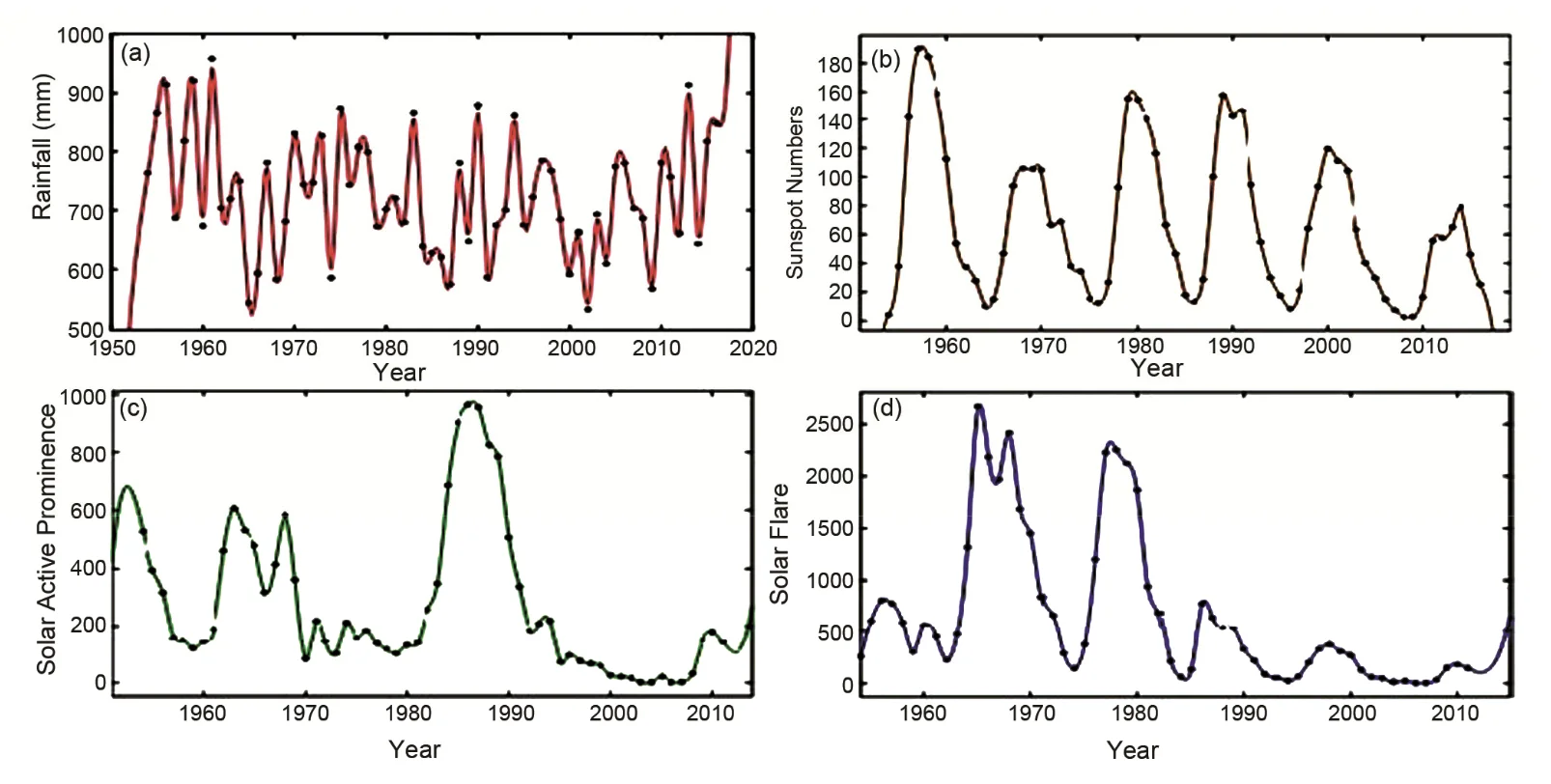
Relationship between rainfall and solar cycles
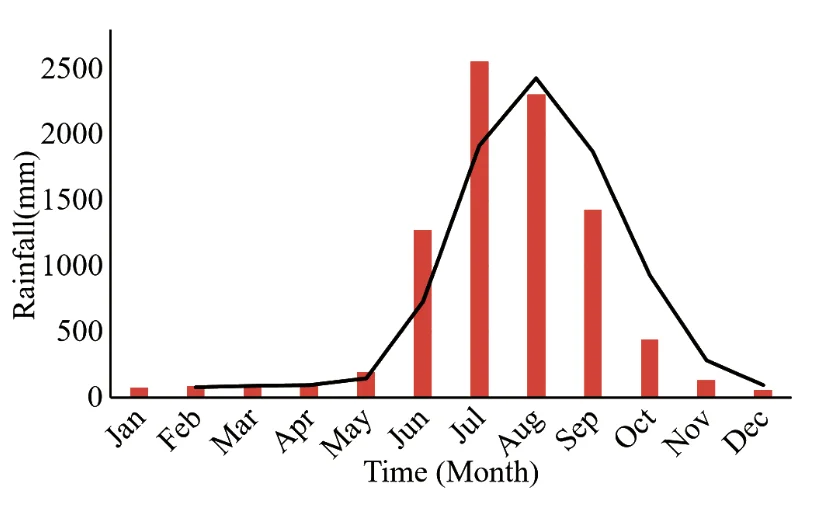
Monthly variations in rainfall from 1964 and 2019 were analyzed with a 2-point moving average trend line and confirmed that rainfall is highest during the monsoon months (JJAS) and lowest in winter (JF) and pre-monsoon (MAM).
A linear trend in solar cycles showed a gradual increase in rainfall from solar cycles 20 to 24 and supports the hypothesis that solar activity impacts long-term rainfall patterns.
A comparative analysis of rainfall and sunspot numbers from 1954 to 2019 revealed a lagging effect where rainfall decreased during the peak of solar cycles but increased during the rising phase.
The findings indicate that rainfall variability corresponds to different phases of solar activity. During the solar maximum, rainfall decreases as sunspots reach their peak. During the solar minimum, rainfall increases because of lower solar intensity and the heightened influence of galactic cosmic rays.
During the rising phase of solar activity rainfall follows sunspot numbers with a short delay while during the declining phase of solar activity rainfall patterns become erratic and show both in-phase and out-of-phase fluctuations.
Fourier analysis and rainfall cyclic patterns
Fast Fourier Transform (FFT) was applied to identify periodic trends in rainfall data. The power-frequency spectrum showed periodicities ranging from 2 to 10 years, with the most dominant cycles at 3.5 years and 2.5 years.
The finding confirms that rainfall patterns exhibit a cyclic behavior similar to solar cycles and reinforces the impact of solar activity on climate variability.
The probability density function analysis revealed that the most probable rainfall range in India between 1964 and 2019 was 700 to 750 mm (27.6 to 29.5 inches), with a mean rainfall of 726.91 mm (28.63 inches).
Study results
The findings of the study show the influence of solar activity features on India’s climate and rainfall patterns. Galactic cosmic rays which fluctuate with solar activity, play an important role in cloud formation and influence precipitation levels.
Weaker interplanetary magnetic fields allow more cosmic rays to penetrate Earth’s atmosphere during periods of low solar activity and it leads to increased cloud cover and higher rainfall.
Stronger solar radiation leads to increased temperatures during high solar activity and it reduces humidity and cloud formation which results in lower rainfall.
The study provides strong statistical evidence linking rainfall variability with solar activity fluctuations over extended periods. Understanding these connections can enhance climate modeling efforts and improve seasonal rainfall predictions, which are critical for agriculture, water resource management, and disaster preparedness.
References:
1 Connection between Rainfall and Solar Activity Features during Solar Cycle 20 to 24 – Mahesh Chandra Mathpal, Raj Kumar Kumar, Alankrita Joshi, Yogesh Chandra, Bimal Pande, and Seema Pande – Indian Journal of Pure & Applied Physics (IJPAP) – January 21, 2025 – DOI: https://doi.org/10.56042/ijpap.v63i1.9942

Rishika holds a Master’s in International Studies from Stella Maris College, Chennai, India, where she earned a gold medal, and an MCA from the University of Mysore, Karnataka, India. Previously, she served as a Research Assistant at the National Institute of Advanced Studies, Indian Institute of Science, Bengaluru, India. During her tenure, she contributed as a Junior Writer for Europe Monitor on the Global Politics website and as an Assistant Editor for The World This Week. Her work has also been published in The Hindu newspaper, showing her expertise in global affairs. Rishika is also a recipient of the Women Empowerment Award at the district level in Haryana, India, in 2022.

I knew this long ago and their just now figuring this out…next when will Earthquakes be recognized as Sun induced…Gotta love The Watchers for weather news on all levels from Sun to Earth.
Thanks, Recon.